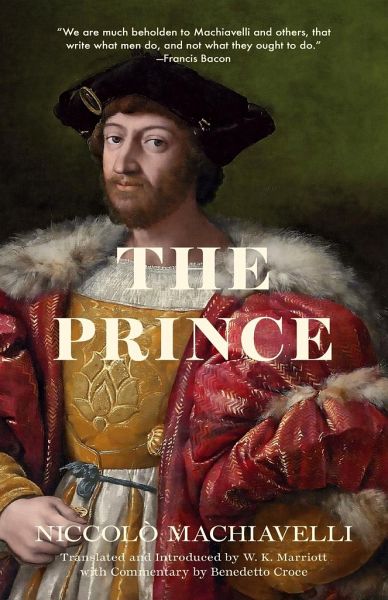
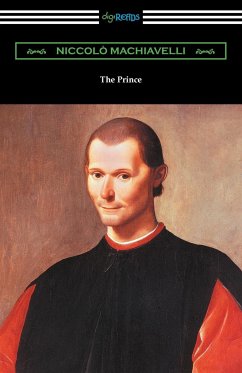
The Prince is widely thought to be one of the first works of modern political philosophy. Machiavelli was the first to decisively divorce politics from ethics. His political realism influenced many important figures in the developing field of materialist philosophy, including Francis Bacon, John Milton, Spinoza, Rousseau, Hume, Edward Gibbon, and Adam Smith. His treatise had a profound impact on political leaders throughout the modern west, including the founding fathers of the United States who, like Machiavelli, favored a republican form of government. Machiavelli emphasized the need for…mehr
The Prince is widely thought to be one of the first works of modern political philosophy. Machiavelli was the first to decisively divorce politics from ethics. His political realism influenced many important figures in the developing field of materialist philosophy, including Francis Bacon, John Milton, Spinoza, Rousseau, Hume, Edward Gibbon, and Adam Smith. His treatise had a profound impact on political leaders throughout the modern west, including the founding fathers of the United States who, like Machiavelli, favored a republican form of government. Machiavelli emphasized the need for looking at the "effective truth" based on experience and historical fact, rather than theorizing about ideal republics or imaginary utopias. Controversial for advancing an amoral view of the world where any means are justified if they serve the ambitions of power, The Prince also ironically seems to undermine its own doctrine by predicting in some ways the doom of a strictly realist approach.
Niccolò Machiavelli (1469-1527) Niccolò Machiavelli was born at Florence on 3rd May 1469. He was the second son of Bernardo di Nicolo Machiavelli, a lawyer of some repute, and of Bartolommea di Stefano Nelli, his wife. Both parents were members of the old Florentine nobility. His life falls naturally into three periods, each of which singularly enough constitutes a distinct and important era in the history of Florence. His youth was concurrent with the greatness of Florence as an Italian power under the guidance of Lorenzo de' Medici, Il Magnifico. The downfall of the Medici in Florence occurred in 1494, in which year Machiavelli entered the public service. During his official career Florence was free under the government of a Republic, which lasted until 1512, when the Medici returned to power, and Machiavelli lost his office. The Medici again ruled Florence from 1512 until 1527, when they were once more driven out. This was the period of Machiavelli's literary activity and increasing influence; but he died, within a few weeks of the expulsion of the Medici, on 22nd June 1527, in his fifty-eighth year, without having regained office. Herbert Butterfield, 1908 edition of The Prince
Es gelten unsere Allgemeinen Geschäftsbedingungen: www.buecher.de/agb
Impressum
www.buecher.de ist ein Internetauftritt der buecher.de internetstores GmbH
Geschäftsführung: Monica Sawhney | Roland Kölbl | Günter Hilger
Sitz der Gesellschaft: Batheyer Straße 115 - 117, 58099 Hagen
Postanschrift: Bürgermeister-Wegele-Str. 12, 86167 Augsburg
Amtsgericht Hagen HRB 13257
Steuernummer: 321/5800/1497
USt-IdNr: DE450055826