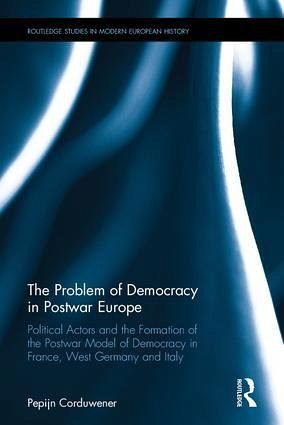
This book is a comparative study of political ideas on democracy postwar Western Europe, arguing that until the end of the 1970s, political actors were deeply divided in their conceptions of democracy. In this way, the book traces the historical roots of the contemporary sentiment of democratic crisis, by showing how the postwar model of democracy was formed.
Pepijn Corduwener is an Assistant Professor in History at Utrecht University.
Inhaltsangabe
Introduction 1. Transforming Democracy After the Second World War 2. Contesting Democratic Legitimacy During the Cold War 3. Converging Conceptions of Democracy at the Turn of the 1960s 4. Political Elites and the Challenge to the Parliamentary Model 5. Democracy Between Crisis and Consensus After the 1973 Oil Crisis Conclusion
Es gelten unsere Allgemeinen Geschäftsbedingungen: www.buecher.de/agb
Impressum
www.buecher.de ist ein Internetauftritt der buecher.de internetstores GmbH
Geschäftsführung: Monica Sawhney | Roland Kölbl | Günter Hilger
Sitz der Gesellschaft: Batheyer Straße 115 - 117, 58099 Hagen
Postanschrift: Bürgermeister-Wegele-Str. 12, 86167 Augsburg
Amtsgericht Hagen HRB 13257
Steuernummer: 321/5800/1497
USt-IdNr: DE450055826