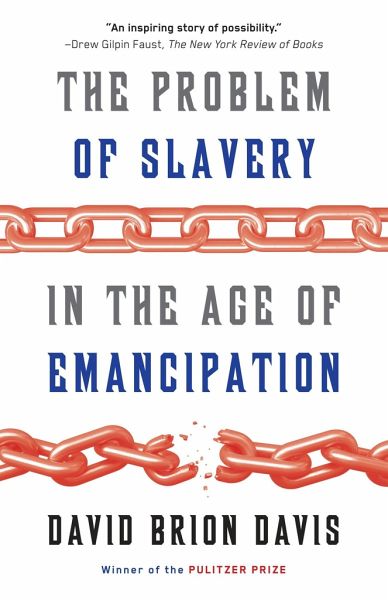
Winner of the National Book Critics Circle Award 2014 With this volume, Davis presents the age of emancipation as a model for reform and as probably the greatest landmark of willed moral progress in human history. Bringing to a close his staggeringly ambitious, prizewinning trilogy on slavery in Western culture Davis offers original and penetrating insights into what slavery and emancipation meant to Americans. He explores how the Haitian Revolution respectively terrified and inspired white and black Americans, hovering over the antislavery debates like a bloodstained ghost. He offers a…mehr
Winner of the National Book Critics Circle Award 2014 With this volume, Davis presents the age of emancipation as a model for reform and as probably the greatest landmark of willed moral progress in human history. Bringing to a close his staggeringly ambitious, prizewinning trilogy on slavery in Western culture Davis offers original and penetrating insights into what slavery and emancipation meant to Americans. He explores how the Haitian Revolution respectively terrified and inspired white and black Americans, hovering over the antislavery debates like a bloodstained ghost. He offers a surprising analysis of the complex and misunderstood significance the project to move freed slaves back to Africa. He vividly portrays the dehumanizing impact of slavery, as well as the generally unrecognized importance of freed slaves to abolition. Most of all, Davis presents the age of emancipation as a model for reform and as probably the greatest landmark of willed moral progress in human history.
Introduction Discovering Animalization Some Evidence of Animalization
1 Some Meanings of Slavery and Emancipation: Dehumanization, Animalization, and Free Soil The Meaning of Animalization, Part I The Meaning of Animalization, Part II The Search for the Animalized Slave Domestication and Internalization
2 The First emancipations: freedom and dishonor Self- Emancipation: Haiti as a Turning Point Freedmen and Slaves Freedmen’s Rights Loss of Mastery The “Horrors of Haiti”
3 Colonizing Blacks, Part I: Migration and Deportation The Exodus Paradigm Precedents: Exiles Precedents: The Displaced
4 Colonizing Blacks, Part II: The American Colonization Society and Americo-Liberians Liberating Liberia
5 Colonizing Blacks, Part III: From Martin Delany to Henry Highland Garnet and Marcus Garvey Nationalism
6 Colonizationist Ideology: Leonard Bacon and “Irremediable Degradation” Bacon’s “Report” of 1823 The Paradox of Sin and “Irremediable Degradation” Some Black Response
7 From Opposing Colonization to Immediate Abolition Paul Cuffe and Early Proposals for Emigration James Forten and Black Reactions to the American Colonization Society The Search for Black Identity and Emigration to Haiti Russwurm, Cornish, and Walker Blacks and Garrison
8 Free Blacks as the Key to Slave Emancipation Recognition of the Issue Abolitionist Addresses to Free African Americans David Walker and Overcoming Slave Dehumanization James McCune Smith and Jefferson’s “What further is to be done with these people?”
9 Fugitive Slaves, Free Soil, and the Question of Violence Frederick Douglass as a Fugitive The Underground Railroad and Runaway Slaves Harriet Jacobs as a Female Fugitive Fugitive Slaves and the Law
10 The Great Experiment: Jubilee, Responses, and Failure An Eschatological Event and America’s Barriers The Enactment of British Emancipation Some American Responses to British Emancipation From Joseph John Gurney to the Issue of Failure
11 The British Mystique: Black Abolitionists in Britain—the Leader of the Industrial Revolution and Center of “Wage Slavery” Frederick Douglass Confronts the World African Americans Embrace the Mother Country The Problems of Race, Dehumanization, and Wage Slavery Joseph Sturge, Frederick Douglass, and the Chartists— the Decline and Expansion of Antislavery in the 1850s
Introduction Discovering Animalization Some Evidence of Animalization
1 Some Meanings of Slavery and Emancipation: Dehumanization, Animalization, and Free Soil The Meaning of Animalization, Part I The Meaning of Animalization, Part II The Search for the Animalized Slave Domestication and Internalization
2 The First emancipations: freedom and dishonor Self- Emancipation: Haiti as a Turning Point Freedmen and Slaves Freedmen’s Rights Loss of Mastery The “Horrors of Haiti”
3 Colonizing Blacks, Part I: Migration and Deportation The Exodus Paradigm Precedents: Exiles Precedents: The Displaced
4 Colonizing Blacks, Part II: The American Colonization Society and Americo-Liberians Liberating Liberia
5 Colonizing Blacks, Part III: From Martin Delany to Henry Highland Garnet and Marcus Garvey Nationalism
6 Colonizationist Ideology: Leonard Bacon and “Irremediable Degradation” Bacon’s “Report” of 1823 The Paradox of Sin and “Irremediable Degradation” Some Black Response
7 From Opposing Colonization to Immediate Abolition Paul Cuffe and Early Proposals for Emigration James Forten and Black Reactions to the American Colonization Society The Search for Black Identity and Emigration to Haiti Russwurm, Cornish, and Walker Blacks and Garrison
8 Free Blacks as the Key to Slave Emancipation Recognition of the Issue Abolitionist Addresses to Free African Americans David Walker and Overcoming Slave Dehumanization James McCune Smith and Jefferson’s “What further is to be done with these people?”
9 Fugitive Slaves, Free Soil, and the Question of Violence Frederick Douglass as a Fugitive The Underground Railroad and Runaway Slaves Harriet Jacobs as a Female Fugitive Fugitive Slaves and the Law
10 The Great Experiment: Jubilee, Responses, and Failure An Eschatological Event and America’s Barriers The Enactment of British Emancipation Some American Responses to British Emancipation From Joseph John Gurney to the Issue of Failure
11 The British Mystique: Black Abolitionists in Britain—the Leader of the Industrial Revolution and Center of “Wage Slavery” Frederick Douglass Confronts the World African Americans Embrace the Mother Country The Problems of Race, Dehumanization, and Wage Slavery Joseph Sturge, Frederick Douglass, and the Chartists— the Decline and Expansion of Antislavery in the 1850s
Epilogue
Acknowledgments
Es gelten unsere Allgemeinen Geschäftsbedingungen: www.buecher.de/agb
Impressum
www.buecher.de ist ein Internetauftritt der buecher.de internetstores GmbH
Geschäftsführung: Monica Sawhney | Roland Kölbl | Günter Hilger
Sitz der Gesellschaft: Batheyer Straße 115 - 117, 58099 Hagen
Postanschrift: Bürgermeister-Wegele-Str. 12, 86167 Augsburg
Amtsgericht Hagen HRB 13257
Steuernummer: 321/5800/1497
USt-IdNr: DE450055826