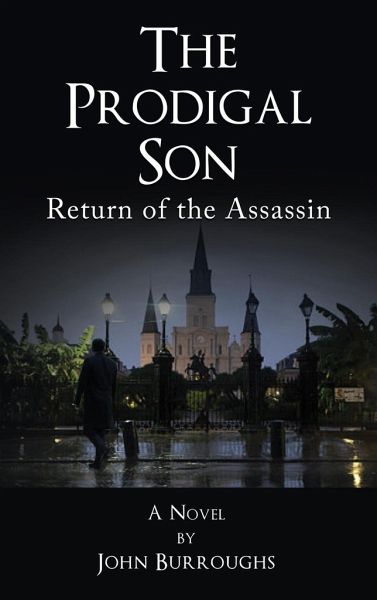
Jack Brantley, a CIA assassin living in Cold War Europe during the late 1970s, is ordered to terminate a colleague who has been discovered trading secret government documents to the Russians in East Berlin. After following his intended target throughout much of West Berlin, Jack carries out his assignment with his usual efficiency and callousness. However, upon the completion of his latest hit Jack becomes quite disenchanted with what he is doing for a living in Europe and resigns from the agency in order to move back to the United States. Upon his return, Jack plies his trade as a private…mehr
Jack Brantley, a CIA assassin living in Cold War Europe during the late 1970s, is ordered to terminate a colleague who has been discovered trading secret government documents to the Russians in East Berlin. After following his intended target throughout much of West Berlin, Jack carries out his assignment with his usual efficiency and callousness. However, upon the completion of his latest hit Jack becomes quite disenchanted with what he is doing for a living in Europe and resigns from the agency in order to move back to the United States. Upon his return, Jack plies his trade as a private gun-for-hire while based out of his hometown on the Florida Gulf Coast. Jack's efficiency as a hired gun makes him a much sought-after hitman, but the aftermath of a recent contract and his subsequent killing of a man in rural south Alabama leaves the former Green Beret and ex-CIA agent battling his inner demons as never before. Jack's next contract is with a very shady underworld figure and the story takes the reader on a ride with him into the heart of New Orleans. Hired to eliminate a well-respected resident of the Crescent City, Jack quickly and efficiently tracks down his subject. However, the resulting encounter with his intended target is something Jack Brantley would never have foreseen when he first took the job, and his own life soon hangs in the balance. Set against the backdrop of the French Quarter and the Warehouse/Arts and Garden districts of New Orleans, The Prodigal Son: Return of the Assassin is a modern-day retelling of the biblical parable as told in the Gospel of Luke. It is a story of redemption, forgiveness and reconciliation that reveals the boundless compassion and merciful love of God toward one of His lost sons. It is a tale that is sure to take the reader on a ride that is well worth the price of the ticket.
John Burroughs (April 3, 1837 - March 29, 1921) was an American naturalist and nature essayist, active in the U.S. conservation movement.[1] The first of his essay collections was Wake-Robin in 1871. In the words of his biographer Edward Renehan, Burroughs' special identity was less that of a scientific naturalist than that of "a literary naturalist with a duty to record his own unique perceptions of the natural world." The result was a body of work whose resonance with the tone of its cultural moment explains both its popularity at that time, and its relative obscurity since Burroughs had his first break as a writer in the summer of 1860 when the Atlantic Monthly, then a fairly new publication, accepted his essay Expression. Editor James Russell Lowell found the essay so similar to Emerson's work that he initially thought Burroughs had plagiarized his longtime acquaintance. Poole's Index and Hill's Rhetoric, both periodical indexes, even credited Emerson as the author of the essay.[7] In 1864, Burroughs accepted a position as a clerk at the Treasury; he would eventually become a federal bank examiner, continuing in that profession into the 1880s. All the while, he continued to publish essays, and grew interested in the poetry of Walt Whitman. Burroughs met Whitman in Washington, DC in November 1863, and the two became close friends.[8] Whitman encouraged Burroughs to develop his nature writing as well as his philosophical and literary essays. In 1867, Burroughs published Notes on Walt Whitman as Poet and Person, the first biography and critical work on the poet, which was extensively (and anonymously) revised and edited by Whitman himself before publication.[9] Four years later, the Boston house of Hurd & Houghton published Burroughs's first collection of nature essays, Wake-Robin.
Es gelten unsere Allgemeinen Geschäftsbedingungen: www.buecher.de/agb
Impressum
www.buecher.de ist ein Internetauftritt der buecher.de internetstores GmbH
Geschäftsführung: Monica Sawhney | Roland Kölbl | Günter Hilger
Sitz der Gesellschaft: Batheyer Straße 115 - 117, 58099 Hagen
Postanschrift: Bürgermeister-Wegele-Str. 12, 86167 Augsburg
Amtsgericht Hagen HRB 13257
Steuernummer: 321/5800/1497
USt-IdNr: DE450055826