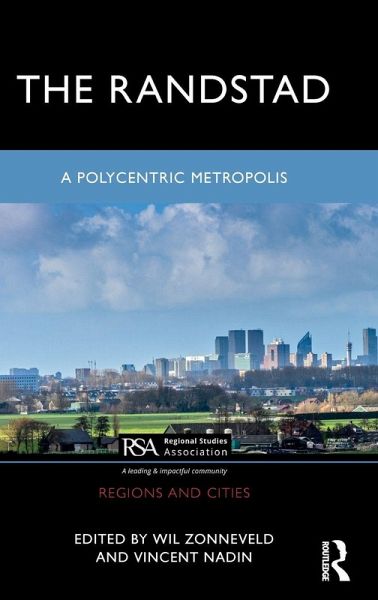
The Randstad metropolitan region encompassing Amsterdam, The Hague, Rotterdam and Utrecht in the western Netherlands is regarded worldwide as a model of a 'successful' polycentric metropolis. It is widely cited as an example of an effectively functioning region made up of inter-connected small cities providing complementary functions which together provide the benefits of one larger monocentric city. The methods of strategic spatial planning, regional design and strategic projects are used as models for practitioners and students around the world. However, the functioning of this cluster of…mehr
The Randstad metropolitan region encompassing Amsterdam, The Hague, Rotterdam and Utrecht in the western Netherlands is regarded worldwide as a model of a 'successful' polycentric metropolis. It is widely cited as an example of an effectively functioning region made up of inter-connected small cities providing complementary functions which together provide the benefits of one larger monocentric city. The methods of strategic spatial planning, regional design and strategic projects are used as models for practitioners and students around the world. However, the functioning of this cluster of cities as a polycentric networked region is controversial both in terms of the actual relations between its component parts and in terms of the value of promoting such a relationship in policy. In short, does the Randstad really function as a polycentric metropolis? What are the costs and benefits of a Randstad metropolis? Should the concept be pursued in government policy and action and how? These questions are of critical interest within the Netherlands but also in other complex urban regions around the world. This book will provide explanations of the place of complex city regions in the globalisation process, a critical analysis of the Randstad itself and lessons for strategic planning in other metropolitan regions.
Wil Zonneveld is Professor of Urban and Regional Planning at Delft University of Technology, the Netherlands, and leader of the Section Spatial Planning and Strategy, Department of Urbanism in the Faculty of Architecture and Built Environment. He published extensively on Dutch and European spatial planning, with a particular emphasis on the conceptualization and design of space and territory. He is co-editor of the Routledge Handbook of Regional Design. Vincent Nadin is Emeritus Professor of Spatial Planning and Strategy and former Head of the Department of Urbanism in the Faculty of Architecture and the Built Environment, TU Delft. He is also Visiting Professor at South China University of Technology School of Architecture. He is joint author with the late Barry Cullingworth of the leading textbook Town and Country Planning in the UK, co-author of European Spatial Planning and Territorial Cooperation and Editor-in-Chief of the Routledge international peer-reviewed journal Planning Practice and Research.
Inhaltsangabe
PART I Introduction 1. Introducing the Randstad: a polycentric metropolis PART II The origins of the Randstad 2. The making of the urban structure of the Randstad 3. Urban conf igurations in a dynamic delta landscape 4. Rotterdam: a dynamic polder city in the Randstad 5. The global petroleumscape in the Dutch Randstad: oilspaces and mindsets PART III The dynamics of a complex metropolitan region 6. Randstad Holland between functional entity and political desire 7. Randstad: spatial planning, polycentrism and urban networks 8. The Randstad and its mainports: towards new heterogeneous discourses in Dutch planning 9. Impact of social housing on the social structure of the Randstad 10. Interaction in the Delta: culture, convention and knowledge clusters in the Randstad PART IV Governance, planning and design 11. Randstad: from a spatial planning concept to a place name 12. Governance and power in the metropolitan regions of the Randstad 13. In control of urban sprawl? Examining the effectiveness of national spatial planning in the Randstad, 1958-2018 14. Probing and planning the future of the Dutch Randstad 15. The (im)possible design of the Randstad: perspectives for the future PART V Conclusion and outlook 16. Conclusion and outlook
Es gelten unsere Allgemeinen Geschäftsbedingungen: www.buecher.de/agb
Impressum
www.buecher.de ist ein Internetauftritt der buecher.de internetstores GmbH
Geschäftsführung: Monica Sawhney | Roland Kölbl | Günter Hilger
Sitz der Gesellschaft: Batheyer Straße 115 - 117, 58099 Hagen
Postanschrift: Bürgermeister-Wegele-Str. 12, 86167 Augsburg
Amtsgericht Hagen HRB 13257
Steuernummer: 321/5800/1497
USt-IdNr: DE450055826