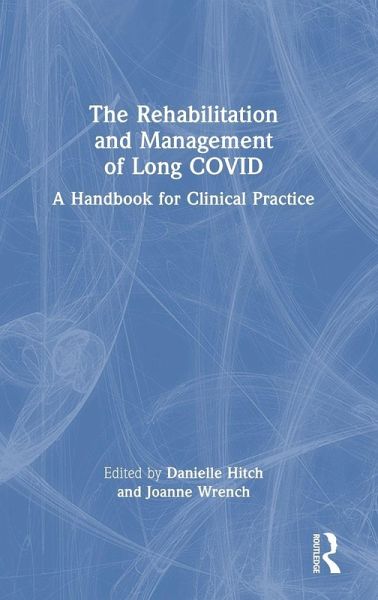
This ground-breaking volume provides the first comprehensive resource for health professionals managing the rehabilitation of people experiencing Long COVID.
This ground-breaking volume provides the first comprehensive resource for health professionals managing the rehabilitation of people experiencing Long COVID.
Danielle Hitch is an Associate Professor of Occupational Therapy and Health Economist in a joint position shared between Deakin University, Geelong and Western Health, Victoria, Australia. Her professional life is founded on an enduring commitment to health equity and social justice, and her own lived experience as a carer and person with disability. Joanne Wrench is a Clinical Neuropsychologist and Director of Psychology at Austin Health and an Honorary Fellow at the University of Melbourne, Victoria, Australia. She is a steadfast believer in equitable access to healthcare and the public health system, in which she has worked for over 20 years.
Inhaltsangabe
1.Introduction. Section One: Understanding Long COVID. 2.What is Long COVID? 3.Long COVID, ME/CFS and Other Post Acute Infection Syndromes. 4.Long COVID as a Patient Identified Disease Entity. Section Two: Long COVID Identification and Planning. 5.The Importance of Screening for and Identifying Long COVID in Individuals, Communities and Populations. 6.Measuring What Matters in Long COVID: Outcome Measures and Monitoring. 7.Setting Rehabilitation Goals and Shared Decision-Making in Long COVID Rehabilitation. Section Three: The Interdisciplinary Long COVID Team. 8.The Roles and Responsibilities of Medical Professionals in Long COVID Care. 9.The Roles and Responsibilities of Allied Health Professionals in Long COVID. 10.Bringing It All Together: Integrated and Co-Ordinated Care for Long COVID. Section Four: Long COVID Interventions and Management. 11.Physical Rehabilitation Techniques for Long COVID. 12.Optimising Participation in Everyday Life for People with Long COVID. 13.Cognitive Rehabilitation for Long COVID. 14.Psychosocial Support and Interventions for Long COVID. 15.Nourishing the Path to Recovery: Nutrition and Long COVID. 16.Management of Postural Orthostatic Tachycardia Syndrome (POTS). Section Five: Models of Care for Long COVID. 17.Hospital Based Models of Care for Long COVID. 18.Interdisciplinary Allied Health Models of Care for Long COVID: Approaches to Symptom Management and Recovery. 19.Community and Primary Care for People with Long COVID. 20.Self Determination and Self-Management for People with Long COVID. 21.The Economics of Long COVID. Section Six: Key Topics in Long COVID Rehabilitation and Management. 22.Intensive Care Unit Survivorship. 23.Long COVID in Children and Young People. 24.Long COVID in Culturally and Linguistically Diverse Communities. 25.Long COVID in Rural and Remote Communities. 26.Gender and Long COVID: Sharing experiences and outcomes. 27.The Social and Political Contexts of Long COVID. Section Seven: Conclusion. 28.The Future of Long COVID: Unanswered Questions, Research Gaps and Emerging Trends.
1.Introduction. Section One: Understanding Long COVID. 2.What is Long COVID? 3.Long COVID, ME/CFS and Other Post Acute Infection Syndromes. 4.Long COVID as a Patient Identified Disease Entity. Section Two: Long COVID Identification and Planning. 5.The Importance of Screening for and Identifying Long COVID in Individuals, Communities and Populations. 6.Measuring What Matters in Long COVID: Outcome Measures and Monitoring. 7.Setting Rehabilitation Goals and Shared Decision-Making in Long COVID Rehabilitation. Section Three: The Interdisciplinary Long COVID Team. 8.The Roles and Responsibilities of Medical Professionals in Long COVID Care. 9.The Roles and Responsibilities of Allied Health Professionals in Long COVID. 10.Bringing It All Together: Integrated and Co-Ordinated Care for Long COVID. Section Four: Long COVID Interventions and Management. 11.Physical Rehabilitation Techniques for Long COVID. 12.Optimising Participation in Everyday Life for People with Long COVID. 13.Cognitive Rehabilitation for Long COVID. 14.Psychosocial Support and Interventions for Long COVID. 15.Nourishing the Path to Recovery: Nutrition and Long COVID. 16.Management of Postural Orthostatic Tachycardia Syndrome (POTS). Section Five: Models of Care for Long COVID. 17.Hospital Based Models of Care for Long COVID. 18.Interdisciplinary Allied Health Models of Care for Long COVID: Approaches to Symptom Management and Recovery. 19.Community and Primary Care for People with Long COVID. 20.Self Determination and Self-Management for People with Long COVID. 21.The Economics of Long COVID. Section Six: Key Topics in Long COVID Rehabilitation and Management. 22.Intensive Care Unit Survivorship. 23.Long COVID in Children and Young People. 24.Long COVID in Culturally and Linguistically Diverse Communities. 25.Long COVID in Rural and Remote Communities. 26.Gender and Long COVID: Sharing experiences and outcomes. 27.The Social and Political Contexts of Long COVID. Section Seven: Conclusion. 28.The Future of Long COVID: Unanswered Questions, Research Gaps and Emerging Trends.
Es gelten unsere Allgemeinen Geschäftsbedingungen: www.buecher.de/agb
Impressum
www.buecher.de ist ein Internetauftritt der buecher.de internetstores GmbH
Geschäftsführung: Monica Sawhney | Roland Kölbl | Günter Hilger
Sitz der Gesellschaft: Batheyer Straße 115 - 117, 58099 Hagen
Postanschrift: Bürgermeister-Wegele-Str. 12, 86167 Augsburg
Amtsgericht Hagen HRB 13257
Steuernummer: 321/5800/1497
USt-IdNr: DE450055826