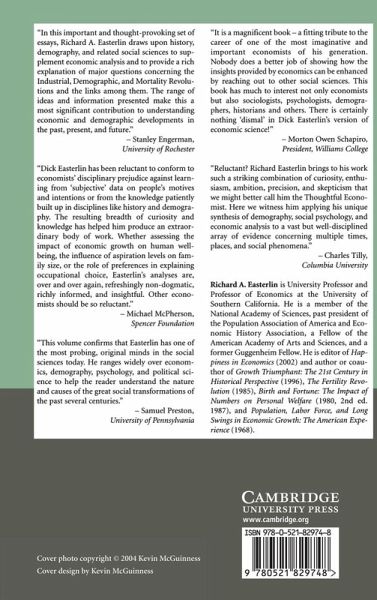
Where is rapid economic growth taking us? Why has its spread throughout the world been so limited? What are the causes of the great twentieth century advance in life expectancy? Of the revolution in childbearing that is bringing fertility worldwide to near replacement levels? Have free markets been the source of human improvement? Economics provides a start on these questions, but only a start, argues economist Richard A. Easterlin. To answer them calls for merging economics with concepts and data from other social sciences, and with quantitative and qualitative history. Easterlin demonstrates…mehr
Where is rapid economic growth taking us? Why has its spread throughout the world been so limited? What are the causes of the great twentieth century advance in life expectancy? Of the revolution in childbearing that is bringing fertility worldwide to near replacement levels? Have free markets been the source of human improvement? Economics provides a start on these questions, but only a start, argues economist Richard A. Easterlin. To answer them calls for merging economics with concepts and data from other social sciences, and with quantitative and qualitative history. Easterlin demonstrates this approach in seeking answers to these and other questions about world or American experience in the last two centuries, drawing on economics, demography, sociology, history, and psychology. The opening chapter gives an autobiographical account of the evolution of this approach, and why Easterlin is a 'reluctant economist'.
Richard A. Easterlin is University Professor and Professor of Economics, Department of Economics, University of Southern California. He is a member of the National Academy of Sciences, past president of the Population Association, a Fellow of the American Academy of Arts and Sciences, and a former Guggenheim Fellow. He is editor of Happiness in Economics (2002) and author or co-author of Growth Triumphant: The 21st Century in Historical Perspective (1996), The Fertility Revolution (1985), Birth and Fortune: The Impact of Numbers on Personal Welfare (1980; 2nd edition 1987), and Population, Labor Force, and Long Swings in Economic Growth: The American Experience (1968).
Inhaltsangabe
List of tables and figures Preface Acknowledgements Part I. Economics: 1. The reluctant economist 2. Economics and the use of subjective testimony 3. Is economic growth creating a new postmaterialistic society? Part II. Economic History: 4. Why isn't the whole world developed? 5. Kuznets cycles and modern economic growth 6. Industrial revolution and mortality revolution: two of a kind? 7. How beneficent is the market? A look at the modern history of mortality Part III. Demography: 8. An economic framework for fertility analysis 9. New perspectives on the demographic transition 10. Does human fertility adjust to the environment? Population change and farm settlement in the northern United States 11. America's baby boom and bust, 1940-80: causes and consequences 12. Preferences and prices in choice of career: the switch to business Epilogue Bibliography Index.
List of tables and figures Preface Acknowledgements Part I. Economics: 1. The reluctant economist 2. Economics and the use of subjective testimony 3. Is economic growth creating a new postmaterialistic society? Part II. Economic History: 4. Why isn't the whole world developed? 5. Kuznets cycles and modern economic growth 6. Industrial revolution and mortality revolution: two of a kind? 7. How beneficent is the market? A look at the modern history of mortality Part III. Demography: 8. An economic framework for fertility analysis 9. New perspectives on the demographic transition 10. Does human fertility adjust to the environment? Population change and farm settlement in the northern United States 11. America's baby boom and bust, 1940-80: causes and consequences 12. Preferences and prices in choice of career: the switch to business Epilogue Bibliography Index.
Es gelten unsere Allgemeinen Geschäftsbedingungen: www.buecher.de/agb
Impressum
www.buecher.de ist ein Internetauftritt der buecher.de internetstores GmbH
Geschäftsführung: Monica Sawhney | Roland Kölbl | Günter Hilger
Sitz der Gesellschaft: Batheyer Straße 115 - 117, 58099 Hagen
Postanschrift: Bürgermeister-Wegele-Str. 12, 86167 Augsburg
Amtsgericht Hagen HRB 13257
Steuernummer: 321/5800/1497
USt-IdNr: DE450055826