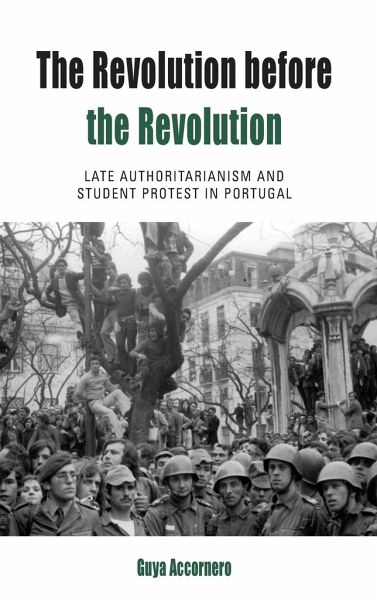
The only book on the Portuguese long sixties. Offers an in-depth historical analysis based on original material, but at the same time is strongly embedded in social movements theory.
The only book on the Portuguese long sixties. Offers an in-depth historical analysis based on original material, but at the same time is strongly embedded in social movements theory.
Guya Accornero is a senior researcher fellow in political science at the Centre for Research and Studies in Sociology, Lisbon University Institute (IUL) - with a grant of the Portuguese Foundation for Science and Technology (FCT, grant number FCT-IF/00223/2012) - and invited professor at the same University. She collaborates with the 'Barometer of News' of the IUL Journalism School. She has been visiting researcher at the Centre for Advanced Studies in Social Sciences of the Juan March Foundation, Madrid; at the Lausanne University Research Centre on Political Action and at the CUNY-Graduate Centre, New York City. Her research interests include contentious politics, radicalization, political violence, repression, anti-austerity protest, housing and anti-gentrification movements. Besides several book-chapters, she has published articles in the journals West European Politics, Democratization, Cultures & Conflicts, Análise Social, Storia e Problemi Contemporanei, Historein, Estudos Ibero-Americanos, and Journal of Contemporary Religion. She is the co-editor of the book Percorsi. Scienze sociali tra Italia e Portogallo (BraDypUS).
Inhaltsangabe
List of Illustrations Acknowledgements Introduction List of Abbreviations Chapter 1. Two Decades that Shook the World, 1956-1974 * Old structures and new conflicts * Student networks and repertories under the New State Chapter 2. The First Protest Cycle: 1956-1965 * The weakening of the Salazarist system * The academic crisis of 1962 * The end of the protest cycle Chapter 3. 'The Marcelo's Spring' and the Opening of a Second Protest Cycle * Marcelism * Mobilization resources and repertoire * The divergent paths of student contestation in Coimbra and Lisbon Chapter 4. Protest Cycle or Permanent Conflict? * The new objectives of the student movement * The University of Lisbon: 'an authentic boiler of revolutionaries' Chapter 5. The Demise of the New State * The end of the regime: mechanisms and processes * Students and the revolution * The ancient regime and the revolution Conclusions: Social Movements and Authoritarianism: A Paradoxical Relationship Bibliography Sources
List of Illustrations Acknowledgements Introduction List of Abbreviations Chapter 1. Two Decades that Shook the World, 1956-1974 * Old structures and new conflicts * Student networks and repertories under the New State Chapter 2. The First Protest Cycle: 1956-1965 * The weakening of the Salazarist system * The academic crisis of 1962 * The end of the protest cycle Chapter 3. 'The Marcelo's Spring' and the Opening of a Second Protest Cycle * Marcelism * Mobilization resources and repertoire * The divergent paths of student contestation in Coimbra and Lisbon Chapter 4. Protest Cycle or Permanent Conflict? * The new objectives of the student movement * The University of Lisbon: 'an authentic boiler of revolutionaries' Chapter 5. The Demise of the New State * The end of the regime: mechanisms and processes * Students and the revolution * The ancient regime and the revolution Conclusions: Social Movements and Authoritarianism: A Paradoxical Relationship Bibliography Sources
Es gelten unsere Allgemeinen Geschäftsbedingungen: www.buecher.de/agb
Impressum
www.buecher.de ist ein Internetauftritt der buecher.de internetstores GmbH
Geschäftsführung: Monica Sawhney | Roland Kölbl | Günter Hilger
Sitz der Gesellschaft: Batheyer Straße 115 - 117, 58099 Hagen
Postanschrift: Bürgermeister-Wegele-Str. 12, 86167 Augsburg
Amtsgericht Hagen HRB 13257
Steuernummer: 321/5800/1497
USt-IdNr: DE450055826