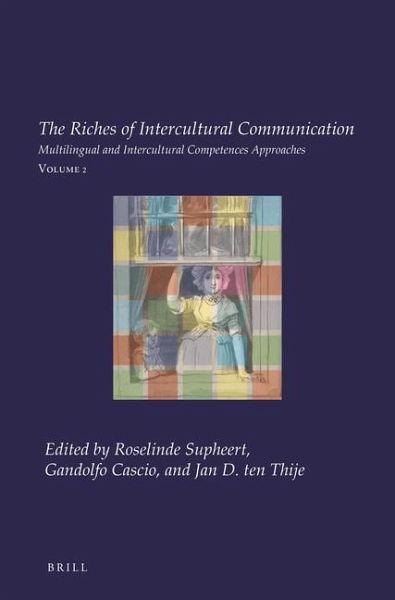
How do you react to an intercultural situation that you do not understand? There are four options. You wait until it's over. You adjust your behavior and "do as the natives do." You blame the other as strange and stupid. Or you start to wonder by thinking about yourself and the other(s). This last option is called a Rich Point. This book provides an overview of research into intercultural communication. It is not a handbook but offers nine studies that illustrate the reflection process from different scholarly perspectives. The approaches in this volume are the multilingualism approach and…mehr
How do you react to an intercultural situation that you do not understand? There are four options. You wait until it's over. You adjust your behavior and "do as the natives do." You blame the other as strange and stupid. Or you start to wonder by thinking about yourself and the other(s). This last option is called a Rich Point. This book provides an overview of research into intercultural communication. It is not a handbook but offers nine studies that illustrate the reflection process from different scholarly perspectives. The approaches in this volume are the multilingualism approach and transfer approach including research into intercultural competences. Volume 1 offers nine additional chapters exemplifying the interaction approach, contrastive approach, and cultural representational approach. Together, the chapters illustrate the essence of the essentialism and non-essentialism debate regarding diversity and inclusion. Have you ever found yourself in an intercultural situation you did not understand? How did you react? Did you wonder if you could have reacted differently? What have you learnt that could support you in similar future occasions? Test your knowledge of Intercultural Communication with this quiz! link
Roselinde Supheert is assistant professor of English Language and Literature at Utrecht University. Her research focuses on adaptation, reception and intercultural communication. Recent publications include (with Roos Beerkens, Emmanuelle Le Pichon-Vorstman, and Jan D. ten Thije, eds.) Enhancing Intercultural Communication in Organizations: Insights from Project Advisers (Routledge Focus on Communication Studies. New York, NY: Routledge, 2020); and the Map Your Hero(ine) website: https: //mapyourhero.com/ Gandolfo Cascio is assistant professor of Italian Literature and Translation Studies at Utrecht University. His areas of research are reception aesthetics and digital philology. He has published the monographs Michelangelo in Parnaso. La ricezione delle 'Rime' tra gli scrittori (Venice: Marsilio, 2019; English trans. Brill, 2022); Dolci detti. Dante, la letteratura e i poeti (Venice: Marsilio, 2021; Nino Martoglio Prize) and the collection of essays Le ore del meriggio. Saggi critici (Castiglione di Sicilia: Il Convivio, 2020; G.A. Borgese Prize). Currently he is carrying out the ICON-funded project Observatory on Dante Studies. Jan D. ten Thije is professor emeritus of Intercultural Communication at the Department of Languages, Literature and Communication at Utrecht University. His main fields of research concern institutional discourse in multicultural and international settings, receptive multilingualism, intercultural training, language education, and functional pragmatics. He is Editor-in-Chief of the European Journal for Applied Linguistics (EuJAL) published by Mouton de Gruyter and Series Editor of Utrecht Studies in Language and Communication published by Brill.
Es gelten unsere Allgemeinen Geschäftsbedingungen: www.buecher.de/agb
Impressum
www.buecher.de ist ein Internetauftritt der buecher.de internetstores GmbH
Geschäftsführung: Monica Sawhney | Roland Kölbl | Günter Hilger
Sitz der Gesellschaft: Batheyer Straße 115 - 117, 58099 Hagen
Postanschrift: Bürgermeister-Wegele-Str. 12, 86167 Augsburg
Amtsgericht Hagen HRB 13257
Steuernummer: 321/5800/1497
USt-IdNr: DE450055826