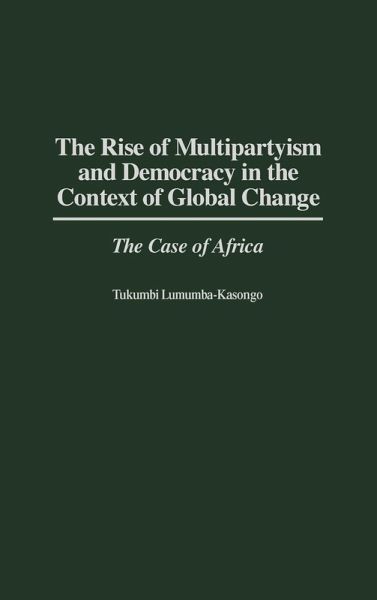
Lumumba-Kasongo examines those forces that contributed to the fate of multiparty democracy in Africa. The forces include the state, political parties, ethnicity, nationalism, religion, underdevelopment, and the global market. Multipartyism in Africa is not necessarily democratic. However, the processes toward multipartyism can produce democratic discourses if they can be transformed by popular and social movements. As the author points out, almost all social classes have demanded some form of democracy. Yet the sociological meanings and teleological perspectives of those forms of democracy…mehr
Lumumba-Kasongo examines those forces that contributed to the fate of multiparty democracy in Africa. The forces include the state, political parties, ethnicity, nationalism, religion, underdevelopment, and the global market. Multipartyism in Africa is not necessarily democratic. However, the processes toward multipartyism can produce democratic discourses if they can be transformed by popular and social movements. As the author points out, almost all social classes have demanded some form of democracy. Yet the sociological meanings and teleological perspectives of those forms of democracy depend on an individual or group's economic and educational status. The dynamics of the global context, as reflected in the adoption of the structural adjustment programs of the World Bank and the stability programs of the International Monetary Fund, are likely to produce non-democratic conditions in Africa. Lumumba-Kasongo challenges the existing paradigms on democracy and development, so the book is of considerable interest to scholars and policy makers involved with African politics and socio-economic development.
Tukumbi Lumumba-Kasongo was trained at Universit, Libre du Congo, Harvard University, and the University of Chicago. He is Professor of Political Science at Wells College, Visiting Scholar, Department of City and Regional Planning, Cornell University, Visiting Research Fellow, Center for the Study of International Cooperation in Education (CICE), Hiroshima University, Japan, Co-Founder and Director of CEPARRED, Research Associate, Institut d'Ethno-Sociologie,Universit, de Cocody, C"te d'Ivoire. He is the Editor of African and Asian Studies published by Brill, Leiden, the Netherlands. He is also the Vice-President of the African Association of Political Science-Representing the Central African region.
Inhaltsangabe
Abbreviations Preface Introduction: Issues, Approaches, and Theoretical Considerations The Nature of Democratic Discourses in the 1990s The Opposition Political Parties and Their Discourses The Role of the Church in Democratic Pluralism in Africa Ethnicity and Nationalism: Real Challenges to Multipartyism? The Military Factor in the Current Democracy Equation Structural Adjustment Programs and Their Implications in the Struggle for Democracy A General Conclusion: What Lessons from the Past and Where to Go from Here? Selected Bibliography Index
Abbreviations Preface Introduction: Issues, Approaches, and Theoretical Considerations The Nature of Democratic Discourses in the 1990s The Opposition Political Parties and Their Discourses The Role of the Church in Democratic Pluralism in Africa Ethnicity and Nationalism: Real Challenges to Multipartyism? The Military Factor in the Current Democracy Equation Structural Adjustment Programs and Their Implications in the Struggle for Democracy A General Conclusion: What Lessons from the Past and Where to Go from Here? Selected Bibliography Index
Es gelten unsere Allgemeinen Geschäftsbedingungen: www.buecher.de/agb
Impressum
www.buecher.de ist ein Internetauftritt der buecher.de internetstores GmbH
Geschäftsführung: Monica Sawhney | Roland Kölbl | Günter Hilger
Sitz der Gesellschaft: Batheyer Straße 115 - 117, 58099 Hagen
Postanschrift: Bürgermeister-Wegele-Str. 12, 86167 Augsburg
Amtsgericht Hagen HRB 13257
Steuernummer: 321/5800/1497
USt-IdNr: DE450055826