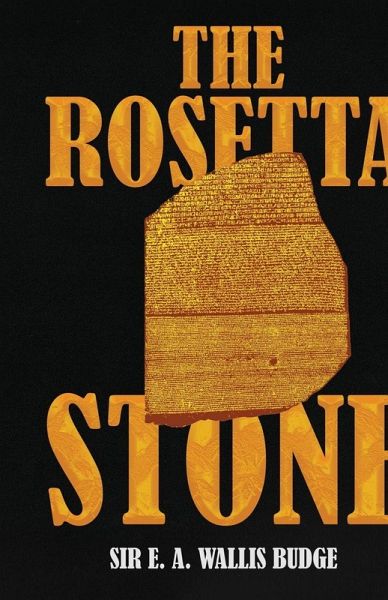
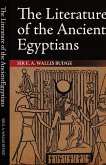
The Rosetta Stone by Sir E. A. Wallis Budge examines one of the most important archaeological discoveries in human history-the inscribed stone that unlocked the meaning of ancient Egyptian hieroglyphs. Budge explores the historical background of the stone, its trilingual inscriptions, and the role it played in the decipherment of the Egyptian writing system. The book provides insight into the linguistic, cultural, and historical significance of the Rosetta Stone, explaining how its discovery transformed the study of ancient Egypt and enabled scholars to access thousands of years of Egyptian…mehr
The Rosetta Stone by Sir E. A. Wallis Budge examines one of the most important archaeological discoveries in human history-the inscribed stone that unlocked the meaning of ancient Egyptian hieroglyphs. Budge explores the historical background of the stone, its trilingual inscriptions, and the role it played in the decipherment of the Egyptian writing system. The book provides insight into the linguistic, cultural, and historical significance of the Rosetta Stone, explaining how its discovery transformed the study of ancient Egypt and enabled scholars to access thousands of years of Egyptian texts. Budge's scholarly yet accessible approach makes this work valuable for readers interested in Egyptology, ancient languages, archaeology, and the history of writing. An essential volume for understanding the foundations of modern Egyptology, The Rosetta Stone highlights the enduring importance of language in preserving and rediscovering human civilization.
Sir Ernest Alfred Thompson Wallis Budge, often cited as E. A. Wallis Budge, was a renowned English Egyptologist, Orientalist, and philologist who made significant contributions to the study of ancient Egypt. Born on July 27, 1857, and passing away on November 23, 1934, Budge was a prolific author whose scholarly work included translations, dictionaries, and a vast corpus of writings on Egyptology, Assyriology, and the history of the Middle East. Among his most notable works is 'The Rosetta Stone,' which provides an informative exploration of the crucial artifact that helped decipher Egyptian hieroglyphs, ultimately unlocking the long-lost language of ancient Egypt. Budge's literary style was characterized by a meticulous attention to detail and a commitment to making the knowledge of ancient civilizations accessible to a broader audience. Despite some of his translations and theories being later critiqued and superseded by modern scholarship, Budge's texts continue to serve as valuable resources for historical study and remain popular among enthusiasts of Egyptology. He served for much of his career at the British Museum, where he was responsible for numerous acquisitions of key artifacts, and his influence is still recognized in the fields of archaeology and philology today. His contributions have fostered a deeper understanding and appreciation of near eastern antiquities across the scholarly community and the world at large.
Es gelten unsere Allgemeinen Geschäftsbedingungen: www.buecher.de/agb
Impressum
www.buecher.de ist ein Internetauftritt der buecher.de internetstores GmbH
Geschäftsführung: Monica Sawhney | Roland Kölbl | Günter Hilger
Sitz der Gesellschaft: Batheyer Straße 115 - 117, 58099 Hagen
Postanschrift: Bürgermeister-Wegele-Str. 12, 86167 Augsburg
Amtsgericht Hagen HRB 13257
Steuernummer: 321/5800/1497
USt-IdNr: DE450055826