This companion brings together scholars working at the intersection of media and class, with a focus on how understandings of class are changing in contemporary global media contexts. From the memes of and about working-class supporters of billionaire "populists", to well-publicized and critiqued philanthropic efforts to bring communication technologies into developing country contexts, to the behind-the-scenes work of migrant tech workers, class is undergoing change both in and through media. Diverse and thoughtfully curated contributions unpack how media industries, digital technologies,…mehr
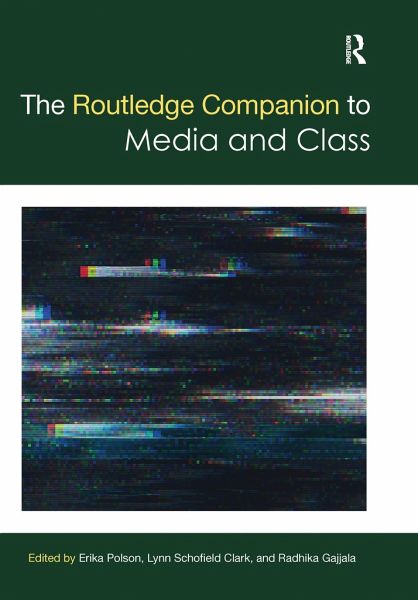
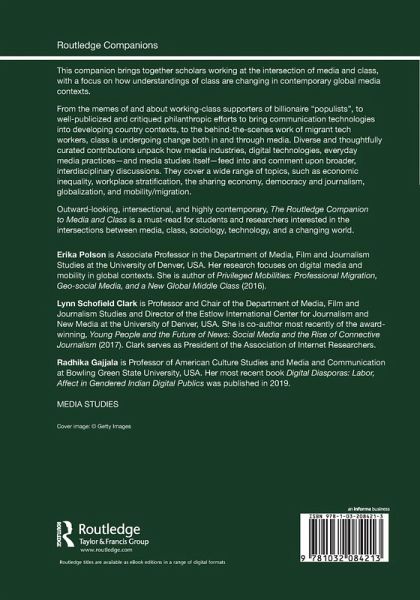
This companion brings together scholars working at the intersection of media and class, with a focus on how understandings of class are changing in contemporary global media contexts.
From the memes of and about working-class supporters of billionaire "populists", to well-publicized and critiqued philanthropic efforts to bring communication technologies into developing country contexts, to the behind-the-scenes work of migrant tech workers, class is undergoing change both in and through media. Diverse and thoughtfully curated contributions unpack how media industries, digital technologies, everyday media practices-and media studies itself-feed into and comment upon broader, interdisciplinary discussions. They cover a wide range of topics, such as economic inequality, workplace stratification, the sharing economy, democracy and journalism, globalization, and mobility/migration.
Outward-looking, intersectional, and highly contemporary, The Routledge Companion to Media and Class is a must-read for students and researchers interested in the intersections between media, class, sociology, technology, and a changing world.
Erika Polson is Associate Professor in the department of Media, Film and Journalism Studies at the University of Denver, USA. Her research focuses on digital media and mobility in global contexts. She is author of Privileged Mobilities: Professional Migration, Geo-social Media, and a New Global Middle Class (2016). Lynn Schofield Clark is Professor and Chair of the Department of Media, Film and Journalism Studies and Director of the Estlow International Center for Journalism and New Media at the University of Denver, USA. She is co-author most recently of the award-winning, Young People and the Future of News: Social Media and the Rise of Connective Journalism (2017). Clark serves as President of the Association of Internet Researchers. Radhika Gajjala is Professor of American Culture Studies and Media and Communication at Bowling Green State University, USA. Her most recent book Digital Diasporas: Labor, Affect in Gendered Indian Digital Publics was published in 2019.
Inhaltsangabe
1. Introduction: Media and Class in the Twenty-first Century. Erika Polson, Lynn Schofield Clark, and Radhika Gajjala Part I: Class and Mass Media 2. Working-class Bodies in Advertising. Matthew P. McAllister and Litzy Galarz 3. Class Hybridity and the Habitus Clivé on American Reality Television. June Deery 4. Migrants Meet Reality Shows: The Class Representation of Non-Koreans in Reality Shows in Korea. Hun-Yul Lee 5. Participation in Reality Television: Entertainment Mobilization in Dance Talent Shows. Annette Hill and Koko Kondo 6. Love, Sex, Money: Gender and Economic Inequality in HIV Edutainment Programming in Kenya. Renée A. Botta Part II: Class in Interactive Digital and Mobile Media 7. Horse Racing, Social Class, and the Spaces of Gambling. Holly Kruse 8. "Keep it Classy": Grindr, Facebook and Enclaves of Queer Privilege in India. Rohit K. Dasgupta 9. YouTube-based Programming and Saudi Youth: Constructing a New Online Class and Monetizing Strategies. Omar Daoudi 10. Mobile Technology and Class: Australian Family Households, Socioeconomic Status and Techno-literacy. Will Balmford and Larissa Hjorth 11. Hanging Out at Home as a Lifestyle: YouTube Home Tour Vlogs in East Asia. Crystal Abidi 12. Young People, Smartphones, and Invisible Illiteracies: Closing the Potentiality-Actuality Chasm in Mobile Media. Sun Sun Lim and Renae Sze Ming Lo 13. Childhood, Media, and Class in South Asia. Shakuntala Banaji Part III: Labor in Digital/Media Contexts 14. The Roots of Journalistic Perception: A Bourdieusian Approach to Media and Class. Sandra Vera-Zambrano and Matthew Powers 15. The Aspirational Class "Mobility" of Digital Nomads. Erika Polson 16. Technologies of Recognition: The Classificatory Function of Social Media in Mobile Careers. André Jansson 17. The Gig Economy and Class (De)composition. Todd Wolfson 18. Digital Hierarchies of Laboring Subjects. Kaitlyn Wauthier, Alyssa Fisher, and Radhika Gajjala 19. Between "World Class Work" and "Proletarianized Labor": Digital Labor Imaginaries in the Global South. Cheryll Ruth Soriano and Jason Vincent Cabañes Part IV: Media, Class, and Expressions of Citizenship 20. Class Distinctions in Urban Broadband Initiatives. Germaine Halegoua 21. "Second-class" Access: Homelessness and the Digital Materialization of Class. Justine Humphry 22. Marginality and Social Class in Moroccan Youth Media. Mohamed El Marzouki 23. Reconsidering Mobility: The Competing Logics of Information and Communication Technologies Across Class Differences in the Context of Denver's Gentrification. Lynn Schofield Clark 24. Class Interplay in Social Activism in Kenya. Job Mwaura Postscript 25. The Vivid Particularities of Class and Media. David Morley
Es gelten unsere Allgemeinen Geschäftsbedingungen: www.buecher.de/agb
Impressum
www.buecher.de ist ein Internetauftritt der buecher.de internetstores GmbH
Geschäftsführung: Monica Sawhney | Roland Kölbl | Günter Hilger
Sitz der Gesellschaft: Batheyer Straße 115 - 117, 58099 Hagen
Postanschrift: Bürgermeister-Wegele-Str. 12, 86167 Augsburg
Amtsgericht Hagen HRB 13257
Steuernummer: 321/5800/1497
USt-IdNr: DE450055826