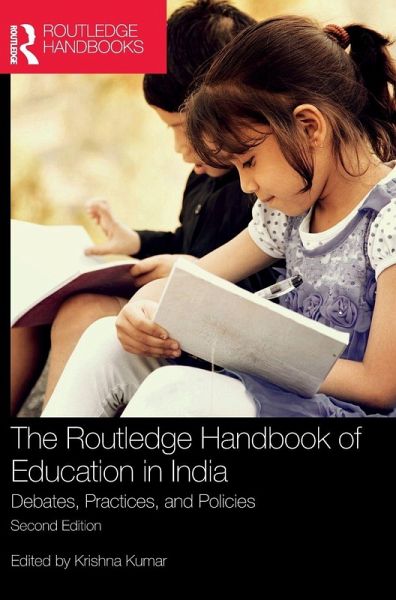
This comprehensive handbook introduces the reader to the education system in India in terms of its structural features, its relations with society and culture, and the debates that have shaped the present-day policy ethos.
This comprehensive handbook introduces the reader to the education system in India in terms of its structural features, its relations with society and culture, and the debates that have shaped the present-day policy ethos.
Krishna Kumar is Honorary Professor of Education at Panjab University, former Professor of Education, University of Delhi, and former Director, National Council of Educational Research and Training (NCERT), India.
Inhaltsangabe
List of figures. List of tables. Notes on contributors. Preface. Introduction Krishna Kumar Part 1: Logic of access 1. Compulsion to educate 2. Education in urban areas 3. Institutional diversity and quality 4. Examination for elimination: celebrating fear and penalising failure Part II: Curriculum and teaching 5. Mind the (language-medium) gap 6. Science and mathematics teaching in schools and colleges 7. The teaching of social sciences in schools and colleges in India 8. The uses and teaching of history 9. An experiment in rural education: the revival of Anand Niketan Part III: Training for professions 10. The making of India as an engineering society 11. Discourse of teacher education in India 12. Management education in India: how far have we come? 13. Technical and Vocational Education and Training in India: Lacking Vision, Strategy and Coherence Part IV: Universities and society 14. Indian higher education: twenty-first-century challenges 15. Gendered access and participation: unequal subject choices in Indian higher education 16. Caste quotas and formal inclusion in Indian higher education 17. Tribes and higher education in India 18. Private Participation in Higher Education in India: Issues and Implications on Access, Equity and Quality Part V: Underbelly 19. Active partners: rethinking the educated unemployed in India 20. Access, success, and excess: debating shadow education in India 21. Understanding Vyapam Index.
List of figures. List of tables. Notes on contributors. Preface. Introduction Krishna Kumar Part 1: Logic of access 1. Compulsion to educate 2. Education in urban areas 3. Institutional diversity and quality 4. Examination for elimination: celebrating fear and penalising failure Part II: Curriculum and teaching 5. Mind the (language-medium) gap 6. Science and mathematics teaching in schools and colleges 7. The teaching of social sciences in schools and colleges in India 8. The uses and teaching of history 9. An experiment in rural education: the revival of Anand Niketan Part III: Training for professions 10. The making of India as an engineering society 11. Discourse of teacher education in India 12. Management education in India: how far have we come? 13. Technical and Vocational Education and Training in India: Lacking Vision, Strategy and Coherence Part IV: Universities and society 14. Indian higher education: twenty-first-century challenges 15. Gendered access and participation: unequal subject choices in Indian higher education 16. Caste quotas and formal inclusion in Indian higher education 17. Tribes and higher education in India 18. Private Participation in Higher Education in India: Issues and Implications on Access, Equity and Quality Part V: Underbelly 19. Active partners: rethinking the educated unemployed in India 20. Access, success, and excess: debating shadow education in India 21. Understanding Vyapam Index.
Es gelten unsere Allgemeinen Geschäftsbedingungen: www.buecher.de/agb
Impressum
www.buecher.de ist ein Internetauftritt der buecher.de internetstores GmbH
Geschäftsführung: Monica Sawhney | Roland Kölbl | Günter Hilger
Sitz der Gesellschaft: Batheyer Straße 115 - 117, 58099 Hagen
Postanschrift: Bürgermeister-Wegele-Str. 12, 86167 Augsburg
Amtsgericht Hagen HRB 13257
Steuernummer: 321/5800/1497
USt-IdNr: DE450055826