
Andere Kunden interessierten sich auch für
 Routledge Handbook of Smart Built Environment155,99 €
 Routledge Handbook of Sports Technology and Engineering218,99 €
 Routledge Handbook of Nature and Environmental Aesthetics217,99 €
 Routledge Handbook of Energy Communities and Smart Cities46,99 €
 Routledge Handbook of Urban Landscape Research42,99 €
 Changing Suburbs44,99 €
 Regional techno socioeconomic vision in dairy efficiency27,99 €




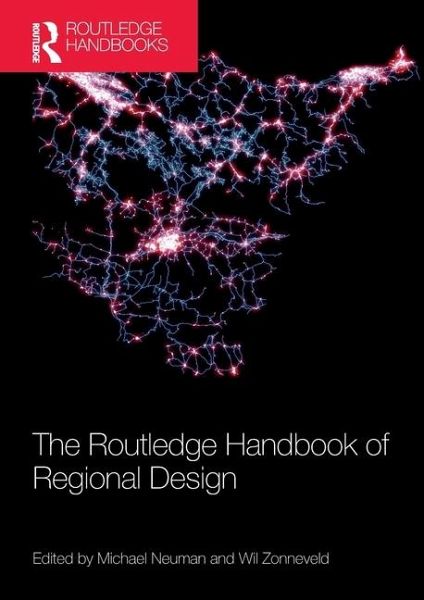
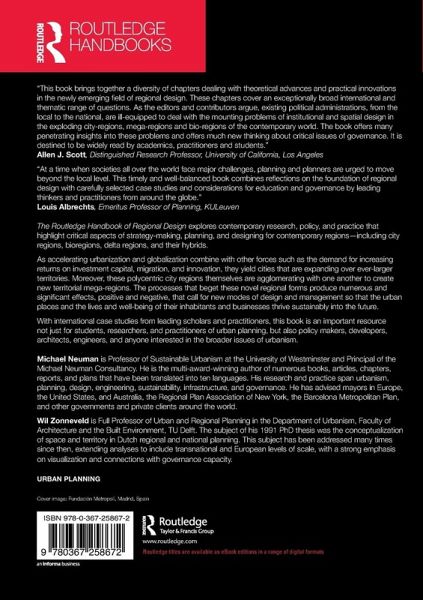
The Routledge Handbook of Regional Design explores contemporary research, policy, and practice that highlight critical aspects of strategy-making, planning, and designing for contemporary regions-including city regions, bioregions, delta regions, and their hybrids.
As accelerating urbanization and globalization combine with other forces such as the demand for increasing returns on investment capital, migration, and innovation, they yield cities that are expanding over ever-larger territories. Moreover, these polycentric city regions themselves are agglomerating with one another to create new territorial mega-regions. The processes that beget these novel regional forms produce numerous and significant effects, positive and negative, that call for new modes of design and management so that the urban places and the lives and well-being of their inhabitants and businesses thrive sustainably into the future.
With international case studies from leading scholars and practitioners, this book is an important resource not just for students, researchers, and practitioners of urban planning, but also policy makers, developers, architects, engineers, and anyone interested in the broader issues of urbanism.
As accelerating urbanization and globalization combine with other forces such as the demand for increasing returns on investment capital, migration, and innovation, they yield cities that are expanding over ever-larger territories. Moreover, these polycentric city regions themselves are agglomerating with one another to create new territorial mega-regions. The processes that beget these novel regional forms produce numerous and significant effects, positive and negative, that call for new modes of design and management so that the urban places and the lives and well-being of their inhabitants and businesses thrive sustainably into the future.
With international case studies from leading scholars and practitioners, this book is an important resource not just for students, researchers, and practitioners of urban planning, but also policy makers, developers, architects, engineers, and anyone interested in the broader issues of urbanism.
"This book brings together a diversity of chapters dealing with theoretical advances and practical innovations in the newly emerging field of regional design. These chapters cover an exceptionally broad international and thematic range of questions. As the editors and contributors argue, existing political administrations, from the local to the national, are ill-equipped to deal with the mounting problems of institutional and spatial design in the exploding city-regions, mega-regions and bio-regions of the contemporary world. The book offers many penetrating insights into these problems and offers much new thinking about critical issues of governance. It is destined to be widely read by academics, practitioners and students."
-Allen J. Scott, Distinguished Research Professor, University of California, Los Angeles
"At a time when societies all over the world face major challenges, planning and planners are urged to move beyond the local level. This timely and well-balanced book combines reflections on the foundation of regional design with carefully selected case studies and considerations for education and governance by leading thinkers and practitioners from around the globe."
-Louis Albrechts, Emeritus Professor of Planning, KULeuven
-Allen J. Scott, Distinguished Research Professor, University of California, Los Angeles
"At a time when societies all over the world face major challenges, planning and planners are urged to move beyond the local level. This timely and well-balanced book combines reflections on the foundation of regional design with carefully selected case studies and considerations for education and governance by leading thinkers and practitioners from around the globe."
-Louis Albrechts, Emeritus Professor of Planning, KULeuven