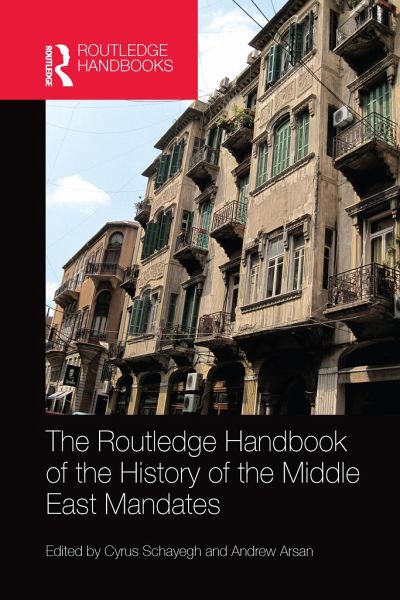
The Routledge Handbook of the History of the Middle East Mandates provides an overview of the social, political, economic, and cultural histories of the Middle East in the decades between the end of the First World War and the late 1940s, when Britain and France abandoned their Mandates. It also situates the history of the Mandates in their wider imperial, international and global contexts, incorporating them into broader narratives of the interwar decades. In 27 thematically organised chapters, the volume looks at various aspects of the Mandates such as: The impact of the First World War and…mehr
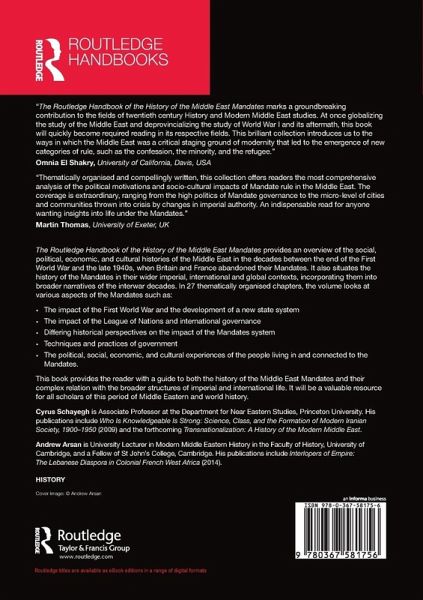
The Routledge Handbook of the History of the Middle East Mandates provides an overview of the social, political, economic, and cultural histories of the Middle East in the decades between the end of the First World War and the late 1940s, when Britain and France abandoned their Mandates. It also situates the history of the Mandates in their wider imperial, international and global contexts, incorporating them into broader narratives of the interwar decades. In 27 thematically organised chapters, the volume looks at various aspects of the Mandates such as: The impact of the First World War and the development of a new state system The impact of the League of Nations and international governance Differing historical perspectives on the impact of the Mandates system Techniques and practices of government The political, social, economic and cultural experiences of the people living in and connected to the Mandates. This book provides the reader with a guide to both the history of the Middle East Mandates and their complex relation with the broader structures of imperial and international life. It will be a valuable resource for all scholars of this period of Middle Eastern and world history.
Cyrus Schayegh is Associate Professor at the Department for Near Eastern Studies, Princeton University. His publications include Who Is Knowledgeable Is Strong: Science, Class, and the Formation of Modern Iranian Society, 1900-1950 (California University Press, 2009) and the forthcoming Transnationalization: A History of the Modern Middle East, under contract by Harvard University Press. Andrew Arsan is University Lecturer in Modern Middle Eastern History in the Faculty of History, University of Cambridge, and a Fellow of St John's College, Cambridge. His publications include Interlopers of Empire: The Lebanese Diaspora in Colonial French West Africa (Hurst & Company and Oxford University Press, 2014).
Inhaltsangabe
Figures, maps, and tables. Acknowledgements. List of contributors. Preface Cyrus Schayegh and Andrew Arsan Foreword: Studying the Mandates: past, present, futureNadine Méouchy and Peter Sluglett Introduction Cyrus Schayegh and Andrew ArsanPart I. The Mandate states in the world: international institutions, transnational linkages Introduction to Part I Andrew Arsan1. Globalisation, imperialism, and the perspectives of foreign soldiers in the Middle East duringthe First World WarLeila Fawaz 2. Between communal survival and national aspiration: Armenian Genocide refugees, the League of Nations and the practices of interwar humanitarianism Keith David Watenpaugh 3. Compassion and connections: feeding Beirut and assembling Mandate rule in 1919 Simon Jackson 4. Exporting obligations: evolutionism, normalization, and mandatory anti-alcoholism from Africa to the Middle East (1918-1939) Philippe Bourmaud5. Education for real life: pragmatist pedagogies and American interwar expansion in Iraq Sarah Pursley6. The Mandate system as a style of reasoning: international jurisdiction and the parcelling of imperial sovereignty in petitions from PalestineNatasha Wheatley7. Citizens from afar: Palestinian migrants and the new world order, 1920-1930 Nadim Bawalsa 8. French Mandate counterinsurgency and the repression of the Great Syrian Revolt Michael ProvencePart II. Mandate states: governance, discourses, interests Introduction to Part II Cyrus Schayegh 9. Colonial gender discourse in Iraq: constructing non-citizens Noga Efrati 10. Mapping the cadastre, producing the fellah: technologies and discourses of rule in French Mandate Syria and Lebanon Elizabeth Williams
Figures, maps, and tables. Acknowledgements. List of contributors. Preface Cyrus Schayegh and Andrew Arsan Foreword: Studying the Mandates: past, present, futureNadine Méouchy and Peter Sluglett Introduction Cyrus Schayegh and Andrew ArsanPart I. The Mandate states in the world: international institutions, transnational linkages Introduction to Part I Andrew Arsan1. Globalisation, imperialism, and the perspectives of foreign soldiers in the Middle East duringthe First World WarLeila Fawaz 2. Between communal survival and national aspiration: Armenian Genocide refugees, the League of Nations and the practices of interwar humanitarianism Keith David Watenpaugh 3. Compassion and connections: feeding Beirut and assembling Mandate rule in 1919 Simon Jackson 4. Exporting obligations: evolutionism, normalization, and mandatory anti-alcoholism from Africa to the Middle East (1918-1939) Philippe Bourmaud5. Education for real life: pragmatist pedagogies and American interwar expansion in Iraq Sarah Pursley6. The Mandate system as a style of reasoning: international jurisdiction and the parcelling of imperial sovereignty in petitions from PalestineNatasha Wheatley7. Citizens from afar: Palestinian migrants and the new world order, 1920-1930 Nadim Bawalsa 8. French Mandate counterinsurgency and the repression of the Great Syrian Revolt Michael ProvencePart II. Mandate states: governance, discourses, interests Introduction to Part II Cyrus Schayegh 9. Colonial gender discourse in Iraq: constructing non-citizens Noga Efrati 10. Mapping the cadastre, producing the fellah: technologies and discourses of rule in French Mandate Syria and Lebanon Elizabeth Williams
Es gelten unsere Allgemeinen Geschäftsbedingungen: www.buecher.de/agb
Impressum
www.buecher.de ist ein Internetauftritt der buecher.de internetstores GmbH
Geschäftsführung: Monica Sawhney | Roland Kölbl | Günter Hilger
Sitz der Gesellschaft: Batheyer Straße 115 - 117, 58099 Hagen
Postanschrift: Bürgermeister-Wegele-Str. 12, 86167 Augsburg
Amtsgericht Hagen HRB 13257
Steuernummer: 321/5800/1497
USt-IdNr: DE450055826