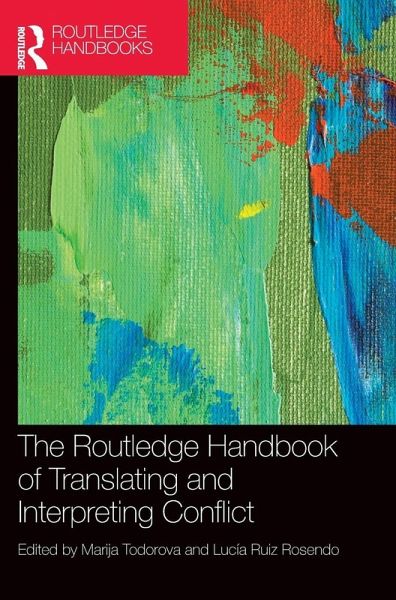
The Routledge Handbook in Translating and Interpreting in Conflict examines how translators and interpreters operate in military, humanitarian, and asylum settings. Covering ethics, trauma, gender, and technology, it draws on global case studies and diverse methods to show how language shapes responses to conflict.
The Routledge Handbook in Translating and Interpreting in Conflict examines how translators and interpreters operate in military, humanitarian, and asylum settings. Covering ethics, trauma, gender, and technology, it draws on global case studies and diverse methods to show how language shapes responses to conflict.
Marija Todorova is Assistant Professor at The Education University of Hong Kong, Hong Kong SAR. She is the author of The Translation of Violence in Children's Literature: Images from the Western Balkans (Routledge 2022) and co-editor of Interpreter Training in Conflict and Post-Conflict Scenarios (Routledge 2023). Lucía Ruiz Rosendo is Associate Professor and Head of the Interpreting Department at the University of Geneva, Switzerland. She is the co-editor of Interpreter Training in Conflict and Post-Conflict Scenarios (Routledge 2023).
Inhaltsangabe
Introduction Lucía Ruiz Rosendo and Marija Todorova PART I Historical overview 1. Alfaqueques on the medieval Iberian Peninsula (12th-15th century): the evolution of linguistic and cultural mediators in a multilingual armed conflict Icíar Alonso-Araguás 2. The changing shapes of interpretation: War with the Mapuche in the southernmost frontier of the Spanish Empire in America. Gertrudis Payàs 3. Language training and interpreting for Japan's imperial ambitions: Kumamoto-connected interpreters for Korean and Chinese in the Russo-Japanese War (1904-1905) Kayoko Takeda 4. The Belgian Interpreter Corps ("Corps des Interprètes") and emerging profiles of interpreters during the First World War Christophe Declercq and Rebecca Tipton 5. Interpreting and translating in the Spanish Civil War, 1936-1939 Julia Kölbl 6. Translating and interpreting during World War II Mägorzata Tryuk 7. Interpreters as interrogators in some armed conflicts of the Cold War María Manuela Fernández Sánchez 8. Interpreting at the International Criminal Tribunal for the Former Yugoslavia Besmir Fidahi¿ 9. Translation, interpretation and the war on terrorism in East Africa: Efforts to win hearts and minds Alamin Mazrui 10. Narratives of war and frames of conflict across languages: Evolution over a century Lesia Ponomarenko and Lucía Ruiz Rosendo PART II Recurring topics 11. Contracting and working with Interpreters: The wartime linguists Eleonora Bernardi and Francisco José Leandro 12. Understanding the complexities of interpreter positionality and positionality management in armed conflict and beyond Conor Martin 13. Ethical issues and neutrality in the work of translators and interpreters in Yemen's armed conflicts Ahmed Moneus 14. From interpreters to fixers: fidelity and agency in premodern and contemporary contexts Zrinka Stahuljak 15. The impact of the interpreter's emotions in conflict zones: the case of the local professional interpreter the Israeli-Palestinian Conflict Manuel Barea Muñoz 16. Interpreting in refugee contexts: The Asylum Claim Process Alejandra González Campanella 17. Red T: Protecting translators and interpreters today for tomorrow Maya Hess 18. Training for translation and interpreting in armed conflicts and cascading crises Patrick Cadwell PART III Emerging topics 19. New trends in language use in warfare Pekka Snellman 20. Intercultural communication in contexts involving terrorist violence Carmen Pena Díaz 21. Countertransference concept as a psychological aspect of interpretation in the field Cherine Haidar Ahmad 22. Women in conflict situations: the case of Kajsa Rothman, a Swedish polyglot in defence of the Loyalist government during the Spanish Civil War (1936-1939) Jesús Baigorri-Jalón 23. Translating political plans in times of conflict: Incompatible interpretations and contesting narratives Ahmad Ayyad 24. Changing landscape of translation and interpreting: A systematic review of technological advancements and their impact on translation and interpreting practice in armed conflicts Khetam Al Sharou 25. Whose nature is it anyway? Translating and researching environmental conflict in the global south Nancy V. Piñeiro PART IV Approaches to research 26. 'Context is All': An interdisciplinary approach Hilary Footitt 27. Between allies and enemies: proposing a model for analysis of military translation cultures Pekka Kujamäki 28. Translating concepts of an armed conflict: Ukraine in the interaction between institutional and press discourses Lesia Ponomarenko and Lucía Ruiz Rosendo 29. Clemente Cerdeira: The interpreter who wanted to change the course of the Spanish civil war Mourad Zarrouk 30. Memories of war: Analyses of memoirs by interpreters and translator Marija Todorova 31. Ethnographic methods to analyse the role of interpreters in conflict and post-conflict scenarios Maura Radicioni and Lucía Ruiz Rosendo Afterword Moira Inghilleri Index
Introduction Lucía Ruiz Rosendo and Marija Todorova PART I Historical overview 1. Alfaqueques on the medieval Iberian Peninsula (12th-15th century): the evolution of linguistic and cultural mediators in a multilingual armed conflict Icíar Alonso-Araguás 2. The changing shapes of interpretation: War with the Mapuche in the southernmost frontier of the Spanish Empire in America. Gertrudis Payàs 3. Language training and interpreting for Japan's imperial ambitions: Kumamoto-connected interpreters for Korean and Chinese in the Russo-Japanese War (1904-1905) Kayoko Takeda 4. The Belgian Interpreter Corps ("Corps des Interprètes") and emerging profiles of interpreters during the First World War Christophe Declercq and Rebecca Tipton 5. Interpreting and translating in the Spanish Civil War, 1936-1939 Julia Kölbl 6. Translating and interpreting during World War II Mägorzata Tryuk 7. Interpreters as interrogators in some armed conflicts of the Cold War María Manuela Fernández Sánchez 8. Interpreting at the International Criminal Tribunal for the Former Yugoslavia Besmir Fidahi¿ 9. Translation, interpretation and the war on terrorism in East Africa: Efforts to win hearts and minds Alamin Mazrui 10. Narratives of war and frames of conflict across languages: Evolution over a century Lesia Ponomarenko and Lucía Ruiz Rosendo PART II Recurring topics 11. Contracting and working with Interpreters: The wartime linguists Eleonora Bernardi and Francisco José Leandro 12. Understanding the complexities of interpreter positionality and positionality management in armed conflict and beyond Conor Martin 13. Ethical issues and neutrality in the work of translators and interpreters in Yemen's armed conflicts Ahmed Moneus 14. From interpreters to fixers: fidelity and agency in premodern and contemporary contexts Zrinka Stahuljak 15. The impact of the interpreter's emotions in conflict zones: the case of the local professional interpreter the Israeli-Palestinian Conflict Manuel Barea Muñoz 16. Interpreting in refugee contexts: The Asylum Claim Process Alejandra González Campanella 17. Red T: Protecting translators and interpreters today for tomorrow Maya Hess 18. Training for translation and interpreting in armed conflicts and cascading crises Patrick Cadwell PART III Emerging topics 19. New trends in language use in warfare Pekka Snellman 20. Intercultural communication in contexts involving terrorist violence Carmen Pena Díaz 21. Countertransference concept as a psychological aspect of interpretation in the field Cherine Haidar Ahmad 22. Women in conflict situations: the case of Kajsa Rothman, a Swedish polyglot in defence of the Loyalist government during the Spanish Civil War (1936-1939) Jesús Baigorri-Jalón 23. Translating political plans in times of conflict: Incompatible interpretations and contesting narratives Ahmad Ayyad 24. Changing landscape of translation and interpreting: A systematic review of technological advancements and their impact on translation and interpreting practice in armed conflicts Khetam Al Sharou 25. Whose nature is it anyway? Translating and researching environmental conflict in the global south Nancy V. Piñeiro PART IV Approaches to research 26. 'Context is All': An interdisciplinary approach Hilary Footitt 27. Between allies and enemies: proposing a model for analysis of military translation cultures Pekka Kujamäki 28. Translating concepts of an armed conflict: Ukraine in the interaction between institutional and press discourses Lesia Ponomarenko and Lucía Ruiz Rosendo 29. Clemente Cerdeira: The interpreter who wanted to change the course of the Spanish civil war Mourad Zarrouk 30. Memories of war: Analyses of memoirs by interpreters and translator Marija Todorova 31. Ethnographic methods to analyse the role of interpreters in conflict and post-conflict scenarios Maura Radicioni and Lucía Ruiz Rosendo Afterword Moira Inghilleri Index
Es gelten unsere Allgemeinen Geschäftsbedingungen: www.buecher.de/agb
Impressum
www.buecher.de ist ein Internetauftritt der buecher.de internetstores GmbH
Geschäftsführung: Monica Sawhney | Roland Kölbl | Günter Hilger
Sitz der Gesellschaft: Batheyer Straße 115 - 117, 58099 Hagen
Postanschrift: Bürgermeister-Wegele-Str. 12, 86167 Augsburg
Amtsgericht Hagen HRB 13257
Steuernummer: 321/5800/1497
USt-IdNr: DE450055826