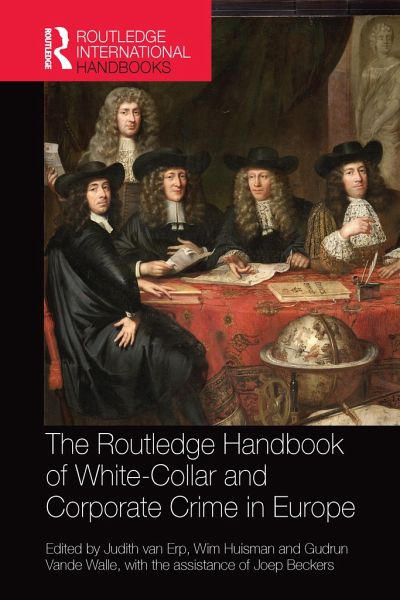
The study of white-collar crime remains a central concern for criminologists around the world and research concentrates on its nature, prevalence, causes and responses. However, most books on white-collar crime tend to focus on Anglo-American examples, which is surprising given the amount of rich data and research taking place in mainland Europe. This new handbook seeks to reset the balance and, for the first time, presents an overview of state-of-the-art research on white-collar crime in Europe. Adding to the existing Anglo-American body of knowledge, the Handbook will discuss specific…mehr
The study of white-collar crime remains a central concern for criminologists around the world and research concentrates on its nature, prevalence, causes and responses. However, most books on white-collar crime tend to focus on Anglo-American examples, which is surprising given the amount of rich data and research taking place in mainland Europe. This new handbook seeks to reset the balance and, for the first time, presents an overview of state-of-the-art research on white-collar crime in Europe.
Adding to the existing Anglo-American body of knowledge, the Handbook will discuss specific European topics and typical European features of white-collar crime. The Routledge Handbook of White-Collar and Corporate Crime in Europe consists of more than thirty chapters on topics ranging from the Icelandic Banking Crisis, to the origins of the study of white collar crime, to contemporary topics, such as white-collar crime in countries post-transition from communist regimes; the illegal e-waste trade and white-collar crime in professional football. Furthermore, the book contains extensive case study analyses of landmark European cases of white-collar crime.
The editors have gathered together the leading voices in the field and a final section offers commentaries on white-collar crime in Europe from eminent criminologists David Friedrichs and Hazel Croall. This Handbook will thus serve as a work of reference for all scholars and students engaged in the study of corporate and white-collar crime and will also set out directions for new research in the future.
Judith van Erp is Professor of Public Institutions at Utrecht University, the Netherlands. Her research addresses corporate compliance and corporate crime. She has published on various public and private modes of regulation and governance of corporate behavior and their intersection, and in particular, on the role of the media and 'naming and shaming' in governing corporate crime. Together with Gudrun Vande Walle and Wim Huisman, she founded and co-chairs the European Working Group on Organizational Crime, a subdivision of the European Society of Criminology. She also co-chairs the Collaborative Research Network on Regulatory Governance of the Law and Society Association. Wim Huisman specializes in prevalence and causes of corporate and white-collar crime. Recently, he published on corporate crime and economic crisis, corporate involvement in gross human rights violations, environmental crime, food fraud and corporate crime theory. He teaches a course on White-collar Crime in the master's programme in Criminology at VU School of Criminology and is the co-chair of the European Society of Criminology's Working Group on Organizational Crime, as well as editor of the Netherlands Journal of Criminology. Gudrun Vande Walle has worked on integrity and anti-corruption policy and on victimization and conflict resolution in relation to corporate crime. She recently exchanged academic research for the practice of investigation and prosecution of Economic and Financial crime for the Belgian public prosecutor. Gudrun teaches a course on Governance and Ethics in the Master Public Administration and Public Management at Ghent University and is member of the research unit "Government and Law" at University of Antwerp. She is co-chair of the European Society of Criminology's Working Group on Organizational Crime.
Inhaltsangabe
1. An introduction to white-collar and corporate crime in Europe W. Huisman J. van Erp G. Vande Walle and J. BeckersPart I Defining and measuring white-collar and corporate crime in Europe2. The measurement of corporate crime: an exercise in futility? C. Walburg3. Determining the adequate enforcement of white-collar and corporate crimes in Europe N. Lord and M. Levi4. Charting Europe's moral economies: Citizens consumers and the crimes of everyday life S. Karstedt5. On the Difficulty of Measuring Economic Crime L. Korsell6. Measuring white-collar crime perceptions among public and white collar offenders: A comparative investigation of four European countries T. Alalehto and D. LarssonPart II Historical perspectives on white-collar and corporate crime in Europe7. Willem Bonger: the unrecognized European pioneer of the study of white collar crime P. Hebberecht8. Corporate involvement in the Holocaust and other Nazi crimes A. Van Baar9. Special criminal law and inspectorates in Europe P. PonsaersPart III Contemporary white-collar and corporate crime in EuropeWhite-collar crime in countries of transition10. Economic Crime and the Privatisation of East German Corporations K. Boers H. Theile B. Bischoff K. Karliczek11. White Collar Crime in Countries of Transition. The Lesson of Hungary E. Inzelt12. Retroactive prosecution of transitional economic crimes in Croatia. Testing the legal principles and human rights P. Novoselec S. Roksandic Vidlicka and A. MaravelskiDeviance in academia 13. Within our walls: white collar crime in Greek academia S. Georgoulas and A. VoulvouliEU fraud.../part contents
1. An introduction to white-collar and corporate crime in Europe W. Huisman J. van Erp G. Vande Walle and J. BeckersPart I Defining and measuring white-collar and corporate crime in Europe2. The measurement of corporate crime: an exercise in futility? C. Walburg3. Determining the adequate enforcement of white-collar and corporate crimes in Europe N. Lord and M. Levi4. Charting Europe's moral economies: Citizens consumers and the crimes of everyday life S. Karstedt5. On the Difficulty of Measuring Economic Crime L. Korsell6. Measuring white-collar crime perceptions among public and white collar offenders: A comparative investigation of four European countries T. Alalehto and D. LarssonPart II Historical perspectives on white-collar and corporate crime in Europe7. Willem Bonger: the unrecognized European pioneer of the study of white collar crime P. Hebberecht8. Corporate involvement in the Holocaust and other Nazi crimes A. Van Baar9. Special criminal law and inspectorates in Europe P. PonsaersPart III Contemporary white-collar and corporate crime in EuropeWhite-collar crime in countries of transition10. Economic Crime and the Privatisation of East German Corporations K. Boers H. Theile B. Bischoff K. Karliczek11. White Collar Crime in Countries of Transition. The Lesson of Hungary E. Inzelt12. Retroactive prosecution of transitional economic crimes in Croatia. Testing the legal principles and human rights P. Novoselec S. Roksandic Vidlicka and A. MaravelskiDeviance in academia 13. Within our walls: white collar crime in Greek academia S. Georgoulas and A. VoulvouliEU fraud.../part contents
Es gelten unsere Allgemeinen Geschäftsbedingungen: www.buecher.de/agb
Impressum
www.buecher.de ist ein Internetauftritt der buecher.de internetstores GmbH
Geschäftsführung: Monica Sawhney | Roland Kölbl | Günter Hilger
Sitz der Gesellschaft: Batheyer Straße 115 - 117, 58099 Hagen
Postanschrift: Bürgermeister-Wegele-Str. 12, 86167 Augsburg
Amtsgericht Hagen HRB 13257
Steuernummer: 321/5800/1497
USt-IdNr: DE450055826