
Andere Kunden interessierten sich auch für
 The Routledge History of the Modern Maritime World since 1500283,99 €
 The Routledge History of Loneliness62,99 €
 The Routledge History of the Senses284,99 €
 The Essential Guide to Western Civilization171,99 €
 The Essential Guide to Western Civilization57,99 €
 The Routledge History of Emotions in Europe60,99 €
 Smell and the Ancient Senses33,99 €







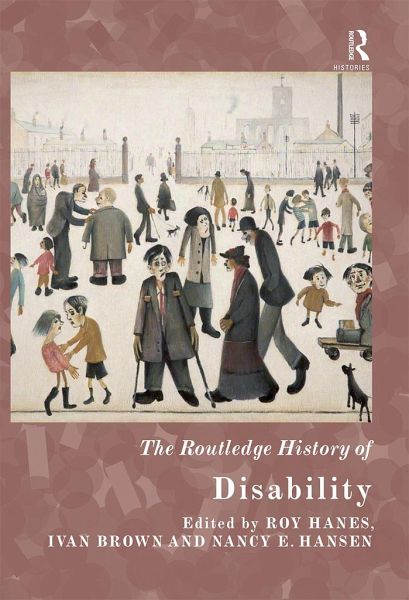
The Routledge History of Disability explores the shifting attitudes towards and representations of disabled people from the age of antiquity to the twenty-first century. Taking an international view of the subject, this wide-ranging collection shows that the history of disability cuts across racial, ethnic, religious, cultural, gender and class divides, highlighting the commonalities and differences between the experiences of disabled persons in global historical context.
The book is arranged in four parts, covering histories of disabilities across various time periods and cultures, histories of national disability policies, programs and services, histories of education and training and the ways in which disabled people have been seen and treated in the last few decades. Within this, the twenty-eight chapters discuss topics such as developments in disability issues during the late Ottoman period, the history of disability in Belgian Congo in the early twentieth century, blind asylums in nineteenth-century Scotland and the systematic killing of disabled children in Nazi Germany.
Illustrated with images and tables and providing an overview of how various countries, cultures and societies have addressed disability over time, this comprehensive volume offers a global perspective on this rapidly growing field and is a valuable resource for scholars of disability studies and histories of disabilities.
The book is arranged in four parts, covering histories of disabilities across various time periods and cultures, histories of national disability policies, programs and services, histories of education and training and the ways in which disabled people have been seen and treated in the last few decades. Within this, the twenty-eight chapters discuss topics such as developments in disability issues during the late Ottoman period, the history of disability in Belgian Congo in the early twentieth century, blind asylums in nineteenth-century Scotland and the systematic killing of disabled children in Nazi Germany.
Illustrated with images and tables and providing an overview of how various countries, cultures and societies have addressed disability over time, this comprehensive volume offers a global perspective on this rapidly growing field and is a valuable resource for scholars of disability studies and histories of disabilities.
"Taking a truly global view of disability history, The Routledge History of Disability brings together an impressive range of scholarship that places the lives of individuals with disabilities in their social, cultural and historical context. Moving beyond the national or local focus of many disability histories, and exploring a variety of impairments, The Routledge History of Disability provides a means for examining disability history comparatively, shedding new light on how social policy, education and civil rights have evolved in different parts of the world."
David Turner, Swansea University, UK
"This book is timely and phenomenal in nationally and internationally highlighting historical events that have affected disabled people. It exposes the origins of issues and controversies about disability, interpreting historical documents and legislation and discussing significant topics such as the eugenics movement and the civil rights movement."
Irene Carter, University of Windsor, Canada
David Turner, Swansea University, UK
"This book is timely and phenomenal in nationally and internationally highlighting historical events that have affected disabled people. It exposes the origins of issues and controversies about disability, interpreting historical documents and legislation and discussing significant topics such as the eugenics movement and the civil rights movement."
Irene Carter, University of Windsor, Canada