
Andere Kunden interessierten sich auch für
") Annals Of The Dudley Observatory V1 (1866)31,99 €
Annals Of The Dudley Observatory V1 (1866)31,99 €") Publications Of The Washburn Observatory Of The University Of Wisconsin V4 (1886)27,99 €
Publications Of The Washburn Observatory Of The University Of Wisconsin V4 (1886)27,99 €") Observations Of Double Stars Made At The United States Naval Observatory (1881)22,99 €
Observations Of Double Stars Made At The United States Naval Observatory (1881)22,99 € The Illustrated Account Given By Hevelius In His Machina Celestis, Of The Method Of Mounting His Telescopes And Erecting An Observatory20,99 €
 Greenwich Hospital: A Series of Naval Sketches, Descriptive of the Life of a Man-of-war's Man30,99 €
 History of the Town of East Greenwich and Adjacent Territory31,99 €
 History of the Town of Greenwich28,99 €



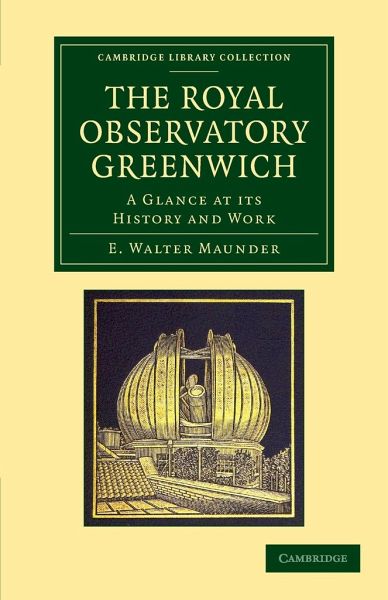
When this highly illustrated work first appeared in 1900, the day-to-day business of an astronomer was prone to misapprehension; the reality tended to be clouded by the temptation to imagine observatories as preoccupied with making awe-inspiring discoveries and glimpsing distant worlds. Describing himself as a hybrid between an engineer and an accountant, astronomer Edward Walter Maunder (1851-1928) explodes the romantic myths and takes the reader on an entertaining tour of the history and real purposes of the Royal Observatory at Greenwich. Founded with the sole aim of advancing navigation at sea, the observatory originally confined its activities to the accurate compilation of celestial charts. In exploring the observatory's various departments and the lives of its Astronomers Royal, Maunder shows how its remit slowly expanded into heliography, meteorology, spectroscopy and the study of magnetism, which transformed it from a tool of the Navy to a major institution in contemporary astronomy.