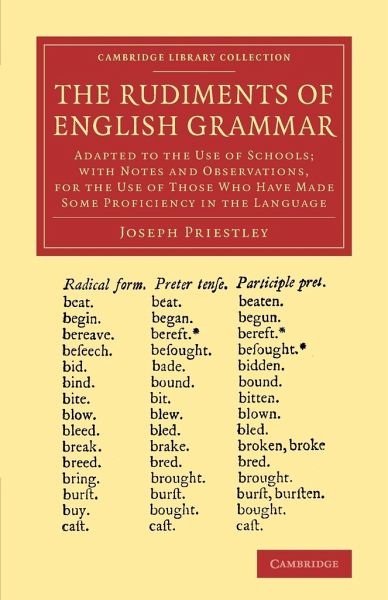
The English polymath Joseph Priestley (1733-1804) defined grammar as nothing more complicated than a system of rules for the correct use of language. This enlarged second edition of his influential 1761 textbook first appeared in 1769; it had by then established him as one of the major grammarians of his age. With little patience for the confusing and superfluous application of Latin rules to English, Priestley champions a simple style of grammatical explanation here, questioning even such fundamental concepts as an English future tense. The text follows a clear question-and-answer structure…mehr
The English polymath Joseph Priestley (1733-1804) defined grammar as nothing more complicated than a system of rules for the correct use of language. This enlarged second edition of his influential 1761 textbook first appeared in 1769; it had by then established him as one of the major grammarians of his age. With little patience for the confusing and superfluous application of Latin rules to English, Priestley champions a simple style of grammatical explanation here, questioning even such fundamental concepts as an English future tense. The text follows a clear question-and-answer structure designed for students. Priestley's determination to modernise the teaching of English and to promote usage as the crucial linguistic standard remain relevant today. A companion work, A Course of Lectures on the Theory of Language and Universal Grammar (1762), is also reissued in this series, along with other works by Priestley ranging in coverage from oratory to oxygen.
English scientist, theologian, and political theorist Joseph Priestley (1733-1804) made numerous contributions to chemistry, physics, and philosophy. Priestley, who was raised in Birstall, West Yorkshire, attended local schools before going to Daventry Academy, where he became very interested in natural philosophy. Priestley made significant scientific advances. His greatest-known distxtery, made in 1774, was oxygen, which he dubbed "dephlogisticated air." His investigations into gases and their characteristics, which are detailed in "Experiments and Observations on Different Kinds of Air," greatly enhanced our knowledge of chemistry. Priestley also studied nitrous oxide and carbon dioxide, among other gases. In addition to his scientific interests, Priestley was a prolific writer on theological and political topics as well as a dissident clergyman. He received criticism for his Unitarian beliefs and his perceived radical religious ideas. Priestley was a liberal and democratic idealist whose political writings shaped the early American history.
Inhaltsangabe
Preface The general distribution 1. Of the inflections of words 2. Of the grammatical use and signification of certain words 3. Of syntax 4. Of prosody 5. Of figures Appendix of verbs irregularly inflected Notes and observations for the use of those who have made some proficiency in the language.
Preface The general distribution 1. Of the inflections of words 2. Of the grammatical use and signification of certain words 3. Of syntax 4. Of prosody 5. Of figures Appendix of verbs irregularly inflected Notes and observations for the use of those who have made some proficiency in the language.
Es gelten unsere Allgemeinen Geschäftsbedingungen: www.buecher.de/agb
Impressum
www.buecher.de ist ein Internetauftritt der buecher.de internetstores GmbH
Geschäftsführung: Monica Sawhney | Roland Kölbl | Günter Hilger
Sitz der Gesellschaft: Batheyer Straße 115 - 117, 58099 Hagen
Postanschrift: Bürgermeister-Wegele-Str. 12, 86167 Augsburg
Amtsgericht Hagen HRB 13257
Steuernummer: 321/5800/1497
USt-IdNr: DE450055826