Building on two successful editions (135,000+ copies sold), this book adds essential updates to a title considered the Rust programming language’s official documentation. The Rust Programming Language, 3rd Edition is the official guide to Rust 2024 and the latest iteration of one of the bestselling Rust books of all time. Rust provides control of low-level details along with high-level ergonomics, allowing you to improve productivity and eliminate the hassle traditionally associated with low-level languages. From web apps to operating systems, Rust is a safe, fast, reliable language used for a wide variety of applications.…mehr
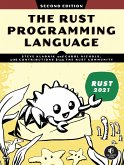
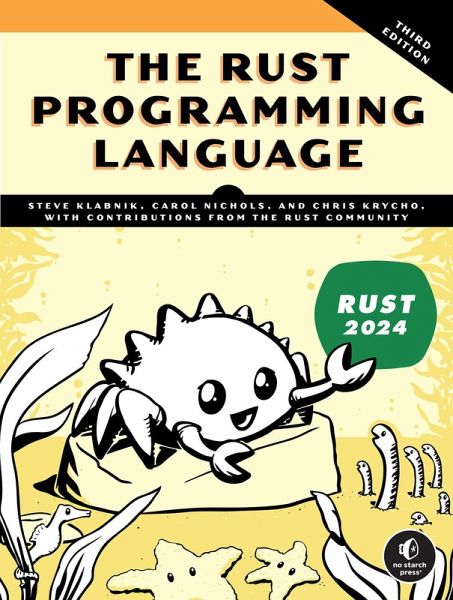
Building on two successful editions (135,000+ copies sold), this book adds essential updates to a title considered the Rust programming language’s official documentation. The Rust Programming Language, 3rd Edition is the official guide to Rust 2024 and the latest iteration of one of the bestselling Rust books of all time. Rust provides control of low-level details along with high-level ergonomics, allowing you to improve productivity and eliminate the hassle traditionally associated with low-level languages. From web apps to operating systems, Rust is a safe, fast, reliable language used for a wide variety of applications.
Steve Klabnik, Carol Nichols, and Chris Krycho, with contributions from the Rust Community
Inhaltsangabe
Foreword Preface Acknowledgments Introduction Chapter 1: Getting Started Chapter 2: Programming a Guessing Game Chapter 3: Common Programming Concepts Chapter 4: Understanding Ownership Chapter 5: Using Structs to Structure Related Data Chapter 6: Enums and Pattern Matching Chapter 7: Managing Growing Projects with Packages, Crates, and Modules Chapter 8: Common Collections Chapter 9: Error Handling Chapter 10: Generic Types, Traits, and Lifetimes Chapter 11: Writing Automated Tests Chapter 12: An I/O Project: Building a Command Line Program Chapter 13: Functional Language Features: Iterators and Closures Chapter 14: More About Cargo and Crates.io Chapter 15: Smart Pointers Chapter 16: Fearless Concurrency Chapter 17: Fundamentals of Asynchronous Programming: Async, Await, Futures, and Streams Chapter 18: Object-Oriented Programming Features Chapter 19: Patterns and Matching Chapter 20: Advanced Features Chapter 21: Final Project: Building a Multithreaded Web Server Appendix A: Keywords Appendix B: Operators and Symbols Appendix C: Derivable Traits Appendix D: Useful Development Tools Appendix E: Editions Index
Es gelten unsere Allgemeinen Geschäftsbedingungen: www.buecher.de/agb
Impressum
www.buecher.de ist ein Internetauftritt der buecher.de internetstores GmbH
Geschäftsführung: Monica Sawhney | Roland Kölbl | Günter Hilger
Sitz der Gesellschaft: Batheyer Straße 115 - 117, 58099 Hagen
Postanschrift: Bürgermeister-Wegele-Str. 12, 86167 Augsburg
Amtsgericht Hagen HRB 13257
Steuernummer: 321/5800/1497
USt-IdNr: DE450055826