
Andere Kunden interessierten sich auch für
 A History of Military Morals168,99 €
 Towards a History of Consciousness101,95 €
 Between State and Church120,40 €
 The History of the History of Mathematics52,05 €
 The Tanner Lectures on Human Values33,99 €
 The Search for Mind-Body Flourishing in Spinoza's Eudaimonism128,99 €
 Studies and Exercises in Formal Logic, Including a Generalization of Logical Processes in Their Application to Complex Inferences37,99 €

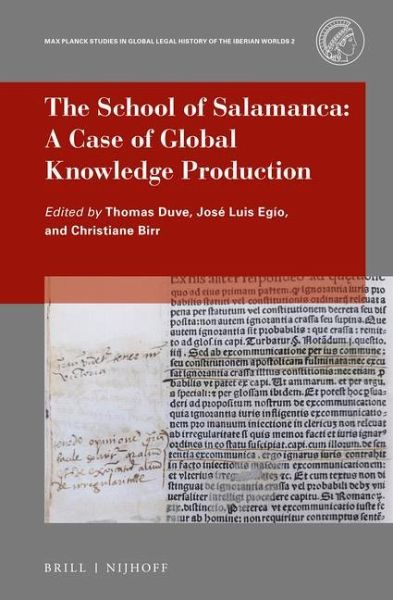
Over the past few decades, a growing number of studies have highlighted the importance of the 'School of Salamanca' for the emergence of colonial normative regimes and the formation of a language of normativity on a global scale. According to this influential account, American and Asian actors usually appear as passive recipients of normative knowledge produced in Europe. This book proposes a different perspective and shows, through a knowledge historical approach and several case studies, that the School of Salamanca has to be considered both an epistemic community and a community of practice that cannot be fixed to any individual place. Instead, the School of Salamanca encompassed a variety of different sites and actors throughout the world and thus represents a case of global knowledge production. Contributors are: Adriana Álvarez, Virginia Aspe, Marya Camacho, Natalie Cobo, Thomas Duve, José Luis Egío, Dolors Folch, Enrique González González, Lidia Lanza, Esteban Llamosas, Osvaldo R. Moutin, and Marco Toste.