23,99 €
inkl. MwSt.
Versandkostenfrei*
Versandfertig in 1-2 Wochen
payback
12 °P sammeln
  • Broschiertes Buch

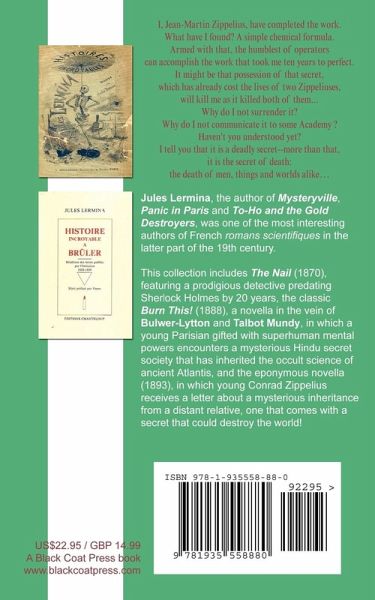
Jules Lermina (1839-1915), the author of Mysteryville, Panic in Paris and To-Ho and the Gold Destroyers, was one of the most interesting authors of French romans scientifiques in the latter part of the 19th century. This collection includes The Nail (1870), featuring a prodigious detective predating Sherlock Holmes by 20 years, the classic Burn This! (1888), a novella in the vein of Bulwer-Lytton and Talbot Mundy, in which a young Parisian gifted with superhuman mental powers encounters a mysterious Hindu secret society that has inherited the occult science of ancient Atlantis, and the…mehr

Produktbeschreibung
Jules Lermina (1839-1915), the author of Mysteryville, Panic in Paris and To-Ho and the Gold Destroyers, was one of the most interesting authors of French romans scientifiques in the latter part of the 19th century. This collection includes The Nail (1870), featuring a prodigious detective predating Sherlock Holmes by 20 years, the classic Burn This! (1888), a novella in the vein of Bulwer-Lytton and Talbot Mundy, in which a young Parisian gifted with superhuman mental powers encounters a mysterious Hindu secret society that has inherited the occult science of ancient Atlantis, and the eponymous novella (1893), in which young Conrad Zippelius receives a letter about a mysterious inheritance from a distant relative, one that comes with a secret that could destroy the world!
Autorenporträt
Jules Lermina was a French novelist, journalist and political activist born on 27 March 1839 in Paris, France. He began his career as a journalist in 1859 and became closely associated with socialist movements of the time. His dedication to these ideals led to several years of imprisonment but also earned him the support of Victor Hugo who admired his commitment. Lermina's early novels appeared under the pseudonym William Cobb allowing him to establish his literary voice while navigating the challenges posed by his political stance. His work as both a writer and activist reflected his deep concern for social justice and human rights. Lermina balanced his passion for storytelling with his engagement in political discourse producing novels essays and journalistic pieces that captured the complexities of the society around him. He continued to write and advocate for change until his death on 23 June 1915 at the age of 76 in Paris France. He was survived by his child Juliette Lermina Flandre leaving behind a lasting literary and political legacy.