
Andere Kunden interessierten sich auch für
 Suicide by Proxy in Early Modern Germany42,99 €
 Suicide by Proxy in Early Modern Germany42,99 €
 Cold Tyranny and the Demonic North of Early Modern England151,99 €
 Empire and Progress in the Victorian Secularist Movement91,99 €
 The Experience of Authority in Early Modern England51,99 €
 The 1549 Rebellions and the Making of Early Modern England111,99 €
 Horses and the Aristocratic Lifestyle in Early Modern England106,99 €





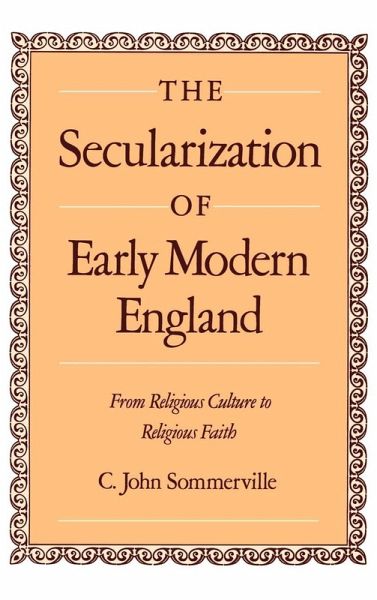
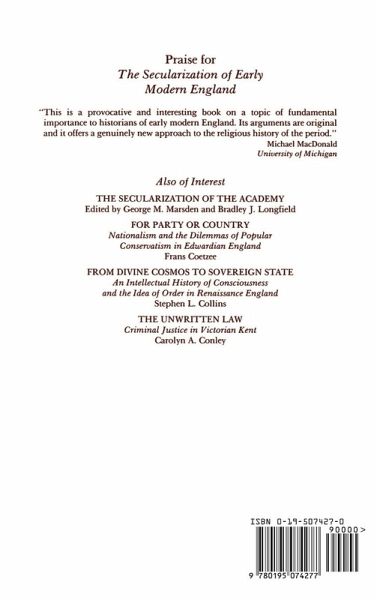
In this provocative work, Sommerville examines the onset of secularization in sixteenth and seventeenth-century England, exploring how and why various aspects of life - art, language, work, play, technology, and power - became divorced from religious values. The work helps modern readers understand what life was like in an age in which religion suffused society and was as basic to thought as the structure of language. Sommerville argues that secularization began earlier in England than many historians believe - even before Henry VIII's seizure of power over the church in the 1530s - and that it advanced in concert with the Protestant Reformation. As more aspects of daily life were divorced from religious values and controls, religious culture was supplanted by religious faith, a reasoned (rather than an unquestioned) belief in the supernatural.
Secularization is a subject of daunting size and is filled with ambiguity. Through the use of insights gained from anthropology and sociology, and by studying an earlier period than is usually considered, this provocative work overcomes the usual obstacles to exploring and explaining why various aspects of life--art, language, work, play, technology, and power--became divorced from religious values in early modern England. Sommerville helps modern readers understand what life was like in an age in which society was suffused with religion and was as basic to thought as the structure of language. Concentrating not only on a decline of religious belief, which is the last aspect of secularization, he shows that a transformation of England's cultural grammar preceded the loosening of belief, and that this was largely accomplished between 1500 and 1700, much earlier than commonly believed. Sommerville asserts that only when definitions of space and time changed, and language and technology were transformed (as well as art and play) could a secular world view be sustained. Demonstrating that the process was more political and theological than economic or social, Sommerville shows that as aspects of daily life became divorced from religious values and controls, religious culture was supplanted by religious faith--a reasoned, rather than an unquestioned, belief in the supernatural. The first large-scale treatment of the history of secularization, The Secularization of Early Modern England will greatly interest students of history, religion, sociology, anthropology, and literature.
Secularization is a subject of daunting size and is filled with ambiguity. Through the use of insights gained from anthropology and sociology, and by studying an earlier period than is usually considered, this provocative work overcomes the usual obstacles to exploring and explaining why various aspects of life--art, language, work, play, technology, and power--became divorced from religious values in early modern England. Sommerville helps modern readers understand what life was like in an age in which society was suffused with religion and was as basic to thought as the structure of language. Concentrating not only on a decline of religious belief, which is the last aspect of secularization, he shows that a transformation of England's cultural grammar preceded the loosening of belief, and that this was largely accomplished between 1500 and 1700, much earlier than commonly believed. Sommerville asserts that only when definitions of space and time changed, and language and technology were transformed (as well as art and play) could a secular world view be sustained. Demonstrating that the process was more political and theological than economic or social, Sommerville shows that as aspects of daily life became divorced from religious values and controls, religious culture was supplanted by religious faith--a reasoned, rather than an unquestioned, belief in the supernatural. The first large-scale treatment of the history of secularization, The Secularization of Early Modern England will greatly interest students of history, religion, sociology, anthropology, and literature.