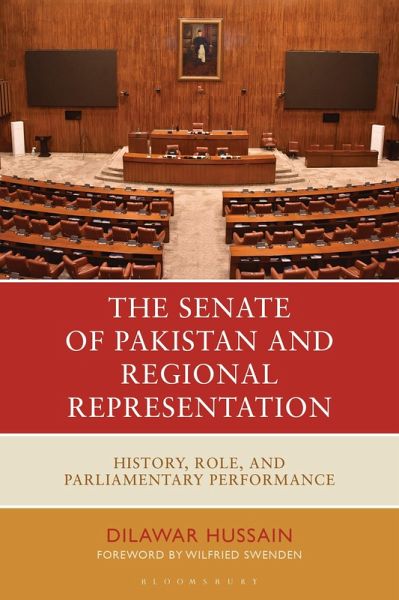
In the first major book on the Senate of Pakistan since its creation in 1973, Dilawar Hussain explores its institutional history, membership, constitutional powers and key functions and how these have changed since the introduction of the Eighteenth Constitutional Amendment in 2010. This book provides empirical flesh to the assumption that, in a federal state, a second chamber is needed to accommodate regional concerns at a federal level. The author explores the institutional history of the Pakistani Senate through its composition, constitutional powers, and key functions as a regional chamber…mehr
In the first major book on the Senate of Pakistan since its creation in 1973, Dilawar Hussain explores its institutional history, membership, constitutional powers and key functions and how these have changed since the introduction of the Eighteenth Constitutional Amendment in 2010. This book provides empirical flesh to the assumption that, in a federal state, a second chamber is needed to accommodate regional concerns at a federal level. The author explores the institutional history of the Pakistani Senate through its composition, constitutional powers, and key functions as a regional chamber and explains the broader institutional environment in which it operates. This book analyses the impact of the Pakistani Senate as an overseer of federal policies and legislation of the federal government and appraises the parliamentary performance of the senators in advancing concerns of the provinces at the federal level. It also argues that the parliamentary nature of the Pakistani federation has strengthened the executive branch in which the Pakistani Senate operates, and has thus undermined its role as a regional chamber. Within a historical and comparative context, the book provides insight into the Senate's 'political legitimacy' and options for its institutional reforms. Additionally, through the exploration of bicameralism internationally, the book offers a conceptual framework for assessing the institutional strength, institutional design and parliamentary performance of the political institutions. This theoretical, methodological and empirical study is a major contribution to the empirical study of parliamentary behavior and the changing nature of political representation in Pakistan and beyond.
Dilawar Hussain, PhD in Legislative Studies, currently works as a Parliamentary and Constitutional Development Professional. He teaches Comparative Federalism and Bicameralism; Governance and Democracy, and Comparative Politics and Governments-Parliaments and Political Institutions- at Quaid-i-Azam University, and the National University of Modern Languages, Islamabad, Pakistan. . Previously, he worked as a Research Fellow at the School of Social and Political Science at the University of Edinburgh, Scotland and the House of Lords.
Inhaltsangabe
List of Figures List of Tables Foreword by Wilfried Swenden Acknowledgments List of Abbreviations Introduction 1. Role of Federal Second Chamber as a Chamber of Regions: A Conceptual Framework 2. Institutional Rationale and Design: Role of the Senate of Pakistan as a Chamber of Regions 3. Institutional Strength and Capacity: Constitutional Powers of the Senate of Pakistan 4. Bicameral Incongruence: Compositional Distinctiveness of the Senate of Pakistan 5. Non-Legislative Policy Work of the Senate of Pakistan: Empirical Evidence and Appraisal 6. Legislative Policy Work of the Senate of Pakistan: Empirical Evidence and Appraisal Conclusion and Recommendations Epilogue: The Contemporary Senate of Pakistan Annex I: Constitution-Making Process and Creation of the Senate of Pakistan: A Chronology, 1971-1973 Annex II: Members of the Constitution Committee, 1972 Annex III: Province/Territory-wise List of the Members of First Senate Elected in August 1973 Annex IV: The Eighteenth Constitutional Amendment of 2010: Extended Role of the Senate of Pakistan Bibliography Index
List of Figures List of Tables Foreword by Wilfried Swenden Acknowledgments List of Abbreviations Introduction 1. Role of Federal Second Chamber as a Chamber of Regions: A Conceptual Framework 2. Institutional Rationale and Design: Role of the Senate of Pakistan as a Chamber of Regions 3. Institutional Strength and Capacity: Constitutional Powers of the Senate of Pakistan 4. Bicameral Incongruence: Compositional Distinctiveness of the Senate of Pakistan 5. Non-Legislative Policy Work of the Senate of Pakistan: Empirical Evidence and Appraisal 6. Legislative Policy Work of the Senate of Pakistan: Empirical Evidence and Appraisal Conclusion and Recommendations Epilogue: The Contemporary Senate of Pakistan Annex I: Constitution-Making Process and Creation of the Senate of Pakistan: A Chronology, 1971-1973 Annex II: Members of the Constitution Committee, 1972 Annex III: Province/Territory-wise List of the Members of First Senate Elected in August 1973 Annex IV: The Eighteenth Constitutional Amendment of 2010: Extended Role of the Senate of Pakistan Bibliography Index
Es gelten unsere Allgemeinen Geschäftsbedingungen: www.buecher.de/agb
Impressum
www.buecher.de ist ein Internetauftritt der buecher.de internetstores GmbH
Geschäftsführung: Monica Sawhney | Roland Kölbl | Günter Hilger
Sitz der Gesellschaft: Batheyer Straße 115 - 117, 58099 Hagen
Postanschrift: Bürgermeister-Wegele-Str. 12, 86167 Augsburg
Amtsgericht Hagen HRB 13257
Steuernummer: 321/5800/1497
USt-IdNr: DE450055826