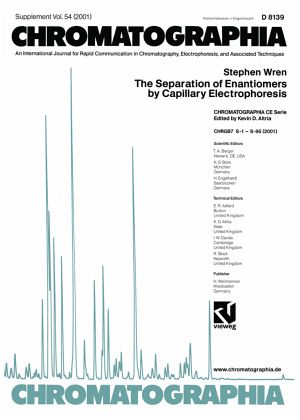
Stephen Wren
The Separation of Enantiomers by Capillary Electrophoresis
Stephen Wren
The Separation of Enantiomers by Capillary Electrophoresis
- Broschiertes Buch
- Merkliste
- Auf die Merkliste
- Bewerten Bewerten
- Teilen
- Produkt teilen
- Produkterinnerung
- Produkterinnerung
This book gives a comprehensive overview on the principles of physical and mathematical modelling of enantiomer separation by CE. Method development strategies are shown and cyclodextrins as a popular group of chiral selectors as well as some other selectors used as buffer additives for enantiomer separation in free solution are described.
Andere Kunden interessierten sich auch für
Aran PaulusAnalysis of Carbohydrates by Capillary Electrophoresis38,99 €
Wim KokCapillary Electrophoresis: Instrumentation and Operation38,99 €
Heinz EngelhardtCapillary Electrophoresis38,99 €
Kevin D. AltriaAnalysis of Pharmaceuticals by Capillary Electrophoresis76,99 €
Analysis of Nucleic Acids by Capillary Electrophoresis76,99 €
Carbohydrate Analysis by Modern Liquid Phase Separation Techniques244,99 €
Progress in Filtration and Separation119,99 €-
-
-
This book gives a comprehensive overview on the principles of physical and mathematical modelling of enantiomer separation by CE. Method development strategies are shown and cyclodextrins as a popular group of chiral selectors as well as some other selectors used as buffer additives for enantiomer separation in free solution are described.
Produktdetails
- Produktdetails
- CHROMATOGRAPHIA CE-Series 6
- Verlag: Vieweg+Teubner / Vieweg+Teubner Verlag
- Artikelnr. des Verlages: 978-3-322-83143-9
- Softcover reprint of the original 1st ed. 2001
- Seitenzahl: 96
- Erscheinungstermin: 15. August 2012
- Englisch
- Abmessung: 297mm x 210mm x 6mm
- Gewicht: 274g
- ISBN-13: 9783322831439
- ISBN-10: 3322831434
- Artikelnr.: 39157789
- Herstellerkennzeichnung
- Vieweg+Teubner Verlag
- Abraham-Lincoln-Straße 46
- 65189 Wiesbaden
- ProductSafety@springernature.com
- CHROMATOGRAPHIA CE-Series 6
- Verlag: Vieweg+Teubner / Vieweg+Teubner Verlag
- Artikelnr. des Verlages: 978-3-322-83143-9
- Softcover reprint of the original 1st ed. 2001
- Seitenzahl: 96
- Erscheinungstermin: 15. August 2012
- Englisch
- Abmessung: 297mm x 210mm x 6mm
- Gewicht: 274g
- ISBN-13: 9783322831439
- ISBN-10: 3322831434
- Artikelnr.: 39157789
- Herstellerkennzeichnung
- Vieweg+Teubner Verlag
- Abraham-Lincoln-Straße 46
- 65189 Wiesbaden
- ProductSafety@springernature.com
The author is a development scientist in pharmaceutical and analytical research and development at AstraZeneca in Macclesfield. He has a general interest in separation science and has been active for a number of years in the field of research into the principles and application capillary electrophoresis in pharmaceutical analysis.
Supplement Vol. 54, 2001.- 1 Enantiomers and Separation.- 1.1 Introduction.- 1.2 Enantiomers and Living Organisms.- 1.3 The Separation of Enantiomers.- 1.4 Electrophoretic Separation of Enantiomers.- 1.5 Enantiomer Separations by Capillary Electrophoresis.- 1.6 Conclusion.- 2 The Principles of Separation in CE.- 2.1 Introduction: Movement and Separation.- 2.2 Separative and Non-Separative Transport in CE.- 2.3 Electrophoretic Mobility.- 2.4 Electroosmotic Mobility.- 2.5 CE Instrumentation.- 2.6 Conclusion.- 3 Modelling Enantiomer Separation by CE.- 3.1 The Use of Models.- 3.2 Background.- 3.3 The Physical Model.- 3.4 A Basic Mathematical Model.- 3.5 Extended Theoretical Models.- 3.6 Conclusion.- 4 Method Development Strategies.- 4.1 The Purpose of the Method.- 4.2 Factors Controlling Resolution.- 4.3 The Structure of the Analyte.- 4.4 The Choice of Chiral Selector.- 4.5 Other Separation Conditions.- 4.6 Optimisation Approaches.- 4.7 Validation.- 4.8 Computer Simulations.- 4.9 Conclusion.- 5 The Use of Cyclodextrins as Chiral Selectors.- 5.1 Introduction.- 5.2 Structure and Properties.- 5.3 Cyclodextrin Production.- 5.4 Complexation Mechanisms.- 5.5 Cyclodextrin Classes.- 5.6 Analyte Classes.- 5.7 Analyte Structure.- 5.8 Batch and Source Variation.- 5.9 Conclusion.- 6 Other Chiral Selectors.- 6.1 Introduction.- 6.2 Ligand Exchange Selectors.- 6.3 Chiral Surfactants.- 6.4 Alkaloids.- 6.5 Crown Ethers.- 6.6 Natural Macromolecules.- 6.7 Non-Aqueous CE.- 6.8 Derivatisation.- 6.9 Capillary Electrochromatography.- 6.10 Conclusion.