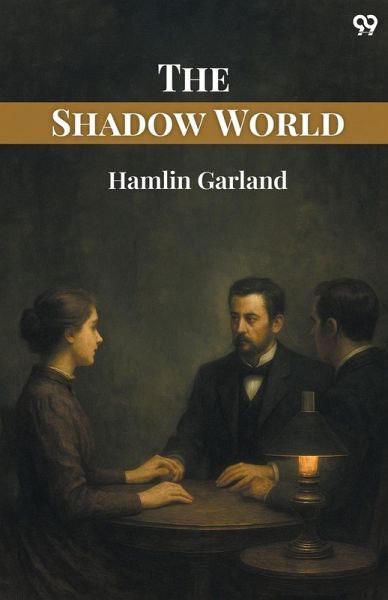
The shadow world examines the collision between rational inquiry and supernatural possibility through the lens of early 20th century spiritualism. The story focuses on a group of intellectuals who gather to test the boundaries of science and perception, using s ances and psychic investigations to probe what lies beyond accepted understanding. Rather than adopting a purely sensational tone, the novel builds its tension through philosophical debates and personal testimonies, highlighting the friction between skepticism and belief. At its core, the narrative contemplates whether the unseen can be…mehr
The shadow world examines the collision between rational inquiry and supernatural possibility through the lens of early 20th century spiritualism. The story focuses on a group of intellectuals who gather to test the boundaries of science and perception, using s ances and psychic investigations to probe what lies beyond accepted understanding. Rather than adopting a purely sensational tone, the novel builds its tension through philosophical debates and personal testimonies, highlighting the friction between skepticism and belief. At its core, the narrative contemplates whether the unseen can be approached through method and reason or if it remains forever beyond comprehension. The characters discussions mirror a cultural moment when interest in the occult was growing among the educated, driven by a desire to reconcile faith with empiricism. The protagonist, with ties to psychical research societies, embodies this tension, guiding others into the realm of the unknown while navigating doubt himself. The shadow world constructs an environment of eerie possibility, inviting the reader to question where truth ends and speculation begins.
Hannibal Hamlin Garland was an American novelist, poet, essayist, short story author, Georgist, and psychical researcher. He is best known for his fiction about hardworking Midwestern farmers. Hannibal Hamlin Garland was born on a farm near West Salem, Wisconsin, on September 14, 1860, as the second of four children of Richard Garland of Maine and Charlotte Isabelle McClintock. The boy was named after Abraham Lincoln's vice president, Hannibal Hamlin. He grew up on numerous Midwestern farms before relocating to Boston, Massachusetts, in 1884 to pursue a writing career. He read diligently at the Boston Public Library. There he grew infatuated with Henry George's views and the Single Tax Movement. George's beliefs influenced several of his writings, including Main-Travelled Roads (1891), Prairie Folks (1892), and his novel Jason Edwards (1892). Main-Travelled Roads was his first big hit. It was a compilation of short stories inspired by his time on the farm. He serialized a biography of Ulysses S. Grant in McClure's Magazine before turning it into a book in 1898. The same year, Garland visited the Yukon to observe the Klondike Gold Rush, which inspired The Trail of the Gold Seekers (1899).
Es gelten unsere Allgemeinen Geschäftsbedingungen: www.buecher.de/agb
Impressum
www.buecher.de ist ein Internetauftritt der buecher.de internetstores GmbH
Geschäftsführung: Monica Sawhney | Roland Kölbl | Günter Hilger
Sitz der Gesellschaft: Batheyer Straße 115 - 117, 58099 Hagen
Postanschrift: Bürgermeister-Wegele-Str. 12, 86167 Augsburg
Amtsgericht Hagen HRB 13257
Steuernummer: 321/5800/1497
USt-IdNr: DE450055826