25,99 €
inkl. MwSt.
Versandkostenfrei*Erscheint vorauss. 17. März 2026
Melden Sie sich
hier
hier
für den Produktalarm an, um über die Verfügbarkeit des Produkts informiert zu werden.

13 °P sammeln
Andere Kunden interessierten sich auch für
 Where the Dreams Cross: T.S. Eliot and French Poetry19,99 €
 Sentimental Narrative and the Social Order in France, 1760 182044,99 €
 The Object of Literature42,99 €
 The Contemporary French Writers20,99 €
 French Fiction in the Mitterrand Years41,99 €
 The French Romanticists32,99 €
 The Travels Of Sir John Mandeville16,99 €




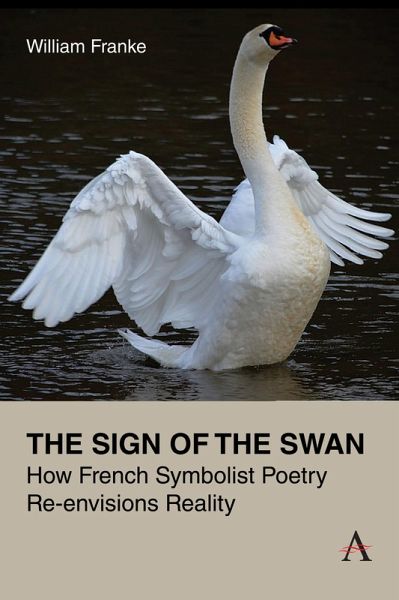
Offers a fresh interpretation of French Symbolist poetics, showing how Mallarmé, Baudelaire, and Rimbaud used visionary, transformative language to challenge modern secular perceptions of reality and reveal the enduring power of poetry. Despite intensive scholarly activity around its various protagonists, there is surprisingly little comprehensive attempt at critical interpretation in English of the French symbolist movement and its far-reaching purport. Most contemporary works on the topic take the form of anthologies of poetry and theory. The turn to religion, moreover, in recent decades ("post-secular" times) has opened new perspectives developed especially by Bertrand Marchal and his satellites in France, but to date without much echo in the English-speaking world. The Sign of the Swan stands out as an ambitious attempt to interpret the profound spiritual revolution wrought by this poetry in a religiously visionary key rather than as simply consonant with the general secularizing trend of art in modern times. Historically, symbolism presents itself when a need to open up other channels of meaning besides those recognized by scientific positivism comes to be strongly felt at various stages of the industrial revolution. Thus, symbolist meaning defines itself against denotative, scientific, pragmatic meaning in language. And yet an indescribable, literal rootedness of language in physiological fact is acknowledged by Mallarmé as a disappearing source of poetic creation. This irrecoverable origin can be compensated for and reconstructed by the productions of fantasy. Paradoxically, Mallarmé's poetry exalts the pure idea and at the same time the concrete materiality of language. This book explains how this coincidence of opposites is possible. The emptiness of language resulting from its merely representing an absent object, what we may term its objective emptiness, makes it open to every sort of subjective in-pouring of contents to fill it out. What is missing on the objective side constitutes an opportunity for investment on the subjective side. It is not surprising that the symbolists discovered one of their richest symbols in the "cygne"-which not only means "swan," but also homophonically says "sign" ("signe"). This word in French symbolist poetry, starting with Baudelaire and Mallarmé, intimates the transfiguration of the pure, blank linguistic sign, "white" like the swan, into an inexhaustible plethora of associations to be made by individuals and their subjective fantasies. The "symbol" thus becomes itself a source of perceptions, a verbal unity containing a universe.