Social capital--the resources and goodwill of network contacts--can be activated to enhance employees' performance, leadership effectiveness, careers, and overall organizational functioning. Despite years of research highlighting networks' role in addressing business challenges, organizational solutions still overwhelmingly focus on enhancing individual knowledge and skills or changing formal organizational structures and processes. Shifts in the business environment make adding a social capital lens to the historical human capital lens no longer just 'nice to do' but an imperative. Employees…mehr
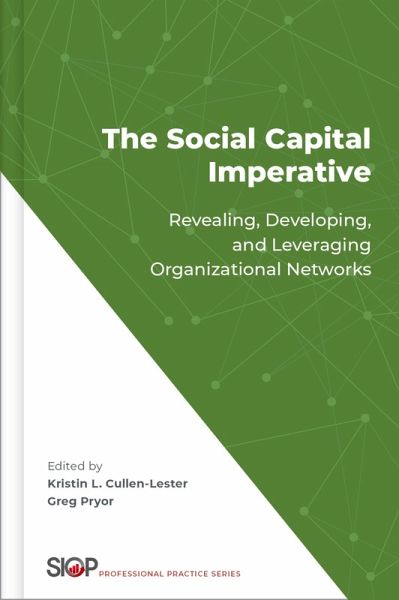
Social capital--the resources and goodwill of network contacts--can be activated to enhance employees' performance, leadership effectiveness, careers, and overall organizational functioning. Despite years of research highlighting networks' role in addressing business challenges, organizational solutions still overwhelmingly focus on enhancing individual knowledge and skills or changing formal organizational structures and processes. Shifts in the business environment make adding a social capital lens to the historical human capital lens no longer just 'nice to do' but an imperative. Employees and organizations will benefit from carefully considering network connections and intentional efforts to foster their development and use. By prioritizing intentional connections, organizations can create a virtuous cycle of opportunities and prevent a vicious cycle of overwhelm. This book guides practitioners in revealing novel insights using network analysis and creating impact by developing and leveraging organizational networks. The opening section provides readers with a strong foundation in network science. The remainder of the book includes review chapters and case studies in strategic application areas. Review chapter authors provide readers with a strong scientific grounding explaining why networks are important for each application area and the likely implications of revealing, developing, and leveraging networks. Case authors provide inspiration and opportunities to learn from their real-life experiences, sharing challenges faced, actions taken, and lessons learned from applying network science within organizations. This book aims to provide clearer links between insights, actions, and outcomes practitioners can expect when revealing, developing, and leveraging organizational networks, demonstrating the powerful perspective that a social capital lens adds.
Kristin Cullen-Lester is an Associate Professor of Management at the University of Mississippi and co-founder of Network Leader. She earned her Ph.D. in industrial-organizational psychology from Auburn University and previously worked as a senior research scientist at the Center for Creative Leadership. Kristin's research examines the impact of professional networks on workplace effectiveness, career success, well-being, and large-scale strategic change. Her research has been funded by the National Science Foundation and published in top academic journals. Kristin has won numerous awards, including the 2021 Award for Distinguished Early Career Contributions to Practice from the Society for Industrial and Organizational Psychology. Greg Pryor is a talent management leader and co-founder of the Connected Commons, a social network science research community. Greg's HBR article, How to Succeed in a New Role, was selected as one of 2023 ten definitive management ideas. Greg served as Senior Vice President and People & Performance Evangelist at Workday, where the Great Place to Work Institute recognized him as Innovator of the Year. Greg served as Juniper Networks' Vice President of Talent, Head of Talent Management for Merrill Lynch's Global Technology and Operations function, and was a Partner in Accenture's Human Performance Practice.
Inhaltsangabe
* Foreword * List of Contributors * Part l Opening * 1: Kristin L. Cullen-Lester;Greg Pryor: The Social Capital Imperative * Part II Network Foundations * 2: Cécile Emery;Daniel S. Halgin;Zexi (Flavia) Li;Xiwen Zhao: Essential Concepts and Measures in Organizational Network Analysis * 3: Scott Hines: Conducting Network Analysis to Deliver Organizational Insights * 4: Nicolas Petit: Tips and Traps When Conducting Network Analysis in Practice * Part III Workforce Well-Being * 5: Michelle Mahdon;Alexandra Gerbasi: The Influence of Networks on Workers' Well-Being * 6: Cody Martin;Michael Hoffman;Clint Kofford: Mitigating Collaboration Overload to Improve Workforce Well-Being at Johnson and Johnson * Part IV Career Management * 7: Caitlin M. Porter;Ashley H. Pearson: Networks as a Source of Competitive Career Advantage * 8: Donna Chrobot-Mason;Ali O'Malley: Combining Networks and Coaching to Spur Professional Development and Change * 9: Deb Zehner;Greg Pryor: Accelerating New Hire Networks * Part V Human Resources * 10: Patrick Downes: Advancing Human Resources Practice by Adopting a Social Network Perspective * 11: Phil Willburn;Curtis Hampton: How Workday Scaled and Sustained a Culture of Connection * 12: Andras Vicsek: Bridging Cultures Through Influencers in Postacquisition Integration * Part VI Creativity and Innovation * 13: Travis J. Grosser;Ziyue Cui: Network Drivers of Employee Innovation * 14: Michael Arena: Strategies for Creating Adaptive Space to Support Innovation at General Motors * Part VII Teams and Team Systems * 15: Cynthia Maupin;Semin Park: Managing Internal and External Networks for Team Effectiveness * 16: Victor Bilgen;Chris Gideon;Neha Parikh Shah: Strategically Building Network Connections Across Geographic Markets to Improve Sales Agility and Enhance Organizational Growth * 17: Lauren Blackwell Landon: Emergency Response Coordination in Space * PART VIII Knowledge Sharing * 18: Andrew Parker;Julia Brennecke: Knowledge Networks in Organizations * 19: Katelyn Cavanaugh;Eric Middleton;Matthew Berkheiser: Removing Knowledge-Sharing Barriers at the University of Texas MD Anderson Cancer Center * PART IX Organizational Change and Transformation * 20: James M. Vardaman;Feigu Zhou: Social Networks and Organizational Change Implementation * 21: Hemerson Paes: How Roche Pharma International Unlocked Cross-Boundary Collaboration at Scale * 22: Theresa Floyd;Giuseppe (Joe) Labianca;Brad Patrick: Crowdsourcing Organizational Structure Through Social Network Analysis * Part X Leadership Effectiveness * 23: Caton Weinberger;Laura Bauer;Dorothy Carter: The Role of Networks in Leadership Effectiveness * 24: Michael Campbell: Designing the Science of Networks into Leadership Development at Workday * Part XI Diversity, Equity, and Inclusion * 25: Juan Du;Meredith Woehler;Kristin L. Cullen-Lester: Engaging Employee Networks to Promote Workforce Diversity and Inclusion * 26: Patrick Decker-Tonnesen;Deb Zehner;Anjali Bhagra: Mayo Clinic's Exploration of Barriers to Women in Leadership * Part XII Closing * 27: Greg Pryor;Kristin L. Cullen-Lester: How to Reveal, Develop, and Leverage Networks for Greater Impact * Index
* Foreword * List of Contributors * Part l Opening * 1: Kristin L. Cullen-Lester;Greg Pryor: The Social Capital Imperative * Part II Network Foundations * 2: Cécile Emery;Daniel S. Halgin;Zexi (Flavia) Li;Xiwen Zhao: Essential Concepts and Measures in Organizational Network Analysis * 3: Scott Hines: Conducting Network Analysis to Deliver Organizational Insights * 4: Nicolas Petit: Tips and Traps When Conducting Network Analysis in Practice * Part III Workforce Well-Being * 5: Michelle Mahdon;Alexandra Gerbasi: The Influence of Networks on Workers' Well-Being * 6: Cody Martin;Michael Hoffman;Clint Kofford: Mitigating Collaboration Overload to Improve Workforce Well-Being at Johnson and Johnson * Part IV Career Management * 7: Caitlin M. Porter;Ashley H. Pearson: Networks as a Source of Competitive Career Advantage * 8: Donna Chrobot-Mason;Ali O'Malley: Combining Networks and Coaching to Spur Professional Development and Change * 9: Deb Zehner;Greg Pryor: Accelerating New Hire Networks * Part V Human Resources * 10: Patrick Downes: Advancing Human Resources Practice by Adopting a Social Network Perspective * 11: Phil Willburn;Curtis Hampton: How Workday Scaled and Sustained a Culture of Connection * 12: Andras Vicsek: Bridging Cultures Through Influencers in Postacquisition Integration * Part VI Creativity and Innovation * 13: Travis J. Grosser;Ziyue Cui: Network Drivers of Employee Innovation * 14: Michael Arena: Strategies for Creating Adaptive Space to Support Innovation at General Motors * Part VII Teams and Team Systems * 15: Cynthia Maupin;Semin Park: Managing Internal and External Networks for Team Effectiveness * 16: Victor Bilgen;Chris Gideon;Neha Parikh Shah: Strategically Building Network Connections Across Geographic Markets to Improve Sales Agility and Enhance Organizational Growth * 17: Lauren Blackwell Landon: Emergency Response Coordination in Space * PART VIII Knowledge Sharing * 18: Andrew Parker;Julia Brennecke: Knowledge Networks in Organizations * 19: Katelyn Cavanaugh;Eric Middleton;Matthew Berkheiser: Removing Knowledge-Sharing Barriers at the University of Texas MD Anderson Cancer Center * PART IX Organizational Change and Transformation * 20: James M. Vardaman;Feigu Zhou: Social Networks and Organizational Change Implementation * 21: Hemerson Paes: How Roche Pharma International Unlocked Cross-Boundary Collaboration at Scale * 22: Theresa Floyd;Giuseppe (Joe) Labianca;Brad Patrick: Crowdsourcing Organizational Structure Through Social Network Analysis * Part X Leadership Effectiveness * 23: Caton Weinberger;Laura Bauer;Dorothy Carter: The Role of Networks in Leadership Effectiveness * 24: Michael Campbell: Designing the Science of Networks into Leadership Development at Workday * Part XI Diversity, Equity, and Inclusion * 25: Juan Du;Meredith Woehler;Kristin L. Cullen-Lester: Engaging Employee Networks to Promote Workforce Diversity and Inclusion * 26: Patrick Decker-Tonnesen;Deb Zehner;Anjali Bhagra: Mayo Clinic's Exploration of Barriers to Women in Leadership * Part XII Closing * 27: Greg Pryor;Kristin L. Cullen-Lester: How to Reveal, Develop, and Leverage Networks for Greater Impact * Index
Es gelten unsere Allgemeinen Geschäftsbedingungen: www.buecher.de/agb
Impressum
www.buecher.de ist ein Internetauftritt der buecher.de internetstores GmbH
Geschäftsführung: Monica Sawhney | Roland Kölbl | Günter Hilger
Sitz der Gesellschaft: Batheyer Straße 115 - 117, 58099 Hagen
Postanschrift: Bürgermeister-Wegele-Str. 12, 86167 Augsburg
Amtsgericht Hagen HRB 13257
Steuernummer: 321/5800/1497
USt-IdNr: DE450055826