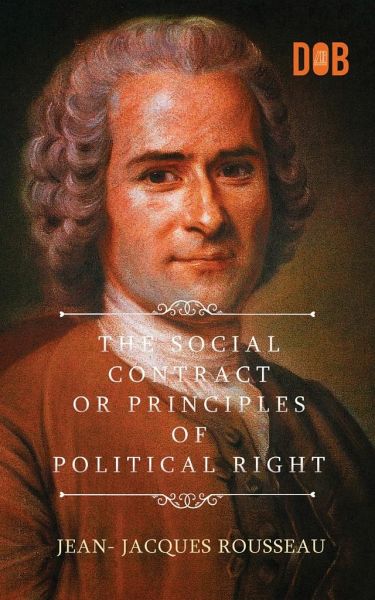
The Social Contract, originally published as On the Social Contract; or, Principles of Political Right (French: Du contrat social; ou Principes du droit politique) is a 1762 French-language book by the Genevan philosopher Jean-Jacques Rousseau. Arguing that all government is fundamentally flawed, and that modern society is based on a system that fosters inequality and servitude, Rousseau demands nothing less than a complete revision of the social contract to ensure equality and freedom.Noting that government derives its authority by the people's willing consent (rather than the authorization…mehr
The Social Contract, originally published as On the Social Contract; or, Principles of Political Right (French: Du contrat social; ou Principes du droit politique) is a 1762 French-language book by the Genevan philosopher Jean-Jacques Rousseau. Arguing that all government is fundamentally flawed, and that modern society is based on a system that fosters inequality and servitude, Rousseau demands nothing less than a complete revision of the social contract to ensure equality and freedom.Noting that government derives its authority by the people's willing consent (rather than the authorization of God), Rousseau posits that a good government can justify its need for individual compromises, rewarding its citizens with "civil liberty and the proprietorship of all he possesses." A milestone of political science, these essays introduced the inflammatory ideas that led to the chaos of the French Revolution, and are considered essential reading for students of history, philosophy, and other social sciences. The Social Contract helped inspire political reforms or revolutions in Europe, especially in France.
Jean-Jacques Rousseau, born on June 28, 1712, in Geneva, was a philosopher, writer, and composer who shaped Enlightenment thought and modern political theory. Raised by his father and aunt after his mother's death, Rousseau's early life was marked by wanderings and diverse experiences. At 15, he left Geneva, converted to Catholicism, and worked various jobs while exploring his intellectual interests.In Paris, Rousseau befriended Denis Diderot and contributed to the Encyclopédie, gaining recognition with his 1750 essay, Discourse on the Arts and Sciences. He argued that advancements in the arts and sciences had led to moral decay, introducing his critical stance on societal progress. His later works, including The Social Contract and Discourse on Inequality, challenged traditional authority and championed the idea of popular sovereignty.Rousseau's novel Émile presented groundbreaking views on education, emphasizing natural development and experiential learning. His radical ideas often brought him into conflict with authorities, resulting in bans and exile. Despite these challenges, Rousseau's philosophy inspired the French Revolution and continues to influence modern political and educational thought.
Es gelten unsere Allgemeinen Geschäftsbedingungen: www.buecher.de/agb
Impressum
www.buecher.de ist ein Internetauftritt der buecher.de internetstores GmbH
Geschäftsführung: Monica Sawhney | Roland Kölbl | Günter Hilger
Sitz der Gesellschaft: Batheyer Straße 115 - 117, 58099 Hagen
Postanschrift: Bürgermeister-Wegele-Str. 12, 86167 Augsburg
Amtsgericht Hagen HRB 13257
Steuernummer: 321/5800/1497
USt-IdNr: DE450055826