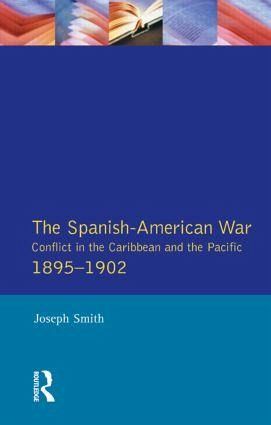
Fought in both Caribbean and Pacific and turning on America's superior naval strength, this short but decisive war had momentous consequences internationally. It ended Spain's imperial power, and the US emerged for the first time as an active force in world affairs, acquiring -- amidst much domestic controversy -- an empire of her own in the Philippines, Guam, Puerto Rico, and Cuba (whose struggle against Spain had sparked the war). Heavy with implications for twentieth-century America, the war is explored in its widest context in this engrossing and impressive study.
Fought in both Caribbean and Pacific and turning on America's superior naval strength, this short but decisive war had momentous consequences internationally. It ended Spain's imperial power, and the US emerged for the first time as an active force in world affairs, acquiring -- amidst much domestic controversy -- an empire of her own in the Philippines, Guam, Puerto Rico, and Cuba (whose struggle against Spain had sparked the war). Heavy with implications for twentieth-century America, the war is explored in its widest context in this engrossing and impressive study.
Joseph Smith Jr. (December 23, 1805 - June 27, 1844) was a religious leader in the United States who founded Mormonism and the Latter Day Saint movement. By the time Smith died fourteen years later, he had garnered tens of thousands of adherents after publishing the Book of Mormon at the age of 24. The religion he founded is still practiced today, with millions of followers worldwide and various churches claiming Smith as their founder, the largest of which is the Church of Jesus Christ of Latter-day Saints (LDS Church). Smith was born in Sharon, Vermont, and relocated to the western portion of New York State with his family after a series of crop failures in 1816. Smith claimed seeing a series of visions while living in an area of great religious revivalism during the Second Great Awakening. The first of these occurred in 1820, when he saw "two personages" (later identified as God the Father and Jesus Christ). In 1823, he said an angel appeared to him and lead him to a buried book of golden plates containing a Judeo-Christian history of an ancient American society. Smith released the Book of Mormon in 1830, describing it as an English translation of those plates.
Inhaltsangabe
Chapter 1 The Spanish-Cuban War (1895âEUR"98) Chapter 2 American Intervention Chapter 3 Military Preparedness Chapter 4 The War at Sea Chapter 5 The American Expeditionary Force Chapter 6 The Battle for Santiago De Cuba Chapter 7 Winding Down the War Chapter 8 Peace Chapter 9 The Aftermath
Chapter 1 The Spanish-Cuban War (1895âEUR"98) Chapter 2 American Intervention Chapter 3 Military Preparedness Chapter 4 The War at Sea Chapter 5 The American Expeditionary Force Chapter 6 The Battle for Santiago De Cuba Chapter 7 Winding Down the War Chapter 8 Peace Chapter 9 The Aftermath
Es gelten unsere Allgemeinen Geschäftsbedingungen: www.buecher.de/agb
Impressum
www.buecher.de ist ein Internetauftritt der buecher.de internetstores GmbH
Geschäftsführung: Monica Sawhney | Roland Kölbl | Günter Hilger
Sitz der Gesellschaft: Batheyer Straße 115 - 117, 58099 Hagen
Postanschrift: Bürgermeister-Wegele-Str. 12, 86167 Augsburg
Amtsgericht Hagen HRB 13257
Steuernummer: 321/5800/1497
USt-IdNr: DE450055826