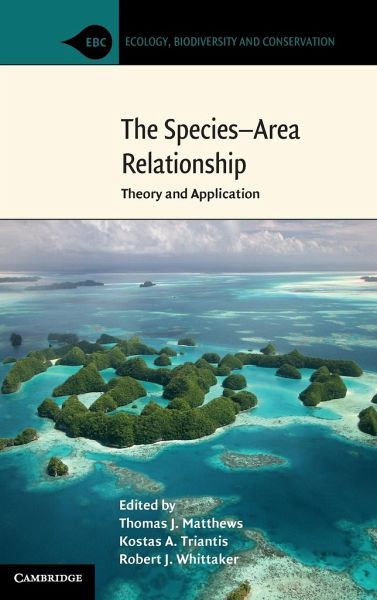
The Species-Area Relationship
Herausgeber: Matthews, Thomas J.; Whittaker, Robert J.; Triantis, Kostas A.
The Species-Area Relationship
Herausgeber: Matthews, Thomas J.; Whittaker, Robert J.; Triantis, Kostas A.
- Gebundenes Buch
Andere Kunden interessierten sich auch für
The Flora of the Palouse Region. Containing Descriptions of all the Spermatophytes and Pteridophytes Known to Grow Wild in the Area Within 35 Kilomete30,99 €
Bevin J KeenAn Analysis of the Relationship Between Environmental Management and Environmental Compliance at Marine Corps Installations28,99 €
Mountain Area Research and Management167,99 €
The Everglades Agricultural Area61,99 €
Land Use and the Carbon Cycle144,99 €
Richard S. K. BarnesThe Brackish-Water Fauna of Northwestern Europe146,99 €
Invasive Species119,99 €-
-
-
Produktdetails
- Verlag: Cambridge University Press
- Seitenzahl: 502
- Erscheinungstermin: 7. April 2021
- Englisch
- Abmessung: 235mm x 157mm x 31mm
- Gewicht: 871g
- ISBN-13: 9781108477079
- ISBN-10: 1108477070
- Artikelnr.: 59982768
- Herstellerkennzeichnung
- Libri GmbH
- Europaallee 1
- 36244 Bad Hersfeld
- gpsr@libri.de
Foreword Mark V. Lomolino; 1. The species-area relationship: both general
and protean? Thomas J. Matthews, Kostas A. Triantis and Robert J.
Whittaker; 2. The History of the Species-Area Relationship Even Tjørve,
Thomas J. Matthews and Robert J. Whittaker; 3. The multiple forms and
functions of species-area relationship Thomas Matthews, François Rigal,
Konstantinos Proios, Kostas Triantis and Robert J. Whittaker; 4. The
factors that underpin the shape of the SAR curve Even Tjørve, Kathleen
Tjørve , Eva izlingová and Arnost izling; 5. Functional and phylogenetic
diversity-area relationships: a review Florent Mazel and Wilfried Thuiller;
6. Species-area relationships in alien species: pattern and process Tim
Blackburn, Phil Cassey and Petr Pysek; 7. Mathematical expressions for the
species-area relationship (SAR) and (the hidden) assumptions behind the
models Even Tjørve and Kathleen Tjørve; 8. Biodiversity scaling on a
continuous plane: geometrical underpinnings of the nested species-area
relationship David Storch and Arnost izling; 9. Upscaling SARs and the
connection with species abundances Luis Borda-de-Agua, Saeid Alirezazadeh,
Manuela Neves, Stephen P. Hubbell, Paulo Borges, Pedro Cardoso, Francisco
Dionísio and Henrique M. Pereira; 10. The SAR: Is It "Produced by Laws
Acting around Us"? John Harte; 11. The species-area relationships of
ecological neutral theory James Rosindell and Ryan Chisholm; 12. The
integration of the species-area relationship with mechanistic community
ecological theory Robert Holt, Dominique Gravel, Adrian Stier and James
Rosindell; 13. The identification biodiversity hotspots using the
species-area relationship Simone Fattorini; 14. Using the species-area
relationship to predict extinctions resulting from habitat loss Simone
Fattorini, Werner Ulrich and Thomas J. Matthews; 15. Using network analysis
and diversity partitioning to examine the temporal dynamics of the
species-area relationship Joseph Veech and Giovanni Strona; 16. Does
Geometry dominate extinction due to habitat loss? Athanasios Kallimanis and
John Halley; 17. External modulators of species-area relationships Isabel
Jones, Carlos Peres, Maíra Benchimol, Anderson S. Bueno, Danielle
Storck-Tonon and Ana Filipa Palmeirim; 18. Applied SARs in marine systems
and fisheries Karl Ugland and Alexandra Kraberg; 19. Conclusions and future
Directions in SAR Research Kostas A. Triantis.

and protean? Thomas J. Matthews, Kostas A. Triantis and Robert J.
Whittaker; 2. The History of the Species-Area Relationship Even Tjørve,
Thomas J. Matthews and Robert J. Whittaker; 3. The multiple forms and
functions of species-area relationship Thomas Matthews, François Rigal,
Konstantinos Proios, Kostas Triantis and Robert J. Whittaker; 4. The
factors that underpin the shape of the SAR curve Even Tjørve, Kathleen
Tjørve , Eva izlingová and Arnost izling; 5. Functional and phylogenetic
diversity-area relationships: a review Florent Mazel and Wilfried Thuiller;
6. Species-area relationships in alien species: pattern and process Tim
Blackburn, Phil Cassey and Petr Pysek; 7. Mathematical expressions for the
species-area relationship (SAR) and (the hidden) assumptions behind the
models Even Tjørve and Kathleen Tjørve; 8. Biodiversity scaling on a
continuous plane: geometrical underpinnings of the nested species-area
relationship David Storch and Arnost izling; 9. Upscaling SARs and the
connection with species abundances Luis Borda-de-Agua, Saeid Alirezazadeh,
Manuela Neves, Stephen P. Hubbell, Paulo Borges, Pedro Cardoso, Francisco
Dionísio and Henrique M. Pereira; 10. The SAR: Is It "Produced by Laws
Acting around Us"? John Harte; 11. The species-area relationships of
ecological neutral theory James Rosindell and Ryan Chisholm; 12. The
integration of the species-area relationship with mechanistic community
ecological theory Robert Holt, Dominique Gravel, Adrian Stier and James
Rosindell; 13. The identification biodiversity hotspots using the
species-area relationship Simone Fattorini; 14. Using the species-area
relationship to predict extinctions resulting from habitat loss Simone
Fattorini, Werner Ulrich and Thomas J. Matthews; 15. Using network analysis
and diversity partitioning to examine the temporal dynamics of the
species-area relationship Joseph Veech and Giovanni Strona; 16. Does
Geometry dominate extinction due to habitat loss? Athanasios Kallimanis and
John Halley; 17. External modulators of species-area relationships Isabel
Jones, Carlos Peres, Maíra Benchimol, Anderson S. Bueno, Danielle
Storck-Tonon and Ana Filipa Palmeirim; 18. Applied SARs in marine systems
and fisheries Karl Ugland and Alexandra Kraberg; 19. Conclusions and future
Directions in SAR Research Kostas A. Triantis.
Foreword Mark V. Lomolino; 1. The species-area relationship: both general
and protean? Thomas J. Matthews, Kostas A. Triantis and Robert J.
Whittaker; 2. The History of the Species-Area Relationship Even Tjørve,
Thomas J. Matthews and Robert J. Whittaker; 3. The multiple forms and
functions of species-area relationship Thomas Matthews, François Rigal,
Konstantinos Proios, Kostas Triantis and Robert J. Whittaker; 4. The
factors that underpin the shape of the SAR curve Even Tjørve, Kathleen
Tjørve , Eva izlingová and Arnost izling; 5. Functional and phylogenetic
diversity-area relationships: a review Florent Mazel and Wilfried Thuiller;
6. Species-area relationships in alien species: pattern and process Tim
Blackburn, Phil Cassey and Petr Pysek; 7. Mathematical expressions for the
species-area relationship (SAR) and (the hidden) assumptions behind the
models Even Tjørve and Kathleen Tjørve; 8. Biodiversity scaling on a
continuous plane: geometrical underpinnings of the nested species-area
relationship David Storch and Arnost izling; 9. Upscaling SARs and the
connection with species abundances Luis Borda-de-Agua, Saeid Alirezazadeh,
Manuela Neves, Stephen P. Hubbell, Paulo Borges, Pedro Cardoso, Francisco
Dionísio and Henrique M. Pereira; 10. The SAR: Is It "Produced by Laws
Acting around Us"? John Harte; 11. The species-area relationships of
ecological neutral theory James Rosindell and Ryan Chisholm; 12. The
integration of the species-area relationship with mechanistic community
ecological theory Robert Holt, Dominique Gravel, Adrian Stier and James
Rosindell; 13. The identification biodiversity hotspots using the
species-area relationship Simone Fattorini; 14. Using the species-area
relationship to predict extinctions resulting from habitat loss Simone
Fattorini, Werner Ulrich and Thomas J. Matthews; 15. Using network analysis
and diversity partitioning to examine the temporal dynamics of the
species-area relationship Joseph Veech and Giovanni Strona; 16. Does
Geometry dominate extinction due to habitat loss? Athanasios Kallimanis and
John Halley; 17. External modulators of species-area relationships Isabel
Jones, Carlos Peres, Maíra Benchimol, Anderson S. Bueno, Danielle
Storck-Tonon and Ana Filipa Palmeirim; 18. Applied SARs in marine systems
and fisheries Karl Ugland and Alexandra Kraberg; 19. Conclusions and future
Directions in SAR Research Kostas A. Triantis.
and protean? Thomas J. Matthews, Kostas A. Triantis and Robert J.
Whittaker; 2. The History of the Species-Area Relationship Even Tjørve,
Thomas J. Matthews and Robert J. Whittaker; 3. The multiple forms and
functions of species-area relationship Thomas Matthews, François Rigal,
Konstantinos Proios, Kostas Triantis and Robert J. Whittaker; 4. The
factors that underpin the shape of the SAR curve Even Tjørve, Kathleen
Tjørve , Eva izlingová and Arnost izling; 5. Functional and phylogenetic
diversity-area relationships: a review Florent Mazel and Wilfried Thuiller;
6. Species-area relationships in alien species: pattern and process Tim
Blackburn, Phil Cassey and Petr Pysek; 7. Mathematical expressions for the
species-area relationship (SAR) and (the hidden) assumptions behind the
models Even Tjørve and Kathleen Tjørve; 8. Biodiversity scaling on a
continuous plane: geometrical underpinnings of the nested species-area
relationship David Storch and Arnost izling; 9. Upscaling SARs and the
connection with species abundances Luis Borda-de-Agua, Saeid Alirezazadeh,
Manuela Neves, Stephen P. Hubbell, Paulo Borges, Pedro Cardoso, Francisco
Dionísio and Henrique M. Pereira; 10. The SAR: Is It "Produced by Laws
Acting around Us"? John Harte; 11. The species-area relationships of
ecological neutral theory James Rosindell and Ryan Chisholm; 12. The
integration of the species-area relationship with mechanistic community
ecological theory Robert Holt, Dominique Gravel, Adrian Stier and James
Rosindell; 13. The identification biodiversity hotspots using the
species-area relationship Simone Fattorini; 14. Using the species-area
relationship to predict extinctions resulting from habitat loss Simone
Fattorini, Werner Ulrich and Thomas J. Matthews; 15. Using network analysis
and diversity partitioning to examine the temporal dynamics of the
species-area relationship Joseph Veech and Giovanni Strona; 16. Does
Geometry dominate extinction due to habitat loss? Athanasios Kallimanis and
John Halley; 17. External modulators of species-area relationships Isabel
Jones, Carlos Peres, Maíra Benchimol, Anderson S. Bueno, Danielle
Storck-Tonon and Ana Filipa Palmeirim; 18. Applied SARs in marine systems
and fisheries Karl Ugland and Alexandra Kraberg; 19. Conclusions and future
Directions in SAR Research Kostas A. Triantis.