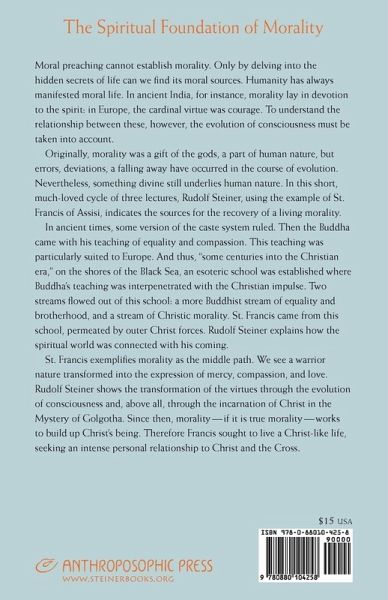
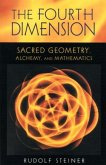
Moral teaching and moral preaching cannot establish morality. It is only by delving into the hidden secrets of life that we can advance not just to moral doctrines but to the moral sources of life -- true moral impulses. At different times, humanity has manifested moral life in different ways. To understand these differences, the evolution of consciousness must be taken into account. Originally morality was a part of human nature, for in their essence human beings are good. But through evolution, there have come errors, deviations, fallings-away. In this small, much-loved cycle of three…mehr
Moral teaching and moral preaching cannot establish morality. It is only by delving into the hidden secrets of life that we can advance not just to moral doctrines but to the moral sources of life -- true moral impulses. At different times, humanity has manifested moral life in different ways. To understand these differences, the evolution of consciousness must be taken into account. Originally morality was a part of human nature, for in their essence human beings are good. But through evolution, there have come errors, deviations, fallings-away. In this small, much-loved cycle of three lectures, Rudolf Steiner indicates the sources for the recovery of a living morality for our time. Rudolf Steiner shows the transformation of the virtues through the evolution of consciousness, and, above all, through the incarnation of the Christ in the Mystery of Golgotha.
Rudolf Steiner (1861-1925) was born in the small village of Kraljevec, Austro-Hungarian Empire (now in Croatia), where he grew up. As a young man, he lived in Weimar and Berlin, where he became a well-published scientific, literary, and philosophical scholar, known especially for his work with Goethe's scientific writings. At the beginning of the twentieth century, he began to develop his early philosophical principles into an approach to systematic research into psychological and spiritual phenomena. Formally beginning his spiritual teaching career under the auspices of the Theosophical Society, Steiner came to use the term Anthroposophy (and spiritual science) for his philosophy, spiritual research, and findings. The influence of Steiner's multifaceted genius has led to innovative and holistic approaches in medicine, various therapies, philosophy, religious renewal, Waldorf education, education for special needs, threefold economics, biodynamic agriculture, Goethean science, architecture, and the arts of drama, speech, and eurythmy. In 1924, Rudolf Steiner founded the General Anthroposophical Society, which today has branches throughout the world. He died in Dornach, Switzerland.
Es gelten unsere Allgemeinen Geschäftsbedingungen: www.buecher.de/agb
Impressum
www.buecher.de ist ein Internetauftritt der buecher.de internetstores GmbH
Geschäftsführung: Monica Sawhney | Roland Kölbl | Günter Hilger
Sitz der Gesellschaft: Batheyer Straße 115 - 117, 58099 Hagen
Postanschrift: Bürgermeister-Wegele-Str. 12, 86167 Augsburg
Amtsgericht Hagen HRB 13257
Steuernummer: 321/5800/1497
USt-IdNr: DE450055826