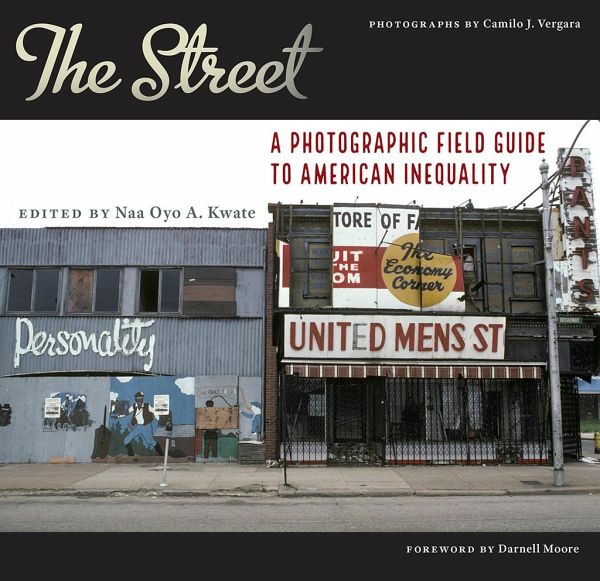
Vacant lots. Historic buildings overgrown with weeds. Walls and alleyways covered with graffiti. These are sights associated with countless inner-city neighborhoods in America, and yet many viewers have trouble getting beyond the surface of such images, whether they are denigrating them as signs of a dangerous ghetto or romanticizing them as traits of a beautiful ruined landscape. The Street: A Field Guide to Inequality provides readers with the critical tools they need to go beyond such superficial interpretations of urban decay. Using MacArthur fellow Camilo José Vergara's intimate…mehr
Vacant lots. Historic buildings overgrown with weeds. Walls and alleyways covered with graffiti. These are sights associated with countless inner-city neighborhoods in America, and yet many viewers have trouble getting beyond the surface of such images, whether they are denigrating them as signs of a dangerous ghetto or romanticizing them as traits of a beautiful ruined landscape. The Street: A Field Guide to Inequality provides readers with the critical tools they need to go beyond such superficial interpretations of urban decay. Using MacArthur fellow Camilo José Vergara's intimate street photographs of Camden, New Jersey as reference points, the essays in this collection analyze these images within the context of troubled histories and misguided policies that have exacerbated racial and economic inequalities. Rather than blaming Camden's residents for the blighted urban landscape, the multidisciplinary array of scholars contributing to this guide reveal the oppressive structures and institutional failures that have led the city to this condition. Tackling topics such as race and law enforcement, gentrification, food deserts, urban aesthetics, credit markets, health care, childcare, and schooling, the contributors challenge conventional thinking about what we should observe when looking at neighborhoods.
NAA OYO A. KWATE is an associate professor of Africana studies and human ecology at Rutgers University-New Brunswick. An interdisciplinary social scientist with wide ranging interests in racial inequality and African American urban life, her books include Burgers in Blackface: Anti-Black Restaurants Then and Now. She resides in Philadelphia. DARNELL MOORE is the Director of Inclusion Strategy for Content & Marketing at Netflix. He is the co-managing editor at The Feminist Wire and the writer-in-residence at the Center on African American Religion, Sexual Politics and Social Justice at Columbia University. Named one of The Root 100's most influential African Americans, Moore has been published in various media outlets including MSNBC, Huffington Post, EBONY, and others. He is the author of No Ashes in the Fire. He resides in Los Angeles. CAMILO JOSÉ VERGARA is one of the nation's foremost urban documentarians, Vergara is a recipient of the 2012 National Humanities Medal and was named a MacArthur fellow in 2002. Since 1977, he has photographed some of the country's most impoverished neighborhoods, repeatedly returning to locations in New York, Newark, Camden, Detroit, Chicago, and Los Angeles. He is also the author of numerous books, the most recent title being Detroit is No Dry Bones. He resides in New York City.
Inhaltsangabe
Foreword Introduction Part I State Systems and Predatory Profit No. 1 Racial Patterning of Travel in America No. 2 Dignity in an Era of Financialization No. 3 The Inequitable Erosion of Hospital Care Part II Symbols and Sentiments No. 4 Building Codes: Built Elements of the Housing Landscape No. 5 Symbols of Social Suffering No. 6 Dissonance No. 7 Race, Gentrification, and the Making of Domestic Refugees Part III Social Stories and Stigmatized Space No. 8 Housing Segregation and the Forgotten Latino American Story No. 9 Stolen Narratives and Racialized Structural Inequality No. 10 Disinvestment v. The People's Persistence No. 11 Racial Patterning of Fast Food Part IV Safety and Security No. 12 Persistence of Black/White Inequities in Infant Mortality No. 13 Urban Childcare Dilemmas No. 14 Disinvestment in Urban Schools No. 15 Racism in Law Enforcement Acknowledgments Notes on Contributors
Foreword Introduction Part I State Systems and Predatory Profit No. 1 Racial Patterning of Travel in America No. 2 Dignity in an Era of Financialization No. 3 The Inequitable Erosion of Hospital Care Part II Symbols and Sentiments No. 4 Building Codes: Built Elements of the Housing Landscape No. 5 Symbols of Social Suffering No. 6 Dissonance No. 7 Race, Gentrification, and the Making of Domestic Refugees Part III Social Stories and Stigmatized Space No. 8 Housing Segregation and the Forgotten Latino American Story No. 9 Stolen Narratives and Racialized Structural Inequality No. 10 Disinvestment v. The People's Persistence No. 11 Racial Patterning of Fast Food Part IV Safety and Security No. 12 Persistence of Black/White Inequities in Infant Mortality No. 13 Urban Childcare Dilemmas No. 14 Disinvestment in Urban Schools No. 15 Racism in Law Enforcement Acknowledgments Notes on Contributors
Es gelten unsere Allgemeinen Geschäftsbedingungen: www.buecher.de/agb
Impressum
www.buecher.de ist ein Internetauftritt der buecher.de internetstores GmbH
Geschäftsführung: Monica Sawhney | Roland Kölbl | Günter Hilger
Sitz der Gesellschaft: Batheyer Straße 115 - 117, 58099 Hagen
Postanschrift: Bürgermeister-Wegele-Str. 12, 86167 Augsburg
Amtsgericht Hagen HRB 13257
Steuernummer: 321/5800/1497
USt-IdNr: DE450055826