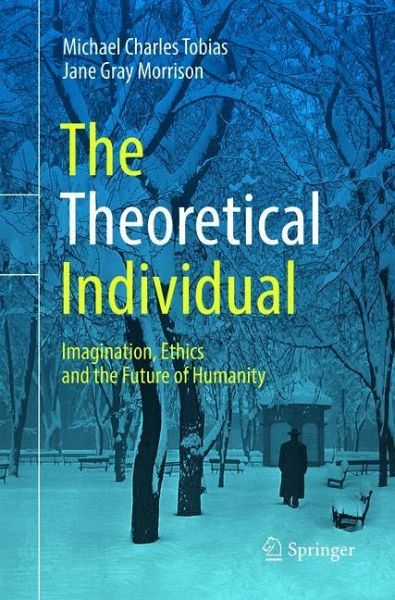
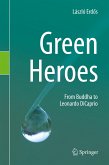
How can the one influence the many? From posing seminal questions about what comprises a human individual, to asking whether human evolution is alive and well, favoring individuals or the species, this work is a daring, up-to-the-minute overview of an urgent, multidisciplinary premise. It explores the extent to which human history provides empirical evidence for the capacity of an individual to exert meaningful suasion over their species, and asks: Can an individual influence the survival of the human species and the planet? If there are to be cultures of transformation dedicated to seeing us…mehr
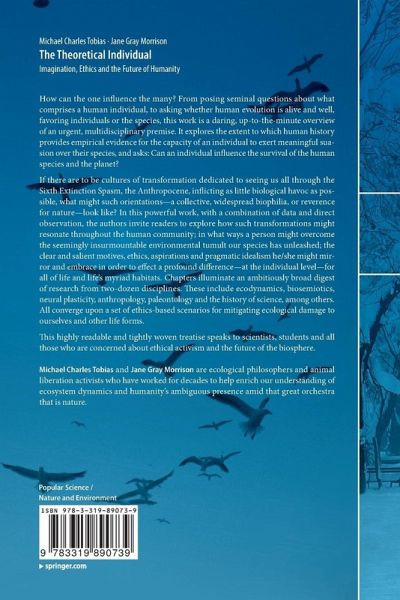
How can the one influence the many? From posing seminal questions about what comprises a human individual, to asking whether human evolution is alive and well, favoring individuals or the species, this work is a daring, up-to-the-minute overview of an urgent, multidisciplinary premise. It explores the extent to which human history provides empirical evidence for the capacity of an individual to exert meaningful suasion over their species, and asks: Can an individual influence the survival of the human species and the planet? If there are to be cultures of transformation dedicated to seeing us all through the Sixth Extinction Spasm, the Anthropocene, inflicting as little biological havoc as possible, what might such orientations-a collective, widespread biophilia, or reverence for nature-look like? In this powerful work, with a combination of data and direct observation, the authors invite readers to explore how such transformations might resonate throughout the human community; in what ways a person might overcome the seemingly insurmountable environmental tumult our species has unleashed; the clear and salient motives, ethics, aspirations and pragmatic idealism he/she might mirror and embrace in order to effect a profound difference-at the individual level-for all of life and life's myriad habitats. Chapters illuminate an ambitiously broad digest of research from two-dozen disciplines. Those include ecodynamics, biosemiotics, neural plasticity, anthropology, paleontology and the history of science, among others. All converge upon a set of ethics-based scenarios for mitigating ecological damage to ourselves and other life forms. This highly readable and tightly woven treatise speaks to scientists, students and all those who are concerned about ethical activism and the future of the biosphere.
Michael Charles Tobias and Jane Gray Morrison are ecological philosophers and animal liberation activists who have worked for decades to help enrich our understanding of ecosystem dynamics and humanity's ambiguous presence amid that great orchestra that is nature.
The three authors have tremendous Bhutanese experience: Dr. Tshewang is Bhutanese and lives in Thimphu. He grew up in the eastern province of Pemagatshel and was the first PhD from Bhutan's Ministry of Agriculture, dealing specifically in the ecodynamics affecting livestock and populations. He went on to become the highest ecological official in the Bhutanese government, founding the National Biodiversity Centre, the country's National Gene Bank and the National Herbarium. Dr. Tshewang was Governor of the nation's eastern-most province, Trashiyangtse, as well as being the Secretary of the National Environment Commission. He led the task force representing multiple stakeholders to develop the Biodiversity Act of Bhutan while leading the National Biodiversity Center of Bhutan. Dr. Tobias led one of the very first outside expeditions to Bhutan in the mid-1970s and has been returning ever since. In 2007 he led a 140-kilometer ecological survey of the most recently consecrated scientific reserve in the country's far-east, Sakten(g). Highly respected global ecologists, Dr. Tobias, and his partner, Jane Gray Morrison have for nearly 20 years run the Dancing Star Foundation -DSF (www.dancingstarfoundation.org; www.dancingstarnews.com) which is devoted to international conservation biology, animal protection and environmental education. DSF was a major donor for the Smithsonian Folklife Festival in 2008 in Washington D.C., - following upon Dr. Tshewang's proposal to the Royal Government of Bhutan that Bhutan be part of that festival. The event succeeded in bringing nearly 150 Bhutanese for ten days to the National Mall in Washington where, among other things, in conjunction with NASA, a Bhutanese monk (and Director of Bhutan's National Museum) had a discussion with an astronaut on inner and outer space. Tobias and Morrison have authored, co-authored and edited over 50 books between them.
Inhaltsangabe
Preface.-Chapter 1: What does Humanity Mean?.-Chapter 2: The Lost Tribes of Tamaulipas.-Chapter 3: Edward Curtis' Vision of Transcendence.-Chapter 4: A Genetic Cul de Sac.-Chapter 5: The Crisis and Redemption of the Individual.-Chapter 6: The Separation of Mind from Species.-Chapter 7: Ecological Existentialism.-Chapter 8: Choices
Preface.-Chapter 1: What does Humanity Mean?.-Chapter 2: The Lost Tribes of Tamaulipas.-Chapter 3: Edward Curtis' Vision of Transcendence.-Chapter 4: A Genetic Cul de Sac.-Chapter 5: The Crisis and Redemption of the Individual.-Chapter 6: The Separation of Mind from Species.-Chapter 7: Ecological Existentialism.-Chapter 8: Choices
Es gelten unsere Allgemeinen Geschäftsbedingungen: www.buecher.de/agb
Impressum
www.buecher.de ist ein Internetauftritt der buecher.de internetstores GmbH
Geschäftsführung: Monica Sawhney | Roland Kölbl | Günter Hilger
Sitz der Gesellschaft: Batheyer Straße 115 - 117, 58099 Hagen
Postanschrift: Bürgermeister-Wegele-Str. 12, 86167 Augsburg
Amtsgericht Hagen HRB 13257
Steuernummer: 321/5800/1497
USt-IdNr: DE450055826