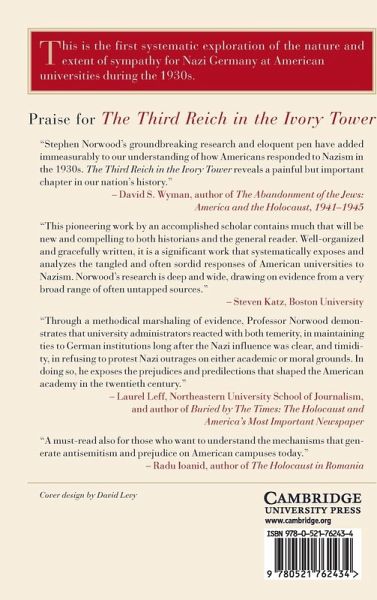
This is the first systematic exploration of the nature and extent of sympathy for Nazi Germany at American universities during the 1930s. Universities were highly influential in shaping public opinion and many of the nation's most prominent university administrators refused to take a principled stand against the Hitler regime. Universities welcomed Nazi officials to campus and participated enthusiastically in student exchange programs with Nazified universities in Germany. American educators helped Nazi Germany improve its image in the West as it intensified its persecution of the Jews and…mehr
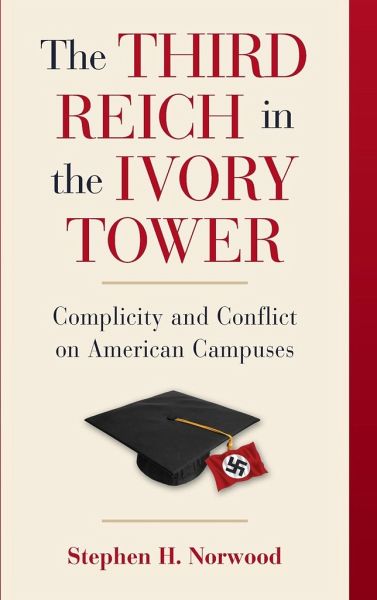
This is the first systematic exploration of the nature and extent of sympathy for Nazi Germany at American universities during the 1930s. Universities were highly influential in shaping public opinion and many of the nation's most prominent university administrators refused to take a principled stand against the Hitler regime. Universities welcomed Nazi officials to campus and participated enthusiastically in student exchange programs with Nazified universities in Germany. American educators helped Nazi Germany improve its image in the West as it intensified its persecution of the Jews and strengthened its armed forces. The study contrasts the significant American grassroots protest against Nazism that emerged as soon as Hitler assumed power with campus quiescence and administrators' frequently harsh treatment of those students and professors who challenged their determination to maintain friendly relations with Nazi Germany.
Stephen H. Norwood, who holds a Ph.D. from Columbia University, is Professor of History at the University of Oklahoma. His two-volume Encyclopedia of American Jewish History, co-edited with Eunice G. Pollack (2008), received the Booklist Editor's Choice Award. He is also the author of three other books on American history, the winner of the Herbert G. Gutman Award in American Social History and the co-winner of the Macmillan/SABR Award in Baseball History. His articles have appeared in anthologies and numerous journals, including American Jewish History, Modern Judaism and the Journal of Social History.
Inhaltsangabe
1. Germany reverts to the Dark Ages: Nazi clarity and American awareness, 1933-1934; 2. Legitimating Nazism: Harvard University and the Hitler regime, 1933-1937; 3. Complicity and conflict: Columbia University's response to Fascism, 1933-1937; 4. The seven sisters colleges and the Third Reich: promoting fellowship through student exchange; 5. A respectful hearing for Nazi Germany's apologists: the University of Virginia Institute of Public Affairs round tables, 1933-1941; 6. Nazi nests: German departments in American Universities, 1933-1941; 7. American Catholic Universities' flirtation with Fascism; 8. 1938, year of the Kristallnacht: the limits of campus protest; Epilogue; Bibliography.
1. Germany reverts to the Dark Ages: Nazi clarity and American awareness, 1933-1934 2. Legitimating Nazism: Harvard University and the Hitler regime, 1933-1937 3. Complicity and conflict: Columbia University's response to Fascism, 1933-1937 4. The seven sisters colleges and the Third Reich: promoting fellowship through student exchange 5. A respectful hearing for Nazi Germany's apologists: the University of Virginia Institute of Public Affairs round tables, 1933-1941 6. Nazi nests: German departments in American Universities, 1933-1941 7. American Catholic Universities' flirtation with Fascism 8. 1938, year of the Kristallnacht: the limits of campus protest Epilogue Bibliography.
1. Germany reverts to the Dark Ages: Nazi clarity and American awareness, 1933-1934; 2. Legitimating Nazism: Harvard University and the Hitler regime, 1933-1937; 3. Complicity and conflict: Columbia University's response to Fascism, 1933-1937; 4. The seven sisters colleges and the Third Reich: promoting fellowship through student exchange; 5. A respectful hearing for Nazi Germany's apologists: the University of Virginia Institute of Public Affairs round tables, 1933-1941; 6. Nazi nests: German departments in American Universities, 1933-1941; 7. American Catholic Universities' flirtation with Fascism; 8. 1938, year of the Kristallnacht: the limits of campus protest; Epilogue; Bibliography.
1. Germany reverts to the Dark Ages: Nazi clarity and American awareness, 1933-1934 2. Legitimating Nazism: Harvard University and the Hitler regime, 1933-1937 3. Complicity and conflict: Columbia University's response to Fascism, 1933-1937 4. The seven sisters colleges and the Third Reich: promoting fellowship through student exchange 5. A respectful hearing for Nazi Germany's apologists: the University of Virginia Institute of Public Affairs round tables, 1933-1941 6. Nazi nests: German departments in American Universities, 1933-1941 7. American Catholic Universities' flirtation with Fascism 8. 1938, year of the Kristallnacht: the limits of campus protest Epilogue Bibliography.
Rezensionen
Reviews of the hardback: 'Stephen Norwood's groundbreaking research and eloquent pen have added immeasurably to our understanding of how Americans responded to Nazism in the 1930s. The Third Reich in the Ivory Tower reveals a painful but important chapter in our nation's history.' David S. Wyman, author of The Abandonment of the Jews
Es gelten unsere Allgemeinen Geschäftsbedingungen: www.buecher.de/agb
Impressum
www.buecher.de ist ein Internetauftritt der buecher.de internetstores GmbH
Geschäftsführung: Monica Sawhney | Roland Kölbl | Günter Hilger
Sitz der Gesellschaft: Batheyer Straße 115 - 117, 58099 Hagen
Postanschrift: Bürgermeister-Wegele-Str. 12, 86167 Augsburg
Amtsgericht Hagen HRB 13257
Steuernummer: 321/5800/1497
USt-IdNr: DE450055826