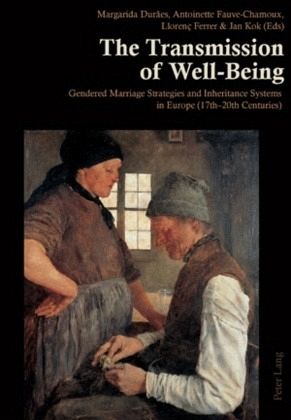
Gendered Marriage Strategies and Inheritance Systems in Europe (17th-20th Centuries) Herausgegeben:Durães, Margarida; Fauve-Chamoux, Antoinette; Ferrer i Alòs, LIorenç; Kok, Jan
Gendered Marriage Strategies and Inheritance Systems in Europe (17th-20th Centuries) Herausgegeben:Durães, Margarida; Fauve-Chamoux, Antoinette; Ferrer i Alòs, LIorenç; Kok, Jan
What does well-being mean when we talk about men and women in the past? Their sheer chances of survival, their protection from want, their social status, their individual agency and their self-esteem were all strongly mediated by the family, the predominant social institution. Family laws and customs of family formation created differences between insiders and outsiders in terms of well-being. Within families, there were strong differences in autonomy, status and freedom between the genders and generations. The book offers a fascinating exploration of gender differences in well-being in many…mehr
What does well-being mean when we talk about men and women in the past? Their sheer chances of survival, their protection from want, their social status, their individual agency and their self-esteem were all strongly mediated by the family, the predominant social institution. Family laws and customs of family formation created differences between insiders and outsiders in terms of well-being. Within families, there were strong differences in autonomy, status and freedom between the genders and generations. The book offers a fascinating exploration of gender differences in well-being in many regions of historic Europe, with some comparative perspectives. It explores how historic family systems differed with respect to choosing a marriage partner, transmitting property, living and care conditions of widows and widowers and the position of children born out of wedlock.
The Editors: Margarida Durães is Professor of Contemporary History at University of Minho (Portugal) where she teaches History of Family and History of Migrations. She developed comparative international projects in cooperation with Brasil, Spain and France. Antoinette Fauve-Chamoux, a social historian and historical demographer, is Maître de Conférences at Ecole des Hautes Etudes en Sciences Sociales (EHESS), Centre de Recherches Historiques/CNRS, Paris (France), where she teaches History of the Family. Llorenç Ferrer i Alòs is Professor Catedrático at the Department of Contemporary History at Barcelona University (Spain) where he teaches economic and social history. His interests are family history, agrarian history, historical demography and industrialization. Jan Kok publishes on family history, historical demography and Information and Communications Technology/ICT-related research practices in the Humanities. He is senior researcher at the Virtual Knowledge Studio and the International Institute of Social History (The Netherlands) and visiting professor at Katholieke Universiteit Leuven (Belgium).
Inhaltsangabe
Contents: Margarida Durães/Antoinette Fauve-Chamoux/Llorenç Ferrer Alòs/Jan Kok: Introduction: Historicizing Well-Being from a Gender Perspective - Marie-Pierre Arrizabalaga: Marriage Strategies and Well-Being among 19th Century Basque Property Owners - Emília Lagido: Consanguineous Marriages as a Strategy of Well-Being. An Example from 19th Century Alto Minho - Isabel dos Guimarães Sá: Cousin Marriage and Well-Being among the Portuguese Royal Family during the 15th and 16th Centuries - Constanta Vintila-Ghitulescu: Marriage Strategies, Women's Dowries and Conflicts between Relatives in Romanian Society (18th Century) - Norberta Amorim/Carlota Santos: Marriage Strategies in Azorean Communities of Pico Island (19th Century). Differentiated Female Behaviour in Choosing a Lifelong Partner - Béatrice Craig: When Generation Trumped Sex. Widow's Well-Being and the Transmission of Family Business in 19th Century Northern France - Margarida Durães: Providing Well-Being to Women through Inheritance and Succession. Portugal in the 18th and 19th Centuries - Beatrice Moring: Men, Women and Property in Finland and Sweden in the 18th and 19th Centuries - Llorenç Ferrer Alòs: Achieving Well-Being in Spain through the Single Heir System (18th-19th Centuries) - Richard Paping: Gender and the Intergenerational Transfer of Property and Social Position in the 18th and early 19th Century Northern Dutch Countryside - Kari Telste: Children Born out of Wedlock. Legal Rights and Social Reforms in Norway from the 17th Century to the Present - Helena Cristina F. Machado: Illegitimate Children and Court Procedures for the Determination of Paternity in Portugal (1893-1966). Gendered and Social Differences on Acceding to Inheritance - Paulo Lopes Matos: Female Life Courses and Property Transmission in the Azorean Periphery (Portugal). The Case of the Island of São Jorge in the 19th Century - Ofelia Rey Castelao: Well-Being or Survival? Women's Future and Family Transmission Strategies in North-Western Rural Spain, 18th-19th Centuries - Antoinette Fauve-Chamoux: To Remarry or Not: Well-Being, Female Property and Widowhood in Early-Modern France - Mikolaj Szoltysek: Female Headship, Household Position, and Gendered Well-Being in Peasant Societies. Evidence from the Territories of the Historical Kingdom of Poland (18th Century) - Sølvi Sogner: Gender, Well-Being, and Old Age for Persons without a Life-Companion. A Rural Case Study around the Turn of the Century 1900. Rendalen, Norway - Mary Louise Nagata: Provisions for Care and Neighborhood Funds in Early Modern Kyoto.
Contents: Margarida Durães/Antoinette Fauve-Chamoux/Llorenç Ferrer Alòs/Jan Kok: Introduction: Historicizing Well-Being from a Gender Perspective - Marie-Pierre Arrizabalaga: Marriage Strategies and Well-Being among 19th Century Basque Property Owners - Emília Lagido: Consanguineous Marriages as a Strategy of Well-Being. An Example from 19th Century Alto Minho - Isabel dos Guimarães Sá: Cousin Marriage and Well-Being among the Portuguese Royal Family during the 15th and 16th Centuries - Constanta Vintila-Ghitulescu: Marriage Strategies, Women's Dowries and Conflicts between Relatives in Romanian Society (18th Century) - Norberta Amorim/Carlota Santos: Marriage Strategies in Azorean Communities of Pico Island (19th Century). Differentiated Female Behaviour in Choosing a Lifelong Partner - Béatrice Craig: When Generation Trumped Sex. Widow's Well-Being and the Transmission of Family Business in 19th Century Northern France - Margarida Durães: Providing Well-Being to Women through Inheritance and Succession. Portugal in the 18th and 19th Centuries - Beatrice Moring: Men, Women and Property in Finland and Sweden in the 18th and 19th Centuries - Llorenç Ferrer Alòs: Achieving Well-Being in Spain through the Single Heir System (18th-19th Centuries) - Richard Paping: Gender and the Intergenerational Transfer of Property and Social Position in the 18th and early 19th Century Northern Dutch Countryside - Kari Telste: Children Born out of Wedlock. Legal Rights and Social Reforms in Norway from the 17th Century to the Present - Helena Cristina F. Machado: Illegitimate Children and Court Procedures for the Determination of Paternity in Portugal (1893-1966). Gendered and Social Differences on Acceding to Inheritance - Paulo Lopes Matos: Female Life Courses and Property Transmission in the Azorean Periphery (Portugal). The Case of the Island of São Jorge in the 19th Century - Ofelia Rey Castelao: Well-Being or Survival? Women's Future and Family Transmission Strategies in North-Western Rural Spain, 18th-19th Centuries - Antoinette Fauve-Chamoux: To Remarry or Not: Well-Being, Female Property and Widowhood in Early-Modern France - Mikolaj Szoltysek: Female Headship, Household Position, and Gendered Well-Being in Peasant Societies. Evidence from the Territories of the Historical Kingdom of Poland (18th Century) - Sølvi Sogner: Gender, Well-Being, and Old Age for Persons without a Life-Companion. A Rural Case Study around the Turn of the Century 1900. Rendalen, Norway - Mary Louise Nagata: Provisions for Care and Neighborhood Funds in Early Modern Kyoto.
Rezensionen
«(...) this book is evidently a distinctive academic tome that will be of interest to anyone interested in history and the development of women's rights in Europe.» (Bulletin Quotidien Europe)
Es gelten unsere Allgemeinen Geschäftsbedingungen: www.buecher.de/agb
Impressum
www.buecher.de ist ein Internetauftritt der buecher.de internetstores GmbH
Geschäftsführung: Monica Sawhney | Roland Kölbl | Günter Hilger
Sitz der Gesellschaft: Batheyer Straße 115 - 117, 58099 Hagen
Postanschrift: Bürgermeister-Wegele-Str. 12, 86167 Augsburg
Amtsgericht Hagen HRB 13257
Steuernummer: 321/5800/1497
USt-IdNr: DE450055826