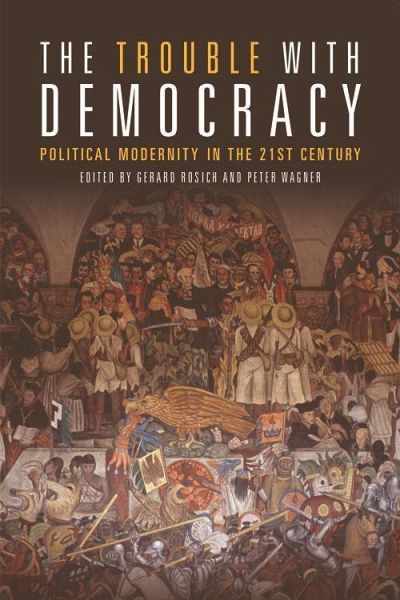
Western political thought has long maintained that democracy, once achieved, is here to stay. This view appears to be supported by successive 'waves of democratisation' across the world but, in truth, the political situation of our time is much more ambiguous. On the one hand, the commitment to democracy seems to be more widely shared than ever; on the other, popular will has ever less impact on political decisions because of alleged constraints in an era of 'globalisation'. Existing democracies suffer from a combination of technocratic governance and populist reactions. Global political…mehr
Western political thought has long maintained that democracy, once achieved, is here to stay. This view appears to be supported by successive 'waves of democratisation' across the world but, in truth, the political situation of our time is much more ambiguous. On the one hand, the commitment to democracy seems to be more widely shared than ever; on the other, popular will has ever less impact on political decisions because of alleged constraints in an era of 'globalisation'. Existing democracies suffer from a combination of technocratic governance and populist reactions. Global political communication has foundered with addressing urgent problems such as climate change, global social justice and economic-financial crises. By placing political condition of our time in its long-term historical context, this book radically reconsiders key issues of political thought and gives you a comparative exploration of the current experiences of democracy in several world-regions.
Gerard Rosich is Doctoral Researcher within the ERC Advanced Grant Research Project Trajectories of Modernity at The University of Barcelona. His work includes 'The limits of recognition: history, otherness and autonomy' in African, American and European Trajectories of Modernity: Past Oppression, Future Justice? edited by Peter Wagner (2015) in the Annual of European and Global Studies series published by Edinburgh University Press. Peter Wagner is Catalan Institute for Research and Advanced Studies Research Professor at the University of Barcelona. His publications include The Trouble with Democracy (Edinburgh University Press, 2016), African, American and European Trajectories of Modernity (Edinburgh University Press, 2015), Modernity as Experience and Interpretation (Polity Press, 2008), A History and Theory of the Social Sciences (Sage, 2001), Theorising Modernity (Sage, 2001) and A Sociology of Modernity (Routledge, 1994).
Inhaltsangabe
Acknowledgements; List of Contributors; 1. Introduction: Re-interpreting Democracy for Our Time, Gerard Rosich and Peter Wagner; 2. Autonomy in and Between Polities: Democracy and the Need for Collective Political Selves, Gerard Rosich; 3. Rethinking 'Modern' Democracy: Political Modernity and Constituent Power, Andreas Kalyvas; 4. Democratic Surplus and Democracy-in-failing: On Ancient and Modern Self-cancellation of Democracy, Nathalie Karagiannis; 5. Setbacks of Women's Emancipation (Condition, Consequence, Measure and Ruse) , Geneviève Fraisse; 6. Political Modernity, Democracy and State-Society Relations in Latin America: A New Socio-historical Problématique?, Manuel A. Garretón; 7. Communitarian Cosmopolitanism: Argentina's Recuperated Factories, Neo-liberal Globalization and Democratic Citizenship, Carlos A. Forment; 8. Middle Classing in Roodepoort: Unexpected Sites of Post-apartheid 'Community', Ivor Chipkin; 9. Democracy and Capitalism in Europe, Brazil and South Africa, Peter Wagner; 10. From Realism to Activism: A Critique of Resignation in Political Theory, Lea Ypi; 11. The World as We Find It: A Suggestion for a Democratic Theory for Our Times, Tracy B. Strong; 12. Epilogue: Democracy as Capacity for Self-transformation, Gerard Rosich and Peter Wagner; Index
Acknowledgements; List of Contributors; 1. Introduction: Re-interpreting Democracy for Our Time, Gerard Rosich and Peter Wagner; 2. Autonomy in and Between Polities: Democracy and the Need for Collective Political Selves, Gerard Rosich; 3. Rethinking 'Modern' Democracy: Political Modernity and Constituent Power, Andreas Kalyvas; 4. Democratic Surplus and Democracy-in-failing: On Ancient and Modern Self-cancellation of Democracy, Nathalie Karagiannis; 5. Setbacks of Women's Emancipation (Condition, Consequence, Measure and Ruse) , Geneviève Fraisse; 6. Political Modernity, Democracy and State-Society Relations in Latin America: A New Socio-historical Problématique?, Manuel A. Garretón; 7. Communitarian Cosmopolitanism: Argentina's Recuperated Factories, Neo-liberal Globalization and Democratic Citizenship, Carlos A. Forment; 8. Middle Classing in Roodepoort: Unexpected Sites of Post-apartheid 'Community', Ivor Chipkin; 9. Democracy and Capitalism in Europe, Brazil and South Africa, Peter Wagner; 10. From Realism to Activism: A Critique of Resignation in Political Theory, Lea Ypi; 11. The World as We Find It: A Suggestion for a Democratic Theory for Our Times, Tracy B. Strong; 12. Epilogue: Democracy as Capacity for Self-transformation, Gerard Rosich and Peter Wagner; Index
Es gelten unsere Allgemeinen Geschäftsbedingungen: www.buecher.de/agb
Impressum
www.buecher.de ist ein Internetauftritt der buecher.de internetstores GmbH
Geschäftsführung: Monica Sawhney | Roland Kölbl | Günter Hilger
Sitz der Gesellschaft: Batheyer Straße 115 - 117, 58099 Hagen
Postanschrift: Bürgermeister-Wegele-Str. 12, 86167 Augsburg
Amtsgericht Hagen HRB 13257
Steuernummer: 321/5800/1497
USt-IdNr: DE450055826