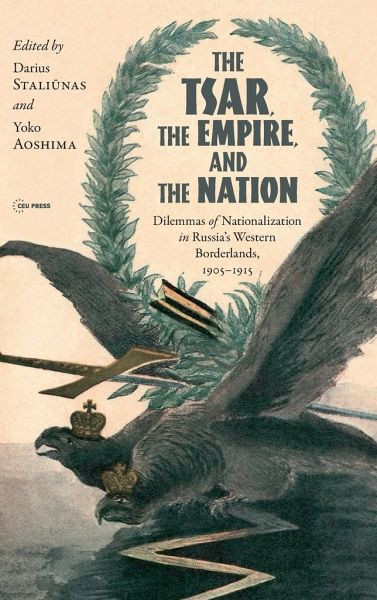
This collection of essays addresses the challenge of modern nationalism to the tsarist Russian Empire. First appearing on the empire's western periphery this challenge, was most prevalent in twelve provinces extending from Ukrainian lands in the south to the Baltic provinces in the north, as well as to the Kingdom of Poland. At issue is whether the late Russian Empire entered World War I as a multiethnic state with many of its age-old mechanisms run by a multiethnic elite, or as a Russian state predominantly managed by ethnic Russians. The tsarist vision of prioritizing loyalty among all…mehr
This collection of essays addresses the challenge of modern nationalism to the tsarist Russian Empire. First appearing on the empire's western periphery this challenge, was most prevalent in twelve provinces extending from Ukrainian lands in the south to the Baltic provinces in the north, as well as to the Kingdom of Poland. At issue is whether the late Russian Empire entered World War I as a multiethnic state with many of its age-old mechanisms run by a multiethnic elite, or as a Russian state predominantly managed by ethnic Russians. The tsarist vision of prioritizing loyalty among all subjects over privileging ethnic Russians and discriminating against non-Russians faced a fundamental problem: as soon as the opportunity presented itself, non-Russians would increase their demands and become increasingly separatist. The authors found that although the imperial government did not really identify with popular Russian nationalism, it sometimes ended up implementing policies promoted by Russian nationalist proponents. Matters addressed include native language education, interconfessional rivalry, the "Jewish question," the origins of mass tourism in the western provinces, as well as the emergence of Russian nationalist attitudes in the aftermath of the first Russian revolution.
Darius Stali?nas is Chief Researcher at the Lithuanian Institute of History. He is the author of Making Russians: Meaning and Practice of Russification in Lithuania and Belarus after 1863 (Amsterdam: Rodopi, 2007), Enemies for a Day: Antisemitism and Anti-Jewish Violence in Lithuania under the Tsars (Budapest: CEU Press, 2015), and, with Dangiras Ma?iulis, Lithuanian Nationalism and the Vilnius Question, 1883-1940 (Marburg: Herder-Institut, 2015). Yoko Aoshima is Associate Professor at the Slavic-Eurasian Research Center, Hokkaido University. She is the editor of Entangled Interactions between Religion and National Consciousness in Central and Eastern Europe (Academic Studies Press, 2020).
Inhaltsangabe
Introduction, Transformations of Imperial Nationality PolicyInconsistently Nationalizing State: The Romanov Empire and the Ukrainian National Movement Anton Kotenko Challenges to Imperial Authorities' Nationality Policy in the Northwest Region, 1905-15 Darius Stali?nasWhat Is the Russian Cause and Whom Does It Serve? Russian Nationalists and Imperial Bureaucracy in the Kingdom of Poland Malte RolfConfessions in the CrossfireInterconfessional Rivalry in Lithuania after the Decree on Toleration Vilma altauskait?The Struggle between Confessional and Nationalist Groups for the Che?m-Podlasian Region: the 1905 Decree on Tolerance and Former Uniates Chiho FukushimaTransformations in EducationNative Language Education in the Western Border Regions around 1905 Yoko AoshimaPolitics around Universal Education in Right-bank Ukraine in the Late Tsarist Period Kimitaka MatsuzatoTo Sense an Empire: Russian Education Policy and the Origins of Mass Tourism in the Northwest Region Jolita Mulevi?i?t?The Formation of Imperial Loyalty in the Education System in the Northwest Region in 1905-1915 Olga MastianicaThe Problem of the Russian RightRight-Wing Russian Organizations in the City of Vil'na and the Northwestern Provinces, 1905-1915 Vytautas PetronisDefending the Empire in the Baltic Provinces: Russian Nationalist Visions in the Aftermath of the First Russian Revolution Karsten BrüggemannRussian Jews and the Russian Right: Why There Were no Jewish Right-Wing Politics in the Late Russian Empire? Vladimir LevinList of Contributors, Index.
Introduction, Transformations of Imperial Nationality PolicyInconsistently Nationalizing State: The Romanov Empire and the Ukrainian National Movement Anton Kotenko Challenges to Imperial Authorities' Nationality Policy in the Northwest Region, 1905-15 Darius Stali?nasWhat Is the Russian Cause and Whom Does It Serve? Russian Nationalists and Imperial Bureaucracy in the Kingdom of Poland Malte RolfConfessions in the CrossfireInterconfessional Rivalry in Lithuania after the Decree on Toleration Vilma altauskait?The Struggle between Confessional and Nationalist Groups for the Che?m-Podlasian Region: the 1905 Decree on Tolerance and Former Uniates Chiho FukushimaTransformations in EducationNative Language Education in the Western Border Regions around 1905 Yoko AoshimaPolitics around Universal Education in Right-bank Ukraine in the Late Tsarist Period Kimitaka MatsuzatoTo Sense an Empire: Russian Education Policy and the Origins of Mass Tourism in the Northwest Region Jolita Mulevi?i?t?The Formation of Imperial Loyalty in the Education System in the Northwest Region in 1905-1915 Olga MastianicaThe Problem of the Russian RightRight-Wing Russian Organizations in the City of Vil'na and the Northwestern Provinces, 1905-1915 Vytautas PetronisDefending the Empire in the Baltic Provinces: Russian Nationalist Visions in the Aftermath of the First Russian Revolution Karsten BrüggemannRussian Jews and the Russian Right: Why There Were no Jewish Right-Wing Politics in the Late Russian Empire? Vladimir LevinList of Contributors, Index.
Es gelten unsere Allgemeinen Geschäftsbedingungen: www.buecher.de/agb
Impressum
www.buecher.de ist ein Internetauftritt der buecher.de internetstores GmbH
Geschäftsführung: Monica Sawhney | Roland Kölbl | Günter Hilger
Sitz der Gesellschaft: Batheyer Straße 115 - 117, 58099 Hagen
Postanschrift: Bürgermeister-Wegele-Str. 12, 86167 Augsburg
Amtsgericht Hagen HRB 13257
Steuernummer: 321/5800/1497
USt-IdNr: DE450055826