
Andere Kunden interessierten sich auch für
 Bayesian Machine Learning in Quantitative Finance106,99 €
 Derivatives Applications in Asset Management68,99 €
 Advanced REIT Portfolio Optimization36,99 €
 Advanced REIT Portfolio Optimization49,99 €
 Liquidity Dynamics and Risk Modeling113,99 €
 Life Insurance Mathematics46,99 €
 Fundamental Analysis, Behavioral Finance and Technical Analysis on the Stock Market47,95 €


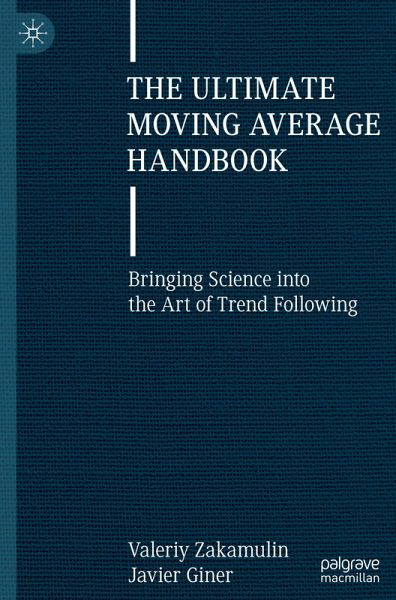
Moving averages of prices serve as the primary tool for tracking trends in financial markets, filtering out noise, and highlighting trend directions. With a plethora of moving averages and trend-following rules at their disposal, traders often find themselves overwhelmed by the sheer variety of choices. Moreover, traders persistently devise new forms of exotic moving averages, each purportedly offering improved responsiveness and smoothness compared to its predecessors. While it is relatively straightforward to visually compare the responsiveness of two different moving averages, assessing their smoothing properties proves to be more challenging. Comparisons made through visual inspection are inherently subjective and prone to biases. A pressing need exists for quantitative metrics to objectively assess the properties of moving averages and their associated trend-following rules.
In this book, the authors propose a quantitative assessment of the properties of trend-following rules based on moving averages. They argue that there are three primary properties of trend-following rules: responsiveness, smoothness, and accuracy. Given the prevalent claims that each exotic moving average offers superior responsiveness and smoothness compared to prior versions, the book provides a means to verify the accuracy of these assertions. It offers systematic and comprehensive coverage of various types of moving averages and the trend-following rules based on moving averages, and focuses on identifying the most crucial properties of trend-following rules and proposing quantitative metrics for their evaluation.
Despite the plethora of books and academic publications, contemporary trend-following with moving averages remains more of an art than a science. This book injects scientific principles into the practice of trend-following, offering invaluable, distinct, and objective insights tailored for traders and investment professionals involved in trend-following investing alongside academics and students within economic and finance departments.
In this book, the authors propose a quantitative assessment of the properties of trend-following rules based on moving averages. They argue that there are three primary properties of trend-following rules: responsiveness, smoothness, and accuracy. Given the prevalent claims that each exotic moving average offers superior responsiveness and smoothness compared to prior versions, the book provides a means to verify the accuracy of these assertions. It offers systematic and comprehensive coverage of various types of moving averages and the trend-following rules based on moving averages, and focuses on identifying the most crucial properties of trend-following rules and proposing quantitative metrics for their evaluation.
Despite the plethora of books and academic publications, contemporary trend-following with moving averages remains more of an art than a science. This book injects scientific principles into the practice of trend-following, offering invaluable, distinct, and objective insights tailored for traders and investment professionals involved in trend-following investing alongside academics and students within economic and finance departments.