
This book aims to investigate the unconscious in literature using Freudian and Lacanian psychology. The works of Thomas Hardy, William Golding, and Iris Murdoch are discussed from Chapter 1 through to Chapter 8. Based on the argument in these chapters, this volume considers the environmental problem by examining the unconscious in the literary texts, including poetry, in the light of philosophers and critics on ecology in Chapter 9. There is a focus on the Oedipus complex, the death drive, and the unsymbolic void, as they have much relevance to each other in the unconscious, and underlie the…mehr
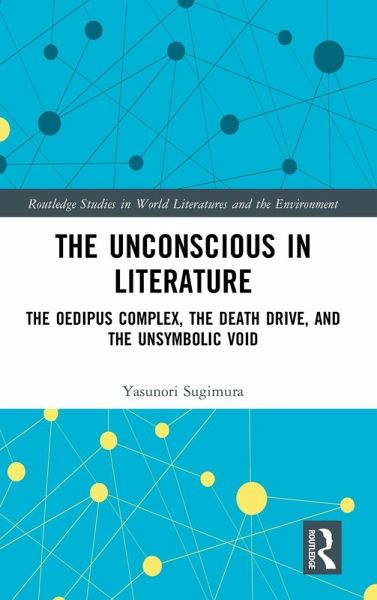
This book aims to investigate the unconscious in literature using Freudian and Lacanian psychology. The works of Thomas Hardy, William Golding, and Iris Murdoch are discussed from Chapter 1 through to Chapter 8. Based on the argument in these chapters, this volume considers the environmental problem by examining the unconscious in the literary texts, including poetry, in the light of philosophers and critics on ecology in Chapter 9. There is a focus on the Oedipus complex, the death drive, and the unsymbolic void, as they have much relevance to each other in the unconscious, and underlie the plots and leitmotifs of the literary texts discussed. The author, furthermore, carefully examines the complicated relationship between the unsymbolic void within nature and the unconscious of human beings in our environment.
Produktdetails
Produktdetails
Routledge Studies in World Literatures and the Environment
Yasunori Sugimura is Professor Emeritus at Otaru University of Commerce, receiving his Ph.D. from Tohoku University. He has published articles on Thomas Hardy, William Golding, and Iris Murdoch in major journals including The Modern Language Review, and has been a visiting scholar at Darwin College, University of Cambridge. His most recent publication includes The Void and the Metaphors: A New Reading of William Golding's Fiction with Peter Lang.
Inhaltsangabe
Introduction Chapter One The Psychological Significance of the Double Ending in The Well-Beloved Chapter Two The Internal Forces of the Plot in A Pair of Blue Eyes Chapter Three The Symbolic Fixed and Dissolved in Tess of the d'Urbervilles Chapter Four A Reconsideration of the Dual Relationship and the Cosmic Perspective in Lord of the Flies Chapter Five Nature and Human Beings in The Inheritors Chapter Six The Black Hole and the Death Drive in Darkness Visible Chapter Seven The Unsymbolic Void amidst the Light in 'Miss Pulkinhorn' Chapter Eight The Depiction of Nature and its Originality in Iris Murdoch's Fiction Chapter Nine The Unrepresentable within Nature Conclusion
Es gelten unsere Allgemeinen Geschäftsbedingungen: www.buecher.de/agb
Impressum
www.buecher.de ist ein Internetauftritt der buecher.de internetstores GmbH
Geschäftsführung: Monica Sawhney | Roland Kölbl | Günter Hilger
Sitz der Gesellschaft: Batheyer Straße 115 - 117, 58099 Hagen
Postanschrift: Bürgermeister-Wegele-Str. 12, 86167 Augsburg
Amtsgericht Hagen HRB 13257
Steuernummer: 321/5800/1497
USt-IdNr: DE450055826