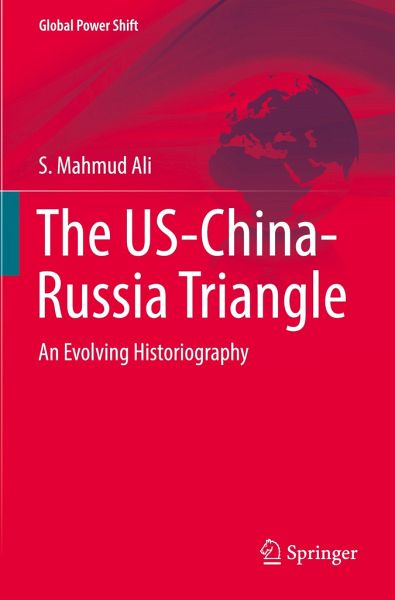
This book analyses international relations between the USA, China, and Russia and provides an overview of how the US-China-Russia triangle has evolved over time. Based on a forensic examination of primary documentation from US archives, the author illustrates how the US strategic perspectives on Chinese-Russian relations have developed since the late-19th century. The author demonstrates how US relations with the Russian and Chinese empires began expanding into greater sophistication and complexity in the 19th century, reflecting changing US concerns, priorities, and preferences vis-à-vis…mehr
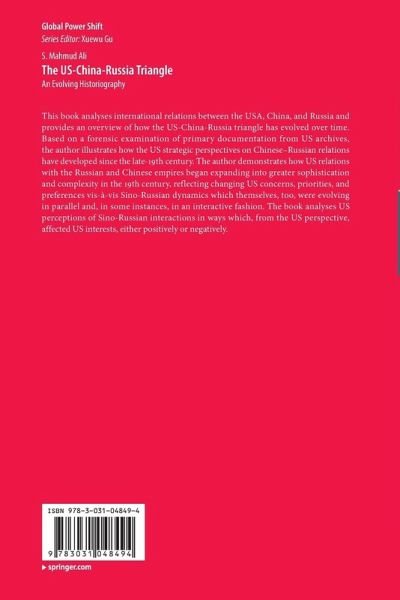
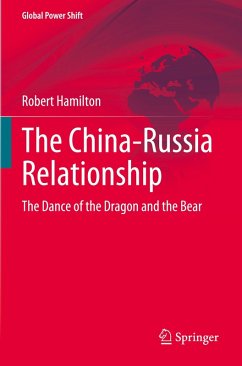
This book analyses international relations between the USA, China, and Russia and provides an overview of how the US-China-Russia triangle has evolved over time. Based on a forensic examination of primary documentation from US archives, the author illustrates how the US strategic perspectives on Chinese-Russian relations have developed since the late-19th century. The author demonstrates how US relations with the Russian and Chinese empires began expanding into greater sophistication and complexity in the 19th century, reflecting changing US concerns, priorities, and preferences vis-à-vis Sino-Russian dynamics which themselves, too, were evolving in parallel and, in some instances, in an interactive fashion. The book analyses US perceptions of Sino-Russian interactions in ways which, from the US perspective, affected US interests, either positively or negatively.
S. Mahmud Ali graduated from the Pakistan Military Academy, Kakul, and was subsequently educated, first, at the Royal United Services Institute for Defence and Security Studies (RUSI), London, and then, at King's College London, where, after a year of post-graduate studies, he embarked on doctoral research and was granted a Ph.D. in "War Studies" by the University of London. Mahmud Ali worked successively as a broadcast-journalist, editor, regional analyst and senior manager at the British Broadcasting Corporation (BBC) World Service, London, for over two decades, during which period he was editorially responsible for coverage of developments in South-, Southeast-, and East Asia. He is the author of eight academic titles including five volumes on the post-1949 evolution of US-Chinese relations.
Inhaltsangabe
Chapter 1. Introduction: A New Cold War? The US-China-Russia Strategic Triangle.- Chapter 2. Triangular Dynamics in the Imperial Era.- Chapter 3. The Triad Confronts Republican Turbulence.- Chapter 4. The Triangle in World War and its Wake.- Chapter 5. The Cold War's 'First Strategic Triangle'.- Chapter 6. Systemic Transitional Fluidity and Displacement Angst.- Chapter 7. Conclusion: Post-Unipolar Triadic Turbulence.
Chapter 1. Introduction: A New Cold War? The US-China-Russia Strategic Triangle.- Chapter 2. Triangular Dynamics in the Imperial Era.- Chapter 3. The Triad Confronts Republican Turbulence.- Chapter 4. The Triangle in World War and its Wake.- Chapter 5. The Cold War's 'First Strategic Triangle'.- Chapter 6. Systemic Transitional Fluidity and Displacement Angst.- Chapter 7. Conclusion: Post-Unipolar Triadic Turbulence.
Es gelten unsere Allgemeinen Geschäftsbedingungen: www.buecher.de/agb
Impressum
www.buecher.de ist ein Internetauftritt der buecher.de internetstores GmbH
Geschäftsführung: Monica Sawhney | Roland Kölbl | Günter Hilger
Sitz der Gesellschaft: Batheyer Straße 115 - 117, 58099 Hagen
Postanschrift: Bürgermeister-Wegele-Str. 12, 86167 Augsburg
Amtsgericht Hagen HRB 13257
Steuernummer: 321/5800/1497
USt-IdNr: DE450055826