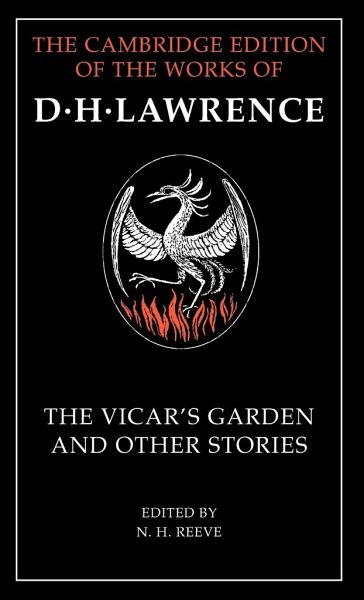
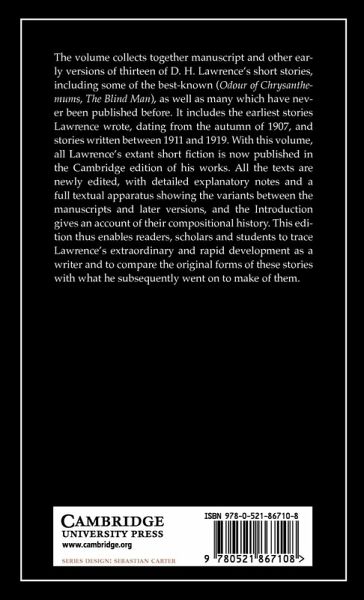
This volume collects together manuscript and other early versions of thirteen of D. H. Lawrence's short stories, including some of the best-known ('Odour of Chrysanthemums', 'The Blind Man'), as well as many which have never been published before. It includes the earliest stories Lawrence wrote, dating from the autumn of 1907, and stories written between 1911 and 1919. With this volume, all Lawrence's extant short fiction is now published in the Cambridge edition of his works. All the texts are newly edited, with detailed explanatory notes and a full textual apparatus showing the variants…mehr
This volume collects together manuscript and other early versions of thirteen of D. H. Lawrence's short stories, including some of the best-known ('Odour of Chrysanthemums', 'The Blind Man'), as well as many which have never been published before. It includes the earliest stories Lawrence wrote, dating from the autumn of 1907, and stories written between 1911 and 1919. With this volume, all Lawrence's extant short fiction is now published in the Cambridge edition of his works. All the texts are newly edited, with detailed explanatory notes and a full textual apparatus showing the variants between the manuscripts and later versions, and the Introduction gives an account of their compositional history. This edition thus enables readers, scholars and students to trace Lawrence's extraordinary and rapid development as a writer and to compare the original forms of these stories with what he subsequently went on to make of them.
Born on September 11, 1885, in Eastwood, Nottinghamshire, England, David Herbert Lawrence was the fourth child of a coal miner and a former schoolteacher. His upbringing in a working-class family deeply influenced his literary themes, particularly the tensions between industrialization and nature. Lawrence's early education and experiences in his hometown laid the foundation for his future works.In 1912, Lawrence met Frieda Weekley, with whom he eloped to Europe, marking the beginning of his extensive travels. This period saw the creation of some of his most significant novels, including Sons and Lovers (1913) and The Rainbow (1915), which explored complex human relationships and societal constraints. His candid portrayal of sexuality and critique of industrial society often led to controversy and censorship.Despite facing persecution and public misrepresentation, Lawrence continued to produce influential works across various genres. His final novel, Lady Chatterley's Lover (1928), was notorious for its explicit content and faced numerous legal challenges. Lawrence's relentless exploration of human emotions and social norms has solidified his legacy as a pivotal figure in modernist literature.
Inhaltsangabe
General editor's preface Acknowledgements Chronology Cue-titles Introduction 'The Vicar's Garden' (1907) 'The Shadow in the Rose Garden' (1914) 'A Page from the Annals of Gresleia' (1907) 'Ruby-Glass' (1907) 'The White Stocking' (1907) 'The White Stocking' (1914) 'Odour of Chrysanthemums' [Version 2] (1910) 'Odour of Chrysanthemums' [Version 3] (1911) 'Intimacy' (1911) 'The Harassed Angel' (1911) 'Vin Ordinaire' (1914) 'The Blind Man' [Version 1] (1918) 'Wintry Peacock' [Version 1] (1919) Appendix. The July 1914 ending of 'Odour of Chrysanthemums' Explanatory notes Textual apparatus Line-end hyphenation A note on pounds, shillings and pence.
General editor's preface Acknowledgements Chronology Cue-titles Introduction 'The Vicar's Garden' (1907) 'The Shadow in the Rose Garden' (1914) 'A Page from the Annals of Gresleia' (1907) 'Ruby-Glass' (1907) 'The White Stocking' (1907) 'The White Stocking' (1914) 'Odour of Chrysanthemums' [Version 2] (1910) 'Odour of Chrysanthemums' [Version 3] (1911) 'Intimacy' (1911) 'The Harassed Angel' (1911) 'Vin Ordinaire' (1914) 'The Blind Man' [Version 1] (1918) 'Wintry Peacock' [Version 1] (1919) Appendix. The July 1914 ending of 'Odour of Chrysanthemums' Explanatory notes Textual apparatus Line-end hyphenation A note on pounds, shillings and pence.
Es gelten unsere Allgemeinen Geschäftsbedingungen: www.buecher.de/agb
Impressum
www.buecher.de ist ein Internetauftritt der buecher.de internetstores GmbH
Geschäftsführung: Monica Sawhney | Roland Kölbl | Günter Hilger
Sitz der Gesellschaft: Batheyer Straße 115 - 117, 58099 Hagen
Postanschrift: Bürgermeister-Wegele-Str. 12, 86167 Augsburg
Amtsgericht Hagen HRB 13257
Steuernummer: 321/5800/1497
USt-IdNr: DE450055826