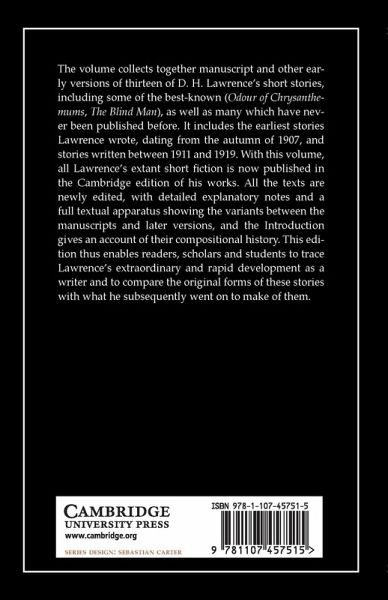
This volume collects together manuscript and other early versions of thirteen of D. H. Lawrence's short stories, including some of the best-known ('Odour of Chrysanthemums', 'The Blind Man'), as well as many which have never been published before. It includes the earliest stories Lawrence wrote, dating from the autumn of 1907, and stories written between 1911 and 1919. With this volume, all Lawrence's extant short fiction is now published in the Cambridge edition of his works. All the texts are newly edited, with detailed explanatory notes and a full textual apparatus showing the variants…mehr
This volume collects together manuscript and other early versions of thirteen of D. H. Lawrence's short stories, including some of the best-known ('Odour of Chrysanthemums', 'The Blind Man'), as well as many which have never been published before. It includes the earliest stories Lawrence wrote, dating from the autumn of 1907, and stories written between 1911 and 1919. With this volume, all Lawrence's extant short fiction is now published in the Cambridge edition of his works. All the texts are newly edited, with detailed explanatory notes and a full textual apparatus showing the variants between the manuscripts and later versions, and the Introduction gives an account of their compositional history. This edition thus enables readers, scholars and students to trace Lawrence's extraordinary and rapid development as a writer and to compare the original forms of these stories with what he subsequently went on to make of them.
David Herbert Richards "D. H." Lawrence (11 September 1885 - 2 March 1930) was an English novelist, poet, playwright, essayist, literary critic and painter. His collected works represent, among other things, an extended reflection upon the dehumanising effects of modernity and industrialisation. Some of the issues Lawrence explores are emotional health, vitality, spontaneity and instinct. Lawrence's opinions earned him many enemies and he endured official persecution, censorship, and misrepresentation of his creative work throughout the second half of his life, much of which he spent in a voluntary exile which he called his "savage pilgrimage." At the time of his death, his public reputation was that of a pornographer who had wasted his considerable talents. E. M. Forster, in an obituary notice, challenged this widely held view, describing him as, "The greatest imaginative novelist of our generation." Lawrence is perhaps best known for his novels Sons and Lovers, The Rainbow, Women in Love and Lady Chatterley's Lover. Within these Lawrence explores the possibilities for life within an industrial setting. In particular Lawrence is concerned with the nature of relationships that can be had within such a setting. Though often classed as a realist, Lawrence in fact uses his characters to give form to his personal philosophy. His depiction of sexual activity, though seen as shocking when he first published in the early 20th century, has its roots in this highly personal way of thinking and being. It is worth noting that Lawrence was very interested in the sense of touch and that his focus on physical intimacy has its roots in a desire to restore an emphasis on the body, and re-balance it with what he perceived to be Western civilisation's over-emphasis on the mind.
Inhaltsangabe
General editor's preface Acknowledgements Chronology Cue-titles Introduction 'The Vicar's Garden' (1907) 'The Shadow in the Rose Garden' (1914) 'A Page from the Annals of Gresleia' (1907) 'Ruby-Glass' (1907) 'The White Stocking' (1907) 'The White Stocking' (1914) 'Odour of Chrysanthemums' [Version 2] (1910) 'Odour of Chrysanthemums' [Version 3] (1911) 'Intimacy' (1911) 'The Harassed Angel' (1911) 'Vin Ordinaire' (1914) 'The Blind Man' [Version 1] (1918) 'Wintry Peacock' [Version 1] (1919) Appendix. The July 1914 ending of 'Odour of Chrysanthemums' Explanatory notes Textual apparatus Line-end hyphenation A note on pounds, shillings and pence.
General editor's preface Acknowledgements Chronology Cue-titles Introduction 'The Vicar's Garden' (1907) 'The Shadow in the Rose Garden' (1914) 'A Page from the Annals of Gresleia' (1907) 'Ruby-Glass' (1907) 'The White Stocking' (1907) 'The White Stocking' (1914) 'Odour of Chrysanthemums' [Version 2] (1910) 'Odour of Chrysanthemums' [Version 3] (1911) 'Intimacy' (1911) 'The Harassed Angel' (1911) 'Vin Ordinaire' (1914) 'The Blind Man' [Version 1] (1918) 'Wintry Peacock' [Version 1] (1919) Appendix. The July 1914 ending of 'Odour of Chrysanthemums' Explanatory notes Textual apparatus Line-end hyphenation A note on pounds, shillings and pence.
Es gelten unsere Allgemeinen Geschäftsbedingungen: www.buecher.de/agb
Impressum
www.buecher.de ist ein Internetauftritt der buecher.de internetstores GmbH
Geschäftsführung: Monica Sawhney | Roland Kölbl | Günter Hilger
Sitz der Gesellschaft: Batheyer Straße 115 - 117, 58099 Hagen
Postanschrift: Bürgermeister-Wegele-Str. 12, 86167 Augsburg
Amtsgericht Hagen HRB 13257
Steuernummer: 321/5800/1497
USt-IdNr: DE450055826