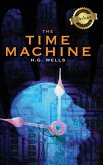
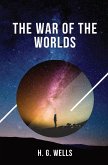
Shortly after astronomers observe explosions on the surface of Mars, meteor-like objects begin crashing into Earth. Martians emerge from their craters in large tripods, wiping out army units with heat-rays as they roam the English countryside. When the order is given to evacuate London, all seems lost. But there is one minor detail that the Martians did not plan for. H. G. Wells is credited with the popularisation of time travel in 1895 with The Time Machine, introducing the idea of time being the "fourth dimension" a decade before the publication of Einstein's first Relativity papers. In…mehr
Shortly after astronomers observe explosions on the surface of Mars, meteor-like objects begin crashing into Earth. Martians emerge from their craters in large tripods, wiping out army units with heat-rays as they roam the English countryside. When the order is given to evacuate London, all seems lost. But there is one minor detail that the Martians did not plan for. H. G. Wells is credited with the popularisation of time travel in 1895 with The Time Machine, introducing the idea of time being the "fourth dimension" a decade before the publication of Einstein's first Relativity papers. In 1896, he imagined a mad scientist creating human-like beings from animals in The Island of Doctor Moreau, which created a growing interest in animal welfare throughout Europe. In 1897 with The Invisible Man, Wells shows how a formula could render one invisible, recognizing that an invisible eye would not be able to focus, thus rendering the invisible man blind. With The War of the Worlds in 1898, Wells established the idea that an advanced civilization could live on Mars, popularising the term 'martian' and the idea that aliens could invade Earth.
Herbert George Wells was an influential English writer, best known for his works in science fiction, though his prolific output spanned various genres, including history, social commentary, politics, and autobiography. Born on September 21, 1866, in Bromley, London, Wells attended the Normal School of Science in London, where he studied biology under Thomas Henry Huxley. Wells initially worked as a teacher and journalist before turning to writing full time. Over his career, he penned more than fifty novels, along with numerous short stories and non-fiction works. His early works, such as "The Time Machine,The War of the Worlds," and "The Invisible Man," helped establish him as one of the pioneers of modern science fiction. He also explored themes of social justice, the possibilities of science and technology, and the complexities of human nature in works like "The History of Mr. Polly" and "The Shape of Things to Come." Throughout his life, Wells engaged in political and philosophical discourse, influenced by thinkers like Mark Twain and Plato. He died on August 13, 1946, in London, leaving behind a legacy that shaped the development of speculative fiction and continued to inspire future generations of writers and thinkers.
Es gelten unsere Allgemeinen Geschäftsbedingungen: www.buecher.de/agb
Impressum
www.buecher.de ist ein Internetauftritt der buecher.de internetstores GmbH
Geschäftsführung: Monica Sawhney | Roland Kölbl | Günter Hilger
Sitz der Gesellschaft: Batheyer Straße 115 - 117, 58099 Hagen
Postanschrift: Bürgermeister-Wegele-Str. 12, 86167 Augsburg
Amtsgericht Hagen HRB 13257
Steuernummer: 321/5800/1497
USt-IdNr: DE450055826