

Andere Kunden interessierten sich auch für
 Physics of the Earth95,99 €
 The Magnetotelluric Method247,99 €
 The Continental Drift Controversy133,99 €
 The Evolution of Matter163,99 €
 The Lithosphere209,99 €
 Geology of the American Southwest111,99 €
 The Geomorphology of the Great Barrier Reef133,99 €







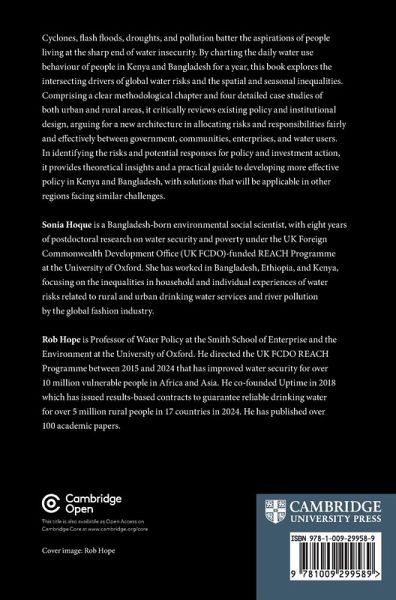
Cyclones, flash floods, droughts, and pollution batter the aspirations of people living at the sharp end of water insecurity. By charting the daily water use behaviour of people in Kenya and Bangladesh for a year, this book explores the intersecting drivers of global water risks and the spatial and seasonal inequalities. Comprising a clear methodological chapter and four detailed case studies of both urban and rural areas, it critically reviews existing policy and institutional design, arguing for a new architecture in allocating risks and responsibilities fairly and effectively between government, communities, enterprises, and water users. In identifying the risks and potential responses for policy and investment action, it provides theoretical insights and a practical guide to developing more effective policy in Kenya and Bangladesh, with solutions that will be applicable in other regions facing similar challenges. This title is also available as Open Access on Cambridge Core.