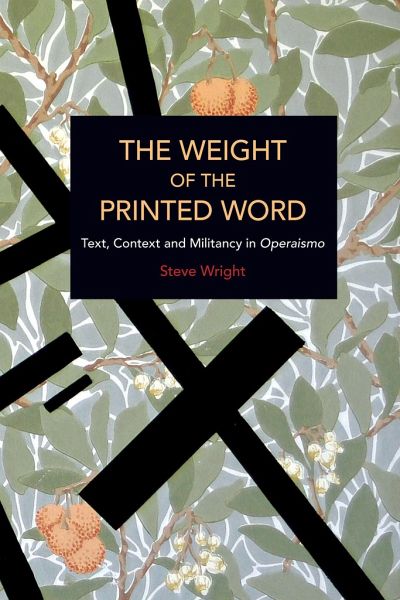
In The Weight of the Printed Word, Steve Wright explores the creation and use of documents as a key dimension in the activities of Italian workerists during the 1960s and 1970s. From leaflets and newspapers to books, internal documents and workers' enquiries; the operaisti deployed a wide variety of printed materials in their efforts to organise among new subjectivities of mass rebellion. As Wright demonstrates, the practice of working with print was a central part of what it meant to be a workerist or autonomist militant during these years: one that throws light both on the meaning of…mehr
In The Weight of the Printed Word, Steve Wright explores the creation and use of documents as a key dimension in the activities of Italian workerists during the 1960s and 1970s. From leaflets and newspapers to books, internal documents and workers' enquiries; the operaisti deployed a wide variety of printed materials in their efforts to organise among new subjectivities of mass rebellion. As Wright demonstrates, the practice of working with print was a central part of what it meant to be a workerist or autonomist militant during these years: one that throws light both on the meaning of political engagement, as well as the challenges posed by the use of technologies of communication and by emergent social subjects.
Steve Wright is a senior lecturer in the Faculty of Information Technology, Monash University. He has written widely on operaismo, including Storming Heaven: Class Composition and Struggle in Italian Autonomist Marxism (Pluto, second edition, 2017).
Inhaltsangabe
Preface Acknowledgements Introduction: Print, Document Work, and Class Politics 1 What Are Militants? Ceto politico and ceto operaio 2 Texts Have Bodies Too: Towards a Materialist Approach to Document Work and Genre 3 Genre, Document Work and Militancy amongst the Operaisti: Some Preliminary Reflections Part 1 The Workers’ Enquiry and Co-research Introduction to Part 1 4 The Fiat Workers’ Enquiry of 1960–61: Setting the Scene 5 The Fiat Workers’ Enquiry of 1960–61: What Actually Happened? 6 The Meaning of the Workers’ Enquiry and Co-research in the Early 1960s Part 2 Essays and Their Contexts Introduction to Part 2 7 Cultural Production in the Italy of the ‘Economic Miracle’ 8 The Essay and Its Discontents 9 The Role of the Review in Classical Workerism 10 The Book Trade and Academia Part 3 Leaflets and Sundries Introduction to Part 3 11 The Emergence of the Assemblea operai e studenti 12 The Assemblea’s Document Work 13 A Short Addendum on Pamphlets Part 4 Potere Operaio Introduction to Part 4 14 Debating Organisation in Print: Potop 1969–71 15 Other Elements of Potere Operaio’s Genre Repertoire 16 Two Brief Interludes: ‘In Praise of Illegal Work’ and ‘Sotto la Mole’ 17 A Gamble That Failed: Potere Operaio del lunedì Part 5 Internal Documents and Perspectives Papers Introduction to Part 5 18 Internal Communication Concerning Potere Operaio’s Press and Organisation 19 ‘The Measures Taken’ 20 Position Papers and Discussion Documents Part 6 ‘Dites-le avec des pavés!’ Autonomist Newspapers and the Challenge of Radio Introduction to Part 6 21 The Best Re(a)d Paper in Autonomia? 22 Senza Tregua – A Brief and Unhappy Existence? 23 ‘A Paper That Speaks, a Radio That Writes’: I Volsci and the Impact of Radio on the Printed Word Part 7 Journals in a Minor Key Introduction to Part 7 24 ‘The Firebrands of Porto Marghera’ 25 ‘There Is No Housework in Marx’ Conclusion: Print, Document Work, and Class Politics Glossary References Index
Preface Acknowledgements Introduction: Print, Document Work, and Class Politics 1 What Are Militants? Ceto politico and ceto operaio 2 Texts Have Bodies Too: Towards a Materialist Approach to Document Work and Genre 3 Genre, Document Work and Militancy amongst the Operaisti: Some Preliminary Reflections Part 1 The Workers’ Enquiry and Co-research Introduction to Part 1 4 The Fiat Workers’ Enquiry of 1960–61: Setting the Scene 5 The Fiat Workers’ Enquiry of 1960–61: What Actually Happened? 6 The Meaning of the Workers’ Enquiry and Co-research in the Early 1960s Part 2 Essays and Their Contexts Introduction to Part 2 7 Cultural Production in the Italy of the ‘Economic Miracle’ 8 The Essay and Its Discontents 9 The Role of the Review in Classical Workerism 10 The Book Trade and Academia Part 3 Leaflets and Sundries Introduction to Part 3 11 The Emergence of the Assemblea operai e studenti 12 The Assemblea’s Document Work 13 A Short Addendum on Pamphlets Part 4 Potere Operaio Introduction to Part 4 14 Debating Organisation in Print: Potop 1969–71 15 Other Elements of Potere Operaio’s Genre Repertoire 16 Two Brief Interludes: ‘In Praise of Illegal Work’ and ‘Sotto la Mole’ 17 A Gamble That Failed: Potere Operaio del lunedì Part 5 Internal Documents and Perspectives Papers Introduction to Part 5 18 Internal Communication Concerning Potere Operaio’s Press and Organisation 19 ‘The Measures Taken’ 20 Position Papers and Discussion Documents Part 6 ‘Dites-le avec des pavés!’ Autonomist Newspapers and the Challenge of Radio Introduction to Part 6 21 The Best Re(a)d Paper in Autonomia? 22 Senza Tregua – A Brief and Unhappy Existence? 23 ‘A Paper That Speaks, a Radio That Writes’: I Volsci and the Impact of Radio on the Printed Word Part 7 Journals in a Minor Key Introduction to Part 7 24 ‘The Firebrands of Porto Marghera’ 25 ‘There Is No Housework in Marx’ Conclusion: Print, Document Work, and Class Politics Glossary References Index
Es gelten unsere Allgemeinen Geschäftsbedingungen: www.buecher.de/agb
Impressum
www.buecher.de ist ein Internetauftritt der buecher.de internetstores GmbH
Geschäftsführung: Monica Sawhney | Roland Kölbl | Günter Hilger
Sitz der Gesellschaft: Batheyer Straße 115 - 117, 58099 Hagen
Postanschrift: Bürgermeister-Wegele-Str. 12, 86167 Augsburg
Amtsgericht Hagen HRB 13257
Steuernummer: 321/5800/1497
USt-IdNr: DE450055826