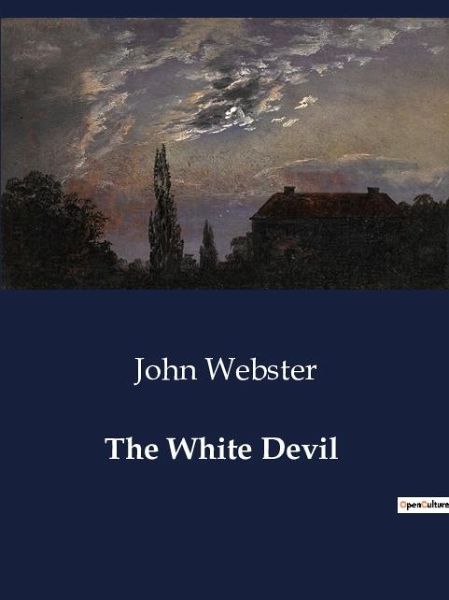
"The White Devil" by John Webster is a complex tragedy that delves into themes of power, corruption, and revenge, set against the backdrop of Italian nobility. The play opens with Count Lodovico being banished for his crimes, setting the stage for a series of events driven by change and betrayal. Central to the plot is the illicit affair between Duke Brachiano and Vittoria Corombona, which leads to the murder of Brachiano's wife, Isabella, through a poisoned portrait. Vittoria is put on trial for her alleged involvement in the murder, where she faces a biased court eager to condemn her. The…mehr
"The White Devil" by John Webster is a complex tragedy that delves into themes of power, corruption, and revenge, set against the backdrop of Italian nobility. The play opens with Count Lodovico being banished for his crimes, setting the stage for a series of events driven by change and betrayal. Central to the plot is the illicit affair between Duke Brachiano and Vittoria Corombona, which leads to the murder of Brachiano's wife, Isabella, through a poisoned portrait. Vittoria is put on trial for her alleged involvement in the murder, where she faces a biased court eager to condemn her. The trial scene is a highlight, showcasing Webster's critique of the judicial system and societal hypocrisy. Flamineo, Vittoria's brother, plays a pivotal role as a manipulative and morally ambiguous character, facilitating the affair and subsequent murders. The play's intricate narrative weaves through various subplots, including the political machinations of Francisco de Medicis and Cardinal Monticelso, who seek to exploit the scandal for their gain. As the story unfolds, the characters' fates are sealed by their own treacherous actions, culminating in a series of violent deaths that underscore the play's dark themes. Webster's use of rich, poetic language and his ability to create complex, flawed characters make "The White Devil" a compelling exploration of the destructive nature of unchecked change and desire. The play remains a powerful commentary on the moral decay of society and the inevitable downfall that follows.
Die Herstellerinformationen sind derzeit nicht verfügbar.
Autorenporträt
Webster's life is obscure and the dates of his birth and death are not known. His father, a carriage maker also named John Webster, married a blacksmith's daughter named Elizabeth Coates on 4 November 1577 and it is likely that Webster was born not long after, in or near London. The family lived in St Sepulchre's parish. His father John and uncle Edward were Freemen of the Merchant Taylors' Company and Webster attended Merchant Taylors' School in Suffolk Lane, London. On 1 August 1598, John Webster, lately of the New Inn was admitted to the Middle Temple, one of the Inns of Court; in view of the legal interests evident in his dramatic work, this may be the playwright. Webster married 17-year-old Sara Peniall on 18 March 1605 at St Mary's Church, Islington. A special licence was needed to permit a wedding in Lent, as Sara was seven months pregnant. Their first child, John Webster III, was baptised at the parish of St Dunstan-in-the-West on 8 March 1606. Bequests in the will of a neighbour who died in 1617, indicate that other children were born to him.
Es gelten unsere Allgemeinen Geschäftsbedingungen: www.buecher.de/agb
Impressum
www.buecher.de ist ein Internetauftritt der buecher.de internetstores GmbH
Geschäftsführung: Monica Sawhney | Roland Kölbl | Günter Hilger
Sitz der Gesellschaft: Batheyer Straße 115 - 117, 58099 Hagen
Postanschrift: Bürgermeister-Wegele-Str. 12, 86167 Augsburg
Amtsgericht Hagen HRB 13257
Steuernummer: 321/5800/1497
USt-IdNr: DE450055826