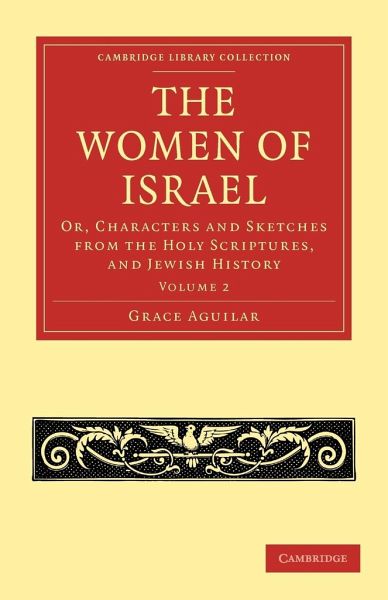
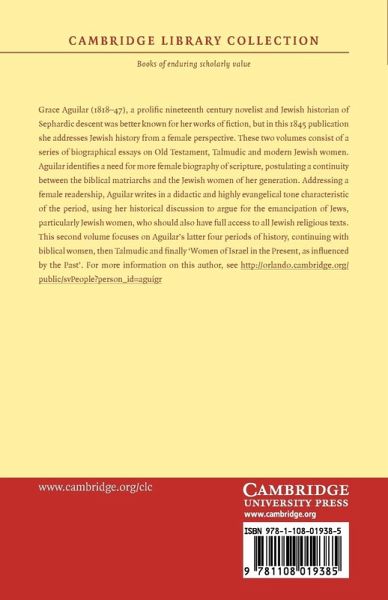
Grace Aguilar (1818-1847), a prolific nineteenth-century novelist and Jewish historian of Sephardic descent, was better known for her works of fiction, but in this 1845 publication she addresses Jewish history from a female perspective. These two volumes consist of a series of biographical essays on Old Testament, Talmudic and modern Jewish women. Aguilar identifies a need for more female biography of scripture, postulating a continuity between the biblical matriarchs and the Jewish women of her generation. Addressing a female readership, Aguilar writes in a didactic and highly evangelical…mehr
Grace Aguilar (1818-1847), a prolific nineteenth-century novelist and Jewish historian of Sephardic descent, was better known for her works of fiction, but in this 1845 publication she addresses Jewish history from a female perspective. These two volumes consist of a series of biographical essays on Old Testament, Talmudic and modern Jewish women. Aguilar identifies a need for more female biography of scripture, postulating a continuity between the biblical matriarchs and the Jewish women of her generation. Addressing a female readership, Aguilar writes in a didactic and highly evangelical tone characteristic of the period, using her historical discussion to argue for the emancipation of Jews, particularly Jewish women, who should also have full access to all Jewish religious texts. This second volume focuses on Aguilar's latter four periods of history. For more information on this author, see http://orlando.cambridge.org/public/svPeople?person_id=aguigr
Grace Aguilar (1816-1847) was a Jewish British novelist, poet, and advocate for Jewish education and women's rights. She was born in London to a Sephardic Jewish family and grew up in a traditional Jewish household. Aguilar's writing often focused on the experiences of Jewish people and their struggles for acceptance and recognition in British society. Her works include novels such as "Home Influence" and "The Days of Bruce", as well as collections of poetry and non-fiction works on Jewish history and religion. Aguilar's life was cut short at the age of 31 when she died in 1847 from complications related to anorexia. Despite her short life, her work had a significant impact on Jewish literature and culture, and she remains an important figure in the history of Jewish women's writing and activism. Aguilar was cremated in Germany's Hessen region in the Frankfurt Jewish cemetery. "Give her of the fruit of her hands; and let her own works praise her at the gate," is how Proverbs 31 describes the "woman of valor" and is used as the inscription on her tombstone.
Inhaltsangabe
Fourth Period. The Monarchy: 1. Michal 2. Abigail 3. Wise woman of Tekoah. Woman of Abel. Rispah. Prophet's widow 4. The Shunammite 5. Little Israelitish maid. Huldah Fifth Period. Babylonian Captivity: 1. The Captivity. Review of Book of Ezra. Suggestions as to the identity of Ahasuerus of Scripture. Choice of Esther 2. Esther continued 3. Esther concluded 4. Review of events narrated in Ezra and Nehemiah Sixth Period. Continuance of the Second Temple: 1. Review of Jewish history, from the return from Babylon to the appeal of Hyrcanus and Aristobulus to Pompey 2. From the appeal to Pompey to the death of Herod 3. From the death of Herod to the war 4. The martyr-mother 5. Alexandra 6. Mariamne 7. Mariamne continued 8. Mariamne continued 9. Mariamne concluded. Alexandra. Salome 10. Helena. Berenice 11. General remarks Seventh Period. Women of Israel in the Present, as Influenced by the Past: 1. The war and dispersion. Thoughts on the Talmud 2. Talmudic ordinances and tales 3. Effects of dispersion. General remarks.
Fourth Period. The Monarchy: 1. Michal 2. Abigail 3. Wise woman of Tekoah. Woman of Abel. Rispah. Prophet's widow 4. The Shunammite 5. Little Israelitish maid. Huldah Fifth Period. Babylonian Captivity: 1. The Captivity. Review of Book of Ezra. Suggestions as to the identity of Ahasuerus of Scripture. Choice of Esther 2. Esther continued 3. Esther concluded 4. Review of events narrated in Ezra and Nehemiah Sixth Period. Continuance of the Second Temple: 1. Review of Jewish history, from the return from Babylon to the appeal of Hyrcanus and Aristobulus to Pompey 2. From the appeal to Pompey to the death of Herod 3. From the death of Herod to the war 4. The martyr-mother 5. Alexandra 6. Mariamne 7. Mariamne continued 8. Mariamne continued 9. Mariamne concluded. Alexandra. Salome 10. Helena. Berenice 11. General remarks Seventh Period. Women of Israel in the Present, as Influenced by the Past: 1. The war and dispersion. Thoughts on the Talmud 2. Talmudic ordinances and tales 3. Effects of dispersion. General remarks.
Es gelten unsere Allgemeinen Geschäftsbedingungen: www.buecher.de/agb
Impressum
www.buecher.de ist ein Internetauftritt der buecher.de internetstores GmbH
Geschäftsführung: Monica Sawhney | Roland Kölbl | Günter Hilger
Sitz der Gesellschaft: Batheyer Straße 115 - 117, 58099 Hagen
Postanschrift: Bürgermeister-Wegele-Str. 12, 86167 Augsburg
Amtsgericht Hagen HRB 13257
Steuernummer: 321/5800/1497
USt-IdNr: DE450055826