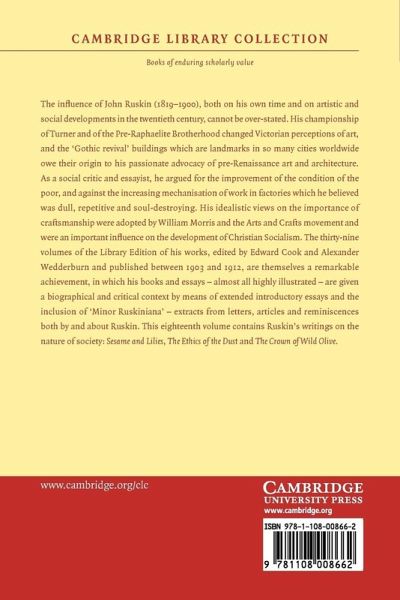
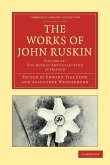
The influence of John Ruskin (1819-1900), both on his own time and on artistic and social developments in the twentieth century, cannot be over-stated. He changed Victorian perceptions of art, and was the main influence behind 'Gothic revival' architecture. As a social critic, he argued for the improvement of the condition of the poor, and against the increasing mechanisation of work in factories, which he believed was dull and soul-destroying. The thirty-nine volumes of the Library Edition of his works, published between 1903 and 1912, are themselves a remarkable achievement, in which his…mehr
The influence of John Ruskin (1819-1900), both on his own time and on artistic and social developments in the twentieth century, cannot be over-stated. He changed Victorian perceptions of art, and was the main influence behind 'Gothic revival' architecture. As a social critic, he argued for the improvement of the condition of the poor, and against the increasing mechanisation of work in factories, which he believed was dull and soul-destroying. The thirty-nine volumes of the Library Edition of his works, published between 1903 and 1912, are themselves a remarkable achievement, in which his books and essays - almost all highly illustrated - are given a biographical and critical context in extended introductory essays and in the 'Minor Ruskiniana' - extracts from letters, articles and reminiscences both by and about Ruskin. This eighteenth volume contains Ruskin's writings on the nature of society, including Sesame and Lilies.
John Ruskin was an English writer, philosopher, art critic, and polymath during the Victorian era. He lived from 8 February 1819 to 20 January 1900. He published on a wide range of topics, including political economy, myth, ornithology, literature, education, and geology. Ruskin was very interested in Viollet le Duc's work, especially his Dictionary, which he regarded to be "the only book of any value on architecture." He taught it to all of his students, including William Morris. Ruskin used a variety of literary genres and writing styles. In addition to articles and treatises, he also published poems, lectures, travel instructions, correspondence, and even a fairy tale. Additionally, he created in-depth drawings and paintings of decorations, landscapes, birds, plants, and rocks. His early writings on art were written in an ornate style that eventually gave way to simpler language that served to better convey his ideas. He highlighted the links between nature, art, and society in all of his writing.
Inhaltsangabe
Introduction Part I. Sesame and Lilies: 1. Bibliographical note 2. Contents 3. Text of all the editions Part II. The Ethics of the Dust: 1. Bibliographical note 2. Dedication 3. Contents 4. Text Part III. The Crown of Wild Olive: 1. Bibliographical note 2. Contents 3. Text of all the editions Appendix.
Introduction Part I. Sesame and Lilies: 1. Bibliographical note 2. Contents 3. Text of all the editions Part II. The Ethics of the Dust: 1. Bibliographical note 2. Dedication 3. Contents 4. Text Part III. The Crown of Wild Olive: 1. Bibliographical note 2. Contents 3. Text of all the editions Appendix.
Es gelten unsere Allgemeinen Geschäftsbedingungen: www.buecher.de/agb
Impressum
www.buecher.de ist ein Internetauftritt der buecher.de internetstores GmbH
Geschäftsführung: Monica Sawhney | Roland Kölbl | Günter Hilger
Sitz der Gesellschaft: Batheyer Straße 115 - 117, 58099 Hagen
Postanschrift: Bürgermeister-Wegele-Str. 12, 86167 Augsburg
Amtsgericht Hagen HRB 13257
Steuernummer: 321/5800/1497
USt-IdNr: DE450055826